

Education and educational institutions are backbone to development of any nation. In this competitive world, as students compete with one another to get admitted in the best university or college, universities are also competing to get best rank. Healthy competition should be there for evolution of better society, through which the students and society can benefit. But, judging all the institutions using the same parameter is like comparing fish and hare in a running race.
Two rankings have been announced in the past one month. One is Times Higher Education Asia University Rankings 2017 and the second is our own Union Human Resource Development Ministry’s National Institutional Ranking Framework. The Parameters of these rankings are:
Times Higher Education Asia University Rankings 2017
- Teaching (the learning environment): 25%
- Research (volume, income and reputation): 30%
- Citations (research influence): 30%
- International outlook (staff, students, research): 7.5%
- Industry income (knowledge transfer):5%
The National Institutional Ranking Framework
- Teaching, Learning and Resources : 30%
- Research and Professional practice: 30%
- Graduation outcome : 20%
- Outreach and Inclusivity : 10%
- Perception: 10%
In Times Higher Education Asia University Rankings 2017, none of the Indian universities were able to occupy a place among top 10 positions. Do Indian universities have the potential to bag a space for India in top 10? Let’s see what does our MHRD’s NIRF say.
Decoding Union MHRD’s National Institutional Ranking Framework:
Participation
In India there are 39,000 colleges, 11,000 private institutions and over 760 universities, a total of almost 51,000 higher educational institutions. In spite of MHRD’s continuous deliberation, out of all these, only 3,319 participated, that’s just above 6% of the total.
Unequal distribution
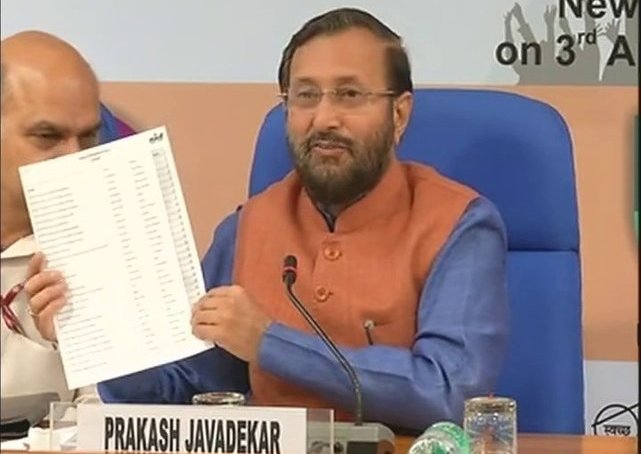
67 out of 100 best institutions are from just eight states,. Moreover from top 10 colleges 6 are from Delhi, 2 are from Chennai (TN), 1 from Kolkata (WB) and 1 from Tiruchirapally (TN). It feels that quality higher education is only for metro cities. Educational institutions outside these cities are struggling for basic amenities. Dismay over these amplifies as HRD minister Prakash Javadekar said. “We will give more funds to the high ranking institutions to create an atmosphere of competition for quality improvement.” If this is true then good institutions may become better and better but the condition of others will remain worse off.
Inconsistency
NIRF 2016 to NIRF 2017 exhibits a high level of inconsistency and contrast in analysis of various institutions, Jamia Milia University from rank 83 in 2016 jumped up to rank 12 and Guru Nanak Dev University fell from rank 26 in 2016 to rank 80 in 2017. Moreover 47 universities are completely new to the list. Do these ranking reflect the real improvements or devaluations? Can the standards of our universities radically change within a span of just 1 year?
Research
HRD minister Prakash Javedkar, while announcing the rankings, mentioned that “the ministry would give utmost importance to research work done by higher education institutes” and also said “JNU, Jadavpur got top rank not for Afzal Guru slogans but for good research”. These statements raised some eyebrows as it was in contrast to his previous announcements of UGC regulation 2016, which delimited the number of research scholars supervised by a faculty member. The Regulation made it mandatory for a professor, at any given time, to not have more than 3 M.Phil. and 8 PhD scholars. In case of Associate Professors the number is 2 (M.Phil) and 6 (PhD), while Assistant Professors can only supervise 1 M.Phil and 4 PhD scholars in any particular university. This directive from the UGC has curtailed the research seats drastically for an institute like JNU, which ranked second this year, from 924 last academic year to only 242, this year. Since research is one of the major criteria for defining the ranks of the universities, it is bound to affect the ranking of the university next year.
Verification
Asking not to be named, a professor of one of the better-ranked institutions, said: “The rankings are given on the basis of information filled by the institutions and no representative from the ministry comes to review the information. Thus, the authenticity of these rankings is questionable.” –Times of India
Faulty Comparison
In a country like India where educational institutions are heterogeneous, a homogeneous comparison is inappropriate. Comparing a social sciences university with Arts and science university and Engineering university is senseless, as neither there would be any competition among these universities nor student of a particular field would be interested to know about other universities.
Jawaharlal Nehru University (JNU), Delhi ranked 2nd among universities is compared with Jawaharlal Nehru Centre for Advanced Scientific Research (JNCASR), Bangalore which is ranked 4th where they had only 300 Research scholars, whereas JNU had over 924 M.Phil and Ph.D research scholars.
In overall ranking 8 out of top 10 are IITs, professional courses are given significance over social sciences and Humanities, which convince other institutions to gravitate towards these professional courses to secure good rank, aiming to get good funding. Detachment of students from social sciences leads detachment from society, universities which are helping in changing discourse of the national politics will turn to voiceless entity. Seeing all this, it feels a long dream for Indian institutions to compete globally.