

For a Muslim the entire text of Quran is unequivocal and absolute. It is unique and incomparable not only in the affluence of its phraseology, the multiplicity of its content and magnificence of its expression but also in eternity and universality of its meaning and message.There are abundant historical references, outside and within the Quran itself, which explicitly indicate its sacred origin and perfectness of the textual narration. The approach adopted in the Quran vis-à-vis laws, norms, and values stands unquestionable all times except the demand of “context”. As such, man’s capacity of exercising rational techniques to understand the relation between man and God’s laws is not that brilliant to challenge or alter the authoritative position of the “sacred text”.
It is quite interesting that even the Prophet (pbuh), on whose noble heart the Quran was revealed, while establishing authority of the “text” wasn’t allowed to change the divinely imparted meaning of the “text” or simply the structural arrangement of the words according to his personnel liking. To affirm this fact Quran says, “And he (Prophet) doesn’t talk out of his desire, indeed! It is (he says) nothing except revelation, revealed (to him)”. This and other similar statements fundamentally ascertain the eternity and absolute legal authority of God’s word. Nevertheless, rapid socio-political transformations caused due to undercurrents of secularization and modernization in the Muslim world produced many controversial figures who openly criticized, questioned and debated the authority and absoluteness of the Quranic text- very basic criterion of the Muslim faith.
There are people, allegedly promoted as “elite Muslims” through media outreach, who have initiated a wave of criticism against the very basic articles of faith such as belief in Quran as the final revealed word of God and belief in the Prophet as the exemplary model set by the God Himself. While, attractively, playing with terminological gimmicks, they are frequently heard talking about introducing “reformation”, “moderation”, “liberation”, and “free thinking” within the established dogmatic structure of Islam. Most of these “self-styled” critics would kick off their argumentation with,“Islam is Ok!But Muslims aren’t” – a point that is seemingly genuine and relevant to contemporary situation of Islam across the Muslim world. Even their disagreements with “orthodox” interpretations of religious text sometimes appear quite reasonable, but once their thought is critically analyzed beyond the polished walls of colorful terminology, one could easily see the hollowness of same old “orientalism” in “new” communicative methods. The mechanism and methodology is same- start with bad of Muslims and end with bad of Islam– but articulation and terminology is, of course, different. Among this “sponsored” brand of critics, Irshad Manji- a Canadian outspoken activist, feminist and self-described Muslim- is a recent voice.
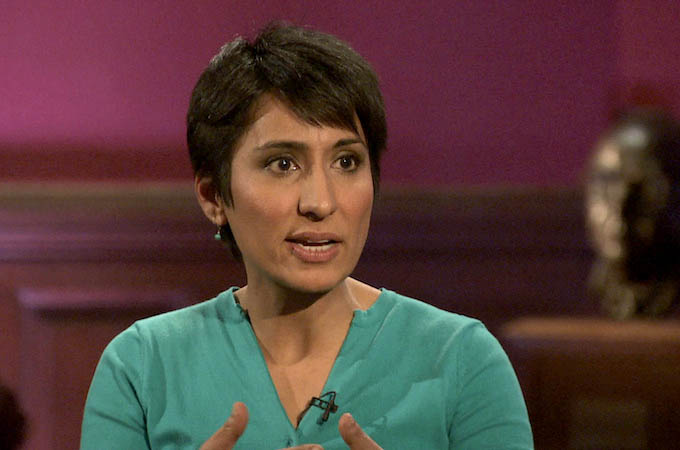
Irshad Manji, who is sexually a transgender, recently came into limelight through her controversial and unorthodox ideas about Islam. She has been a media attraction because of her boldness while randomly criticizing and challenging the historically established interpretations of the sacred Quranic text vis-à-vis women’s rights, sexual ethics, and culture. She calls it “tribal culture” to abide by a particular set of cultural values and adopt a scheme of thought experienced and developed by the people who lived centuries back in a different time and space paradigm. In journey of her life, from a conservative madrasa childhood to a liberal transgender youth largely influenced by Western structures, Irshad evolved as a so called “liberal rationalist Muslim” who believes that beside demand of the context, free thinking occupies central place in interpretation and application of religious laws. She has been continuously advocating for a “paradigm of change” in the Muslim world while disconnecting the present from the past historical roots.
It is noteworthy that her two books namely The Trouble with Islam Today and Allah, Liberty and Love became foremost reason of her speedy fame throughout the East and West. In both of her works, which are structurally autobiographical, Irshad has raised few justified queries regarding application of Islamic laws in the modern times. She has highlighted some absurd cultural impositions and reactionary expressions such as gender discrimination, family structure, radicalization and terrorism, which actually aren’t part of the divine structure, and has quite strangely concluded with pushing the whole blame on Islam. To give her liberal and secular ideas global outreach, especially focusing the Muslim youth corridors, Irshad has been actively participating in debates and joining public discussions. Until now, Irshad’s “media image” has helped her in attracting a quite healthy readership around her sponsored “reformation” project – a movement against “conservative” Islam. While analyzing and exploring her religious philosophy through her writings and listening to her speeches and discussions, one could develop an idea that “reformation” and “subjective ijtihad” are two fundamental aspects of her compatible, scientific and relevant religious framework.
Many of Irshad’s critics hold this opinion that her argumentation is unsubstantiated and paradoxical. She very often quotes the text but out of context that actually reflects overwhelming influence of Western intellectualism on her religious understanding. Her parameter of “good religion” and “bad religion” appears to be determined and polished by the secular values of the West that diminishes the role of religion to individual’s personal choice. While listening to her speeches, one could make out that actually Irshad has some real problem with Islam as many other so called “Muslim liberals” do have. For example, in an interview in Oxford Union with Shaikh Mahdi, Irshad was questioned about her book describing “Islam in trouble today”? While answering the question, she said, “in a word, Muslims, we are the trouble with Islam today; we have allowed ‘tribal culture’ to colonize the faith of Islam”. Being an eloquent speaker, she cunningly plays with words and tries to position herself at a point where she alone is capable of differentiating between Islam, Muslim and “tribal culture”- which otherwise are wrongly interchanged.
Nevertheless, while going through her book, “The Trouble with Islam Today” one could see that putting such difference is nothing but, phenomenally, a tricky way to play with old stereotypes and remain a media highlight. Quite contrary, on one hand, she advocates the behavioural interpretation of religion by saying that “our behaviour defines Islam” and denounces involvement of all forms of classical textual narratives in doing so. If, for the sake of argument, her theory of “behavioural interpretation” is accepted holistically and people, of all capacities, are let free to interpret the text according to their subjective liking and disliking then entire Muslim world would eventually trap into endless anarchy. It would lose ‘social cohesion’ and every single individual would come forth with his/her own justifications. It can be well understood from an anthropological point of view that defines society as a composite structure where all social dynamics such as traditions, cultural practices, and religious beliefs are deeply interwoven – one influencing and influenced by the other. Yet, on the other hand, Irshad explains her theory of “reformation” as a progressive movement to “liberate” Islam from all “cultural interpretations” that, according to her, have distorted the actual face of Islam. She wants to see Islam as a “personal matter” between man and God. These arguments are self-contradictory as former supports “cultural involvement” in defining religion and latter evidently rejects it.
In most of her interviews, Irshad Manji is heard talking about Ijtihad – an approved principle of legal theory of Islam. But again, Irshad’s self-orchestrated “project Ijtihad” is problematic as she doesn’t abide by any of the classical principles of exercising Ijtihad. On contrary to “established” definitions, Irshad’s conception of Ijtihad is based on “free thinking”- a changed name for Western “liberal thinking”. She believes that customary practices and old traditions of Islam should be “reformed” and that can be only achieved through empowering every single Muslim to exercise his/her rational thinking while responding to codification of religious laws. Therefore, she doesn’t accept the prerequisites, established by the classical scholars, such as well-grounded knowledge of Quran, Hadith, Fiqh, history, and Arabic language for exercising ijtihad. Instead, Irshad advocates theory of “subjective ijtihad” that implies every Tom, Dick and Harry can exercise Ijtihad without fulfilling any of the above mentioned conditions of.
At this point, one can’t only disagree with Irshad but may also submit a genuine concern regarding the consequences of empowering every single individual to do Ijtihad through the mechanization of “liberal thinking”. Because, there are apprehensions that such methodology may prove even worse than those “classical interpretations” which according to Irshad have caused the real trouble in Islamic scheme of thought. It would surely harm the very foundations of Irshad’s own project of “embracing diversity” as every person by virtue of his/her ‘intellectual’ capacity, would claim his/her interpretation as the right one- simultaneously suppressing the ‘other’. Thus, in spite of “bridging-up” the gap between different “interpretations”, Irshad’s project Ijtihad would create more “sub-sects” within the already existing sects. It would drive the wave of “conflict” down to the deepest layer of society. Consequently, every Muslim society will experience dissent even between the individuals- no to talk of the groups. Furthermore, but most importantly, it would also empower those terrorist groups who have been exploiting the “religious text” as a source of motivation, mobilization, and radicalization. They would publicly claim their “radical” interpretation as the right one. Through “misapplication” of Ijtihad, they would be also able to justify their brutal and inhuman activities conducted on the name of “safeguarding” their religion. Keeping theseadversative consequences in view, I suggest that Irshad, above all, actuallyneeds to revisit and “reform” her own “Project Ijtihad” inspite of talking about “re-interpretation” of the divine text.
The other thing that too is usually heard in Irshad’s discussions is something about abandoning the “tribal culture”. Here again she reflects an over dominated Western mindset. However, it is pointless to mention that both classical and contemporary Muslim scholars, time and again, have clearly distinguished between what is to be genuinely called as “Islamic” and what is part of a “culture”. But again, Irshad has some “real problem” with Islam, therefore, instead of highlighting some genuine problems and working for some possible remedial measures, she chooses to keep herself engaged with media for humiliating Islam and Muslims equally. It passes on a vibe that actually Irshad has herself “something to hide” which we don’t know. I feel Irshad needs self-introspection before blaming others of being “ignorant” about the meaning and message of the “text”. She must raise question to herself first that whether she has read the whole text of Quran and Hadith or she is just a “copy-cat” of biased orientalism. If ulamas and scholars have already addressed issues such as wrongly equating regional or cultural practices with Islamic traditions, especially in South Asian and some of the Middle East Muslim countries, then why she felt this need again.
In this backdrop, I could say “tribal culture” to Irshad isn’t a particular cultural milieu of a country, rather it is that exemplary society which was established by the Prophet(pbuh) and continues to stand as a “model” for all times to come. It is not just a hypothetical claim that I have made, rather I have strong evidence in support of my argument. When, Irshad, in the above mentioned interview, was questioned about her faith, she loudly accepted her belief in Allah. But when she was questioned about her faith in Prophethood, her words became quite opaque as if she doesn’t care to answer this question.That is probably because accepting the ‘Prophetic model’ in totality as demanded by the “text” would have surely nullified her controversial philosophy of “reformation” and project of “liberal thinking” right at the word go.
In the concluding remarks, I must say that Irshad’s criticism to Islam and its dogmatic structure is nothing new at all. People like Tasleema Nasreen, Salman Rushdie and others have already spewed venom against Quran and “Prophetic” model of Islam. So far as the genuine “problems” are concerned there are good number of scholars, organizations and associations who are constructively and positively working to sort out some practical solutions. Though Irshad has some genuine points, as other critics do have, but it doesn’t mean her words are final and absolutely unbiased. I think, to become Irshad’s “revolutionary Muslim” one doesn’t really need to challenge the foundations of his/her faith, rather, one need to read the text, understand the text, contextualize the text and finally apply the text.