

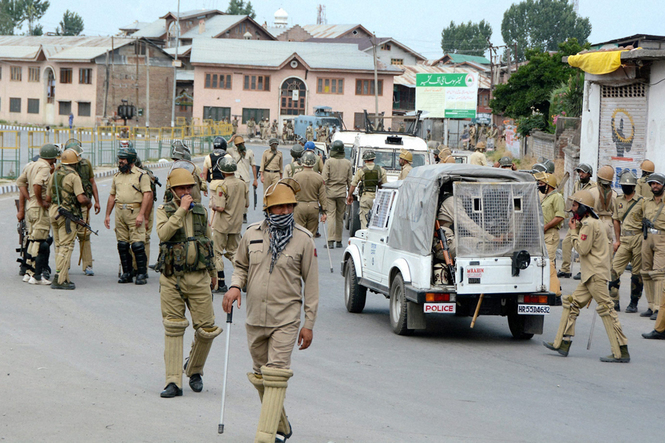
General Rawat’s recent statement that Kashmir is fighting a dirty war and needs innovative ways to deal with it, has brought a new set of controversies to the Kashmir imbroglio. He considers Kashmir’s crisis as a law and order problem, which many others disagree with and considers it a political problem. The broader question that lies here is, why is there a law and order problem and who will solve it? Although, he reiterates that the fear of army is necessary in maintaining law and order but will that bring peace to Valley remains a million-dollar question?
There are more complex questions than the simplified answers. The tragedy is that the condition in Kashmir is going out of hand and from bad to worse. People of Kashmir have become fearless and are increasingly coming out on streets to protest. Curfews, strikes, protests so on and so forth have become a daily routine. Thousands of people, with their injuries, are suffering either in hospitals or their homes. Hundreds have already died, and the number is increasing.These protests are led by the separatist leaders, the general public of Kashmir as well as those who opted for armed rebellion. Every new killing leads to new protests which further exacerbates the condition. This vicious circle goes on and on.
This time it is Sabzar, last time it was Burhan, next year it may be someone else. The trend is continuing without any way out. How to solve this problem has been along debated issue in Kashmir but what is more important at this juncture is to understand why this issue exists.
I think the best way to look at it is to go back to history. It dates back to the 1940s when Kashmir was an independent state ruled by Maharajas. During the partition in 1947, India opted to be a secular country while Pakistan became a theocratic country. The general trend was that Muslims shifted to Pakistan and Hindus stayed back in India. Kashmir chooses to be with none because of its Muslim majority population ruled by Hindu ruler, Maharaja Hari Sing. Although, India approached Maharaja for his consent, unlike as they did in Hyderabad where the consent of people was taken, he put on hold the accord of accession. After the Kabali (Pakistan tribesman) raid in Kashmir, Maharaja resorted help from the then Prime Minister of India, Pandit Jawaharlal Nehru on the pretext of accession with India. But, it was decided/promised that a plebiscite will be held in Kashmir after the Kabalis will leave, wherein people of Kashmir will be given the right to self determination- whether they want to be with India, independent or Pakistan
On this pretext, Indian army landed in Kashmir to fight Kabalis. But, once the coup was over, India did not hold the promised plebiscite. It is not only India that bears whole responsibility of not letting the plebiscite to take place, Pakistan equally shares the responsibility. The conditions that UN put for holding a plebiscite in Kashmir were; a) Pakistan has to take out all its forces and people from Kashmir and then b) India has to hold a plebiscite in Kashmir. None of these conditions were met by any of the countries.
Kashmir from an Independent country with its own constitution became an occupied territory and now the world’s most militarized zone. Off the total land area of J&K, around 50 percent is under India while Pakistan and China share 25 percent each. The area under China is mostly hilly terrain used as a trade corridor between Pakistan and China while the part under Pakistan is known as Pakistan Occupied Kashmir (POK) or Azad Kashmir. The rest part is the present Kashmir which acceded with India during the 1950s.
Kashmir during the 1950s had its own autonomy wherein the Centre controlled external affairs, defense, telecommunication and currency, all other affairs were under the control of state government. But, this autonomy slowly faded away due to continuous amendments by the Central government except for the article 370 which gives special status to the J&K state under Indian constitution. This article has been used, abused and misused but still, it has its own essence. According to this act, the laws passed by central government will not directly be passed on to the state. The main aim of this article was to secure the people of Kashmir as well as to narrow down the trust deficit between India and Kashmir.
Things never went well. People of Kashmir did not consider themselves as part of India, and thus, there was a continuous resistance from the people against Indian occupation in Kashmir. This resistance reached to its peak during the early 1990s when people of Kashmir turned towards arms, backed by Pakistan to fight Indian occupation. This uprising resulted in huge collateral damage in which hundreds of thousands of people were killed without any favorable outcome.
The condition in Kashmir relatively stabilized during the early 2000s. One of the reasons may be attributed to Atal Bihari Vajpayee governance, but it did not last long. In 2008, a fresh round of protest started. The reason for the protest was the Amarnath land which was covertly sold to Amarnath shrine board without public notice. This infuriated Kashmiri public but this time the mode of protest was stone-pelting. The protest again broke-out in 2009 after the twin rape and murder of Aisiya and Nelofer and in 2010 due to fake encounters and the merciless killing of Tufail Mutto. On Feb 9, 2013, Afzal Guru was hanged the leading new set of protests and the new set of people opting for arms. Further, in 2016, the protests were on rampant after the killing of Burhan Wani. This trend may continue in future as well. The worrying part is, is there any end to these protests?
May be Gen. Rawat is right in claiming it a dirty war, but it is going on since 1950s. Putting human beings as the shield will no way put an end to it. It will rather have a malign influence on the people of Kashmir. Awarding Major Leetul Gogoi will no doubt boosts the confidence of Army, but at the same time, it will dwindle the link between Army and common public. Innovation is welcomed, but they should safeguard rather than jeopardizing the lives and dignity of common people.