

We all grew up reading great writer Munshi Premchand’s stories in our childhood. Most of his stories were based on the suffering of the peasants and farmers during the British rule. Be it his stories like ‘PooshKiRaat’, ‘Kafan’ or the epic novel ‘Godaan’, Very poignantly he described the sorrow and grief of the farmers when they lose everything, just to get a fistful of the crop in returns. These stories were not fictions; rather they were the documentation of rural India at a time when the Englishmen were ruling a nation which turned to be world’s largest democracy later. Gandhi, who saw a dream of a developed India, started his journey to fight against the Englishmen from Champaran. He knew that farmers are the backbone of the country. We cannot imagine a prosperous nation without thinking about the welfare of the cultivators. It was not just the British government which was eating up all farmers at that time but a harassment of their own countrymen like the Zamindars (landowners) and other powerful men from the upper caste for their greed. there was almost a close association between the land ownership and the caste hierarchy, with the upper castes controlling exercise over the greater plots of lands and the lower castes being landless and the destitute tillers. It has been more than 70 years since the British left the country. We are now sending satellites to Mars but our farmers are left with the same circumstances as they were before 1947. Our leaders have replaced the British and Premchand’s novels still remain relevant for our farmers today.
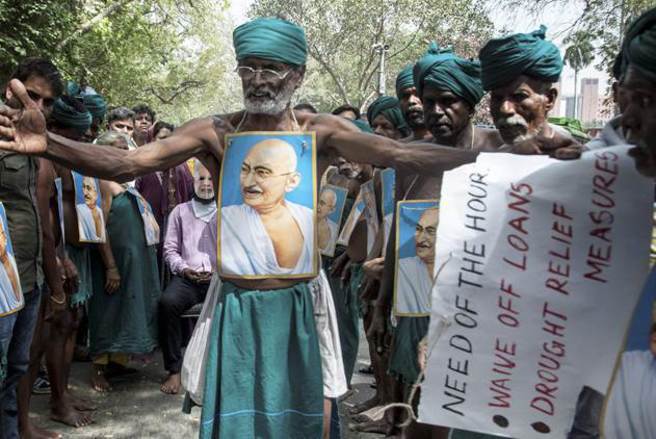
Today farmers in several parts of India are striving to survive with the pressure of debts and get the proper amount for their produces. They have been fighting for their demands since independence, but their voice has continue to remain unheard. Today farmers are protesting in different parts of the country, but their solicitation remains the same. They are demanding for appropriate prices for their agricultural produce. They want a waiver for the loan as they lost everything.
It was in April when around 100 farmers from Tamil Nadu gathered at Jantar Mantar in New Delhi demanding drought relief package from the Center. To show their protest, they carried skulls of the dyed farmers, drank their own urine and ran naked in front of prime minister’s residence. In May it was a farmers’ protest in the BJP led state of Madhya Pradesh which turned violent. At least six people were killed as the police fired at the protesters. While in another BJP led state Maharashtra, farmers emptied milk containers and dumped vegetables on roads to show their disagreement. They claimed that they were offered price lower than their input costs for their produces. Now in Rajasthan which is also a BJP-led the state, farmers went on an indefinite strike for the similar demands. Apart from it they are also angry over the cheque payments in spite of getting cash for their produces. Haryana also saw a mass protest in the recent days. The farmers blocked state highways demanding appropriate price for their sunflower seeds, potatoes, and maize apart from a loan wavier. Uttar Pradesh is another state which may join the violent movement.
These protests are the results of failed policies and plans by the governments to address the severe agrarian crisis in India. Is it only the natural calamities like drought responsible the crisis? Well, it is due to the several policies of the government which failed to address the cause of issues present in the farm sector in India. Farmers have always been no more than vote banks for the political parties. The Modi government which promised relief to farmers prior to elections has more inclination towards the interest of the practice of corporate agriculture now. Nearly 83% of the farmers who have less than two hectares of land are ignored while framing policies for the welfare of the cultivators. They remain to be the major victims of this agrarian crisis. Our farmers have been attempting suicides in large number since decades. According to the reports of National Crime Records Bureau (NCRB), a total of 296,438 farmers attempted suicide in India since 1995. The main reason behind these suicide attempts is the burden of debts, increased production costs and the selling price lower than the inputs.
There is a lack of proper layout by the government to increase crop production despite the rise in food demands. The government fails to achieve appropriate agricultural growth due to lack of proper research. It fails to provide a solution to the cause of sufferings of the farmers. Loan waivers can relax the farmers to an extent but is a not a solution to the existing crisis.
A framework is required to prepare before policy implementation in the country. The framework shall be made through consulting smaller farmers from every state and research on the attempts to increase crop productivity and its market value. Gandhi believed that farmers are the backbone of Indian economy and we require some humane efforts to strengthen it. To promote native agricultural practices, we need to educate and aware farmers about the gain, losses and benefiting steps in their practice. A well-informed and skilled farmer can fight with root causes of crop failure to a major extent.