

Batla house encounter took palace on 19 September 2008 in Jamia Nagar Delhi. In the encounter two suspected terrorists Atif Amin and Sajad Mohmad were killed. Mohd Saif and Zeeshan were arrested and as per the reports one of the accused managed to escape. In this encounter inspector Mohan Chand Sharma who led the operation was killed. After the encounter the accusations were raised against the Delhi police for carrying a fake encounter. Not only civil society but the media and students raised their voice against the encounter.
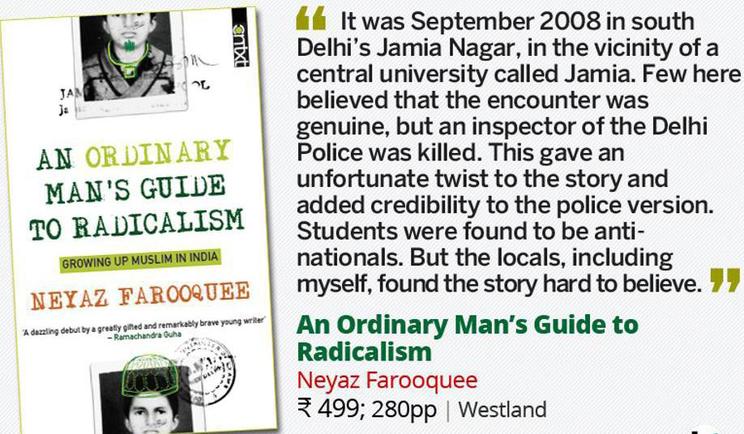
The book “An Ordinary Man’s Guide To Radicalism” penned down by Neyaz Farooquee also deals with the Batla house encounter. As in the prologue the author of the book himself says “How do you respond when something like a police encounter happens in your locality, and a few doors down, two men are killed, two of your neighbors, who have been labeled terrorists. Imagine for a moment, that this happened not in Imphal or Srinagar, where such occurrences are not unheard of, but in your safe cozy neighborhood. Let’s get to the facts.
It was September 2008 in south Delhi’s Jamia Nagar, in the vicinity of a central university called Jamia Millia Islamia. Few here believe that the encounter was genuine, but an inspector of the Delhi Police was killed. This gave an unfortunate twist to the story and added credibility to the police version. Students were found to be anti nationals. But the locals, including myself, found the story hard to believe.”
Neyaz Farooquee the author of this book is a journalist and it is because of the encounter as the author says, he decided that he wanted to be a journalist. Nayaz as a writer has contributed to Hindustan Times, New York Times, Al Jazeera, Caravan and Thelka. Neyaz was also a fellow at the new Indian Foundation and non-fiction fellow at Sarai-CSDS. This book has been written in simple and lucid language. As the author himself acknowledges this book is not in English language, it’s in Hindustani, the language that I speak naturally.
After reading the story of the kid who came from Dehli with many hopes from a modest village in Bihar for study purpose, and later working in Delhi many events shaped him as a person and here I would like to remark that while reading the book the reader not only laughs but sometimes it moves the reader to tears. As the author says after the Batla House encounter Ami told me to be careful and avoid stepping out unless it was really important. She had a good reason to fear, it is because the most educated person in her maternal family, her cousin has been killed by the police in Mumbai riots following the demolition of Babri Masjid in 1992. The author in this book himself narrates how his uncle was brutally killed. “My uncle was a maulana who taught at a madrasa cum masjid in Mumbai. At around 10:30 am, while he was doing his ablutions before reading the Quran, a troupe of policemen entered his madrasa from the rooftop of bakery next door. The asked for the head maulana – Maulana Qasim, my uncle.
His son, barely in his teens, scared and confused, directed them towards his Abbu. But his Abbu knew what the police action meant in that communally charged city. He shouted to his students:’Monsters have come, start reading Darood – Darood, a common pryaer that is read in daily life in the praise of Prophet Muhammad (peace be upon him) and that many consider good to read for a dying soul.
My cousin witnessed it all. They shot his Abbu, but his eyes were still open. They dragged him down the stairs from the upper floors. Then they kicked his Abbu towards the railing. Still alive, he clung to the railing, while his polio stricken leg dangled in the air. Then they shot more bullets and his Abbu finally fell to the street below. His Abu asked them for water. But they put their shoes in his mouth.”
The above mentioned Maulana who was brutally killed, for the outside world the case is known as Suleman Usman Bakery firing in which besides the mulana eight more were sent to heaven. The unfortunate thing is this it was eight years after the murder of the maulana that the FIR against the police men was registered. But the unarmed men inside the madarasa and the nearby bakery were accused in the riot soon after the shooting. The accused policemen are yet to be punished the main accused became the chief of Mumbai Police and eventually retired. It was only in 2015 a trial was ordered against them.
The book has total 18 chapters. In chapter 14 titled “You are as patriotic as anyone else”, the author has exposed both the left and the right. It is because after Batla House encounter not a single person who could be called a leader showed courage to come in Jamia locality and say ‘I will stand by you’. But as the author says while exposing the false claims of leaders that “The left often claimed to represent minorities, Muslims included, but there was no voice of political leaders worth recalling, at least not in the beginning, when we were scared even to speak aloud about it. The Right claims to extend a well meaning hand of friendship towards Muslims, but now there was none in sight. These words expose the false claims of both Right and left they even didn’t dare to say the Muslims particularly those living in Jamia Nagar are as loyal as anyone else or to say Muslims are as patriotic as anyone else after the encounter.
At last what I can say every chapter of this book is interesting and the good thing is that, side by side the author is narrating his own story. I think every Indian should read this book especially Indian Muslims and students of Jamia must go through the book.