

Introduction
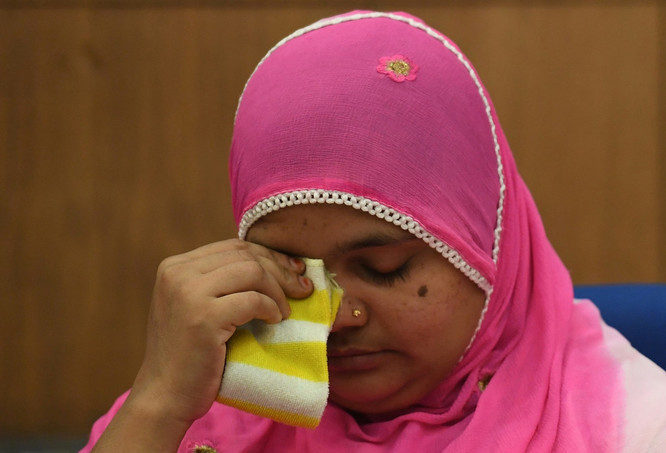
Bilkis Bano is one of the many Muslim women of Gujarat who suffered sexual violence during the anti-Muslim pogrom of 2002. Martha Nussbaum in her essay ‘Body of the Nation: why women were mutilated in Gujarat’, says, ‘Muslim female bodies symbolize a recalcitrant part of the nation, one as yet undominated by Hindu male power. One reaction to that situation might have been to abduct the woman and to place her in one’s own household. But if women are things, instruments, objects, then their bodies may also be used in gruesome ways—if that is what will best satisfy one’s desires for power, honor, and security. Once the status of end-in-itself is denied, everything else follows on a whim.’1 Sexual violence against women, especially Dalit and Muslim women, is even more egregious because it is often nearly impossible for them to seek justice from the state.
The state is after all a manifestation of Brahmanical Hindu ideology; instead of addressing the sexual crime that is committed against a Muslim woman, instead of recognising the legitimacy of her statement against the perpetrators, she is made to undergo further humiliation. Even if the survivor is able to appeal to legal redress, the process of trial is long and tortuous. During the trial, the statements of witnesses often change during duress. A survivor and the witnesses corroborating her words are vulnerable to intimidation by forces who actively conspire to impede legal procedures. Often, these cases are dropped or dismissed, citing lack of sufficient or credible evidence. Even if conviction occurs, there is a possibility that the accused will not complete his prison sentence. There is also the concern of how effective the law is in deterring sexual violence against Muslim women. In a nutshell, there are innumerable hindrances that a survivor of sexual violence has to confront before her search for justice comes to fruition. The long ordeal of seeking justice is often a deterrent for women like Bilkis Bano from seeking legal redress in the first place. Therefore, to persist in the search for justice, and to distinguish it from revenge requires a considerable degree of moral courage.
Shouts for Revenge, Deaf Ears for Justice
The genocidal events which took place in Gujarat 2002 have become part of common consciousness. But judicial statements, political leaders and their repeated references to the spectre of jehadi terrorism, and hints of a pre-meditated controversy by Muslims have twisted the narrative in mass psyche. Narendra Modi, the then Chief Minister of Gujarat, broadcast a speech on state television, in which he declared that those who were responsible for the attack on Hindus would be taught a lesson. By portraying the burning of the S-6 coach of the Sabarmati express as pre-planned by Muslims with possible connivance by Pakistan’s ISI, Modi sought to highlight the supposed disloyalty of Muslim citizens, thereby creating a category of less ‘national’ and patriotic citizens. Unpatriotic Muslims were a perfect target for revenge by Hindus seeking to defend the nation. The widespread killings of Muslims which followed the fire aboard the Sabarmati Express was termed as a ‘spontaneous’ response to a heinous action. Modi popularised the ‘kriya-pratikriya’ or the action-reaction trope, so that the killings of Muslims would be seen as only a natural response to the killings of Hindus in the ill-fated coach of the Sabarmati Express. According to Modi’s exhortation to Hindus, it would be cowardly to not avenge the deaths of Hindus; after all, it is but natural to demand an eye for an eye and a tooth for a tooth. As per the rhetoric uttered by Modi, the tragedy at Godhra had resulted in the deaths of Hindus at the hands of Muslims. This called for acts of revenge to be committed by any Hindu with asmita and self-pride, so that no one would dare to repeat such acts of terror against Hindus. The object of revenge was the Muslim community; Muslims were to be killed because they were defiling the sacred body of Bharat Mata. The act of killing Muslims would elevate the status of Hindus as nationalists and defenders of the nation.
The accident at Godhra provided the perfect alibi to Hindutva agents to orchestrate a wave of anti-Muslim hatred in Gujarat. But reports have suggested that contrary to the loud claims of Modi and his cohorts, the fire on the Sabarmati Express was not the work of a pre-planned conspiracy by Muslims at Godhra station. A recent news article has this to say: ‘the truly damning report of Mohinder Singh Dahiya, then assistant director of the Forensic Studies Laboratory (FSL) at Gandhinagar, Gujarat, put paid to the theory of the coach being set afire by an angry mob, which had mysteriously collected outside the Godhra railway station. The report concluded that the coach was set afire by someone “standing in the passage of the compartment near seat number 72, using a container with a wide opening about 60 litres of inflammable liquid has been poured and then a fire has been started in the bogie.”’2 Modi’s invective against Muslims was therefore based on sheer falsehood. He had deliberately concocted lies in order to construct a narrative of Hindu victimhood and unleash an anti-Muslim pogrom throughout Gujarat.
A call for revenge by Modi attracted a ready audience; evidence collected by investigative reports show that the pogrom had been planned for many months. But what about a call for justice? Survivors of the pogrom met humiliation and intimidation at every step of legal redress: incriminating details were omitted from FIRs, cases were abruptly closed, witnesses were threatened while the police refused to provide any protection to them. Their call for justice faced a hostile state, a state which even refused to accept that mass crimes and sexual violence had occurred in the first place.
‘Testimonial Injustice’
Bilkis Bano was gangraped during the pogrom of 2002. She is the survivor and the only eyewitness of the massacre of her family of fourteen members, including her three year old daughter. Several women of her family were raped before being murdered. In March 2002, when Bilkis filed the first FIR at the Limkheda police station, the rapists’ names were not written down. A year later, citing inconsistencies in the FIR, a ‘Summary A’ report was filed and accepted by the Limkheda judicial magistrate, which effectively closed the case.3 In 2004, the Supreme Court ordered that her case should be transferred to a suitable court in Mumbai, since the Gujarat CID was harassing Bilkis and her extended family members. Justice eluded Bilkis for fifteen years.
Bilkis went through a long period of ‘testimonial injustice’, during which her eyewitness account was not given credibility, and the details of her testimony were omitted, and even her physical safety threatened. As Miranda Fricker writes, ‘Testimonial injustice occurs when prejudice causes a hearer to give a deflated level of credibility to a speaker’s word.’4 Bilkis had to undergo testimonial injustice because of her identity as a Muslim woman. Fricker introduces the notion of identity prejudice as ‘a label for prejudices against people qua social type’; this focuses on the central case of testimonial injustice:
‘the injustice that a speaker suffers in receiving deflated credibility from the hearer owing to identity prejudice on the hearer’s part, as in thecase where the police don’t believe someone because he is black…testimonial injustice..is connected with other forms of social injustice that the subject is likely to suffer, and that is what makes it the central case—it is central from the point of view of revealing…the broader pattern of social injustice.’5
Bilkis was subjected to the violence of the state precisely because she had the courage to seek justice from the state itself. This contradiction highlights the vulnerability and precariousness of people belonging to minority identities, wherein they have to rely on the protection of the same agents of the state which unleash violence on them. As Judith Butler writes,
Precarity also characterizes that politically induced condition of maximized precariousness for populations exposed to arbitrary state violence who often have no other option than to appeal to the very state from which they need protection. In other words, they appeal to the state for protection, but the state is precisely that from which they require protection.To be protected from violence by the nation-state is to be exposed to the violence wielded by the nation-state, so to rely on the nation-state for protection from violence is precisely to exchange one potential violence for another.6
The CBI chargesheet in Bilkis’ case details the complicity of the police officials who were on duty.7 Not only did they take advantage of Bilkis’ illiteracy and got her thumb impression on an incomplete, truncated version of the FIR, but they also made no efforts to send the bodies of her family members for a post-mortem. Bilkis was not sent for medical examination, the bodies of her family members were not identified. Even the scene of the massacre was not protected; the CBI chargesheet reports that even the body of Saleha, Bilkis’ infant daughter disappeared.8 Obviously, these acts of omission intended to shield the criminals from blame and to deny Bilkis’ testimony a credible hearing.
While delivering the verdict in May 2017 the Bombay High Court observed, ‘In this case, the truth and falsehood are mixed up in such a manner that at every stage of the evidence, the truth is hidden under layers of intentional laxity, omissions, contradictions and falsehood, and the truth is required to be unearthed.’9 The court observed that all the police personnel from Limkheda who attended to Bilkis were either accused or examined by the defence as defence witnesses, and none of them supported the prosecution’s case.10 Bilkis’ search for justice was a battle against those agents of the state who wanted to silence her and preclude the natural course of law before it could sentence Hindutva criminals.
Different Consciences, Same Crime
When the verdict in Bilkis’ case was delivered by the High Court in Mumbai, there was another case which had grabbed national attention. In Mukesh & Anr vs State of NCT for Delhi popularly known as the ‘Nirbhaya rape case’, the Supreme Court delivered a verdict sentencing Jyoti Singh’s rapists to capital punishment. The verdicts of both the cases were pronounced at the same time, but the attention they received from the ‘conscience’ of the nation was starkly different.
The gangrape that happened in on December 16, 2012 in Delhi became a media spectacle in no time. The victim succumbed to her injuries after the brutal gangrape; it was befitting that this case should be deemed as a ‘rarest of the rare’ case which merited nothing short of a death penalty. There were some sections of civil society which were against the death sentence; they argued that a carceral legal approach will not help to eradicate sexual violence against women. Moreover, the recommendations of the Justice Verma Committee Report which was submitted in January 2013 did not mention death penalty for those convicted for gang rape. Instead, it recognised the need to curb all forms of sexual offences and suggested penalties for other kinds of sexual offences such as voyeurism, stalking and acid attacks.11 But the verdict in Nirbhaya’s case was not strictly determined by dispassionate considerations of law. One wonders if the pronouncement of death sentence was made in deference to the public outrage against Jyoti Singh’s rapists. Is the objective procedure of legal justice influenced by a subjective and dubious moral judgement of the body politic, the aam janta?
If it is a question of following due process of law, then the verdict for two different cases, where the nature of crime is identical, should be the same. But the verdict in Bilkis’ case and the verdict in Nirbhaya’s case differed, in the very reading of the law. The gangrape of Bilkis and the rape and murder of other women in her family was not deemed as a ‘rarest of the rare’ case. But in the case of Nirbhaya, the court declared, ‘The brutal, barbaric, and demonaical (sic) conduct of the convicts shook the conscience of humanity and they don’t deserve leniency.’12 Moreover, the nature of investigation by the police also differed vastly in the two cases. The investigation against Nirbhaya’s rapists was perfectly done, there was no testimonial injustice in her case. The trial also concluded without undue procrastination; there was no delay or denial of justice. Contrast this to Bilkis’ case, where the quest for justice was actively impeded by the police. As noted by a commentary, ‘The court in Para 324 relied upon cases of Sevaka Perumal & Anr vs State of Tamil Nadu[(1991) 3 SCC 471] and Dhananjoy Chatterjee alias Dhana vs State of West Bengal [(1994) 2 SCC 220] to drive home the point that the instant case does not involve history-sheeters or hardcore criminals and the act was given effect during post-Godhra riots where the accused were boiling with revenge, which led them to pounce upon and rape Muslim women, which unfortunately included the prosecutrix herself.’13
The judgement of the court seems to suggest that since the sexual violence against Bilkis Bano and her family was not pre-meditated, but was driven by a spontaneous desire for revenge, the crime need not be considered as belonging to the ‘rarest of the rare’ category. Thus, despite the CBI suggesting that Bilkis’ rapists deserve the death penalty, the Bombay HC commuted the sentence to life imprisonment. It is disturbing to note that the reasoning of the court gives cognisance and legitimacy to the desire for revenge just as Mod did. The court echoes almost a note of approbation when speaking of a majoritarian desire for revenge against Muslims. The rape of Jyoti Singh was not an act of ‘revenge’, and therefore it was more heinous. But Bilkis is identified as a Muslim woman even by the objective maxims of law; she is a part of a community which has always been scapegoated as a target of revenge. In a nutshell, the reading of the law for the same crime in two different cases differs as per the identity of the rape victim.
There were no public condemnations of the mass rapes that occurred in Gujarat during the pogrom. In stark contrast to the silence over the sexual violence against Muslim women, the rape of Jyoti Singh was followed by a wave of outrage and anger. The rapes of Dalit women such as in Khairlanji or the rapes of Muslim women do not excite indignation from the national public. This is because the bodies of Dalit and Muslim women are not seen as a semiotic representation of the nation, which is imagined as a motherland, as a Hindu goddess. This is not to suggest that mass outrage is a salutary feature of gender justice; on the contrary, recognition of misogyny and the resolve to eradicate violence against sexual minorities must become a part of everyday consciousness, instead of being merely epiphenomenal to legal trials. Unless the courts of law learn to see different cases of rape from the same perspective, unless they learn how to apply the same reading of law in different cases without prejudice about the identity of the rape victim, gender justice will remain a far cry.
How should the general public respond to acts of sexual violence? Apart from antagonistic positions regarding the persistence or abolition of the death penalty in cases of gang rape, there is another fundamental concern. This pertains to public memory of sexual violence. The problem with public frenzy and media-generated outrage, such as the one which followed the rape of Jyoti Singh, is that it is too ephemeral to permeate social consciousness. People tend to forget too easily. And if they do remember, they do so only selectively. Very few remember the rape and murder of Surekha and Priyanka Bhotmange. Similarly, public memory of rapes of Muslim women is regrettably fleeting. Avishai Margalit speaks of ‘a moral duty of remembrance.’ He insists that everyone has a moral obligation to remember ‘gross crimes against humanity, especially when those crimes are an attack on the very notion of a shared humanity.’[1]4 Margalit says that the responsibility to remember is central to the notion of care.
The memories of survivors of the Gujarat pogrom constitute evidence of the majoritarian politics of Hindutva in Gujarat. This in turn catapulted the BJP and Narendra Modi to power in the general elections of 2014. But the collective memory of those who have survived violence engineered by the state, is a testament against the ruthlessness of that power. The events that befell Muslims in Gujarat in 2002 are today denied by a majority of people. When there is failure to acknowledge the voices and memories of survivors of violence, there is also a failure to condemn violence. Therefore, in order to halt the iterative violence instigated by the state, in order to forestall the state from killing with impunity, there needs to be a recognition of those who have been affected by that violence.
Conclusion: The Moral Integrity of Bilkis Rasool
After the Bombay High Court pronounced the verdict in her case, Bilkis gave a public statement in which she affirmed her faith in law. ‘To fellow Indians, I appeal to all of you,’ she said,‘at a time when we hear news everyday of people being attacked and killed because of their religion or community – please help affirm their faith in the secular values of our country and support their struggles for justice, equality, and dignity. For this verdict does not mean the end of hatred but it does mean that somewhere, somehow justice can prevail. This has been an long, seemingly never ending struggle for me, but when you are on the side of truth, you will be heard, and justice will be yours in the end.’15 She said, ‘My rights, as a human being, as a citizen, woman, and mother were violated in the most brutal manner, but I have trusted in the democratic institutions of our country. Now, my family and I feel we can begin to lead our lives again, free of fear.’16 As reported in a press statement, she said, ‘Yes, the horrors I suffered deserve the maximum punishment, but at the same time, I do not want anyone else to die in my name.’17 Bilkis refrained from demanding the death penalty for her rapists, for those who had murdered her family members.
Bilkis’ response to the killings of her family members and Modi’s response to the killings of Hindus at Godhra (with whom he did not share a familial bond) are a study in contrast. It would have been very natural for Bilkis to demand that those who were guilty of killing her infant daughter should be put to death. But instead, Bilkis expressed her faith in the judicial process, despite the fact that the court had not done full justice to her and had given credence to the Hindutva bloodlust for revenge, despite the fact that ‘justice delayed is justice denied.’ That the verdict finally went in Bilkis’ favour does not give much credit to investigative agencies; after all, the police and the Gujarat CID had threatened to kill her if she persisted with the case. In the final analysis, the verdict is a testament to Bilkis’ grit and determination, a courage that stopped short of vindictiveness.
Bilkis’ search for justice indicates that minorities are much more deferential to the due process of law than the majority, even if the law does not treat them as an equal citizen, even if the law explicitly criminalizes them (such as law banning the trade and consumption of beef). But the majority is intoxicated with power, and rides roughshod over law. This is ironical, considering the fact that the law of the land is fundamentally arraigned against minorities; for commission of the same crime, a Dalit or a Muslim will be held under greater suspicion than a Hindu and for suffering from the same crime, a Dalit or a Muslim will get a much more delayed redress than a Hindu or none at all. Minorities are more vulnerable to the vagaries of law. But Bilkis’ faith in the fairness of legal justice, and her patient wait for justice should be a lesson to genocidaires who give open calls for mass murder. To not demand an eye for an eye, a tooth for a tooth requires immense moral courage. Hers is a moral integrity that very few are capable of. And that is where her victory lies.
NOTES
- Martha Nussbaum, “Body of the Nation: why women were mutilated in Gujarat.” Boston Review, June 1, 2004.
- ‘15 years after Godhra, we still don’t know who lit the fire’, Hindustan Times, February 27, 2017, available at http://www.hindustantimes.com/analysis/15-years-after-the-godhra-we-still-don-t-know-who-lit-the-fire/story-vkeZowN2nhvVkAJPZAPntN.html
- ‘Bilkis Bano Case: A Timeline of Events’, available at https://thewire.in/132049/bilkis-bano-case-timeline/
- Miranda Fricker, Epistemic Injustice: Power and Ethics of Knowing, (Oxford:Oxford University Press, 2007), p. 1
- ibid
- Judith Butler, Frames of War: When is Life Grievable, (London: VersonBooks, 2009), p. 25-26
- ‘Bilkis Rasool Case- CBI Chargesheet’, available at http://www.sabrang.com/cc/archive/2004/apr-may/bilkiscase.pdf
- ibid
- ‘Bilkis Bano gangrape case verdict: Bombay HC convicts 5 Gujarat cops, 2 doctors,upholds life for 11’, Indian Express, May 5 2017, available at http://indianexpress.com/article/india/bilkis-bano-verdict-gujarat-2002-riots-bombay-hc-life-imprisonment-cbi-death-convicts-4640051/
- ibid
- ‘Recommendations of the Justice Verma Committee: 10-point cheat sheet’, January 24, 2013, available at http://www.ndtv.com/cheat-sheet/recommendations-of-the-justice-verma-committee-10-point-cheat-sheet-511292
- ‘Nirbhaya rapists to hang as Supreme Court upholds death sentence’, may 5, 2017, Times of India, available at http://timesofindia.indiatimes.com/india/nirbhaya-rapists-to-hang-as-supreme-court-upholds-death-sentence/articleshow/58531250.cms
- ‘Bilkis Bano’s Case: not rarest of rare?’, May 8, 2017, available at http://www.livelaw.in/bilkis-banos-case-not-rarest-rare/
- Avishai Margalit, The Ethics of Memory (Cambridge, MA: Harvard University Press, 2002)
- ‘Verdict has Vindicated my Truth, Upheld my Faith in Judiciary: Bilkees Bano’, May 5, 2017, available at https://sabrangindia.in/article/verdict-has-vindicated-my-truth-upheld-my-faith-judiciary-bilkees-bano
- ibid
- ‘Bilkis Bano — determined but not vindictive’, May 9 2017, available at https://www.newslaundry.com/2017/05/09/bilkis-bano-determined-but-not-vindictive
(Note: This was originally published in volume 2, issue no. 11, 2017 of The Baroda Pamphlet. This has been republished here with permission.)