

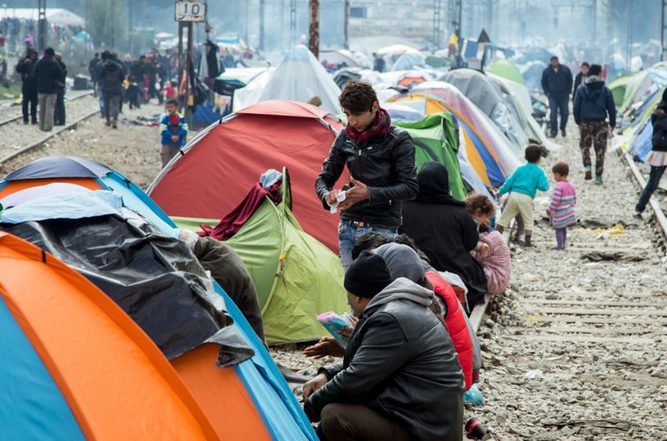
The European migration crisis is now at the center of discussion in the EU and the member-states. The phenomena of migration into European countries and the pro-immigration policies of the EU have not gone well with the members states like Hungary, Slovakia. Czech Republic etc. Many are claiming that this issue has led to the East-West divide within EU, the migration crisis however has come as an opportunity to the Populist parties and leaders, who are leaving no stone unturned in exploiting this situation. Victor Orban of Hungary, leading from the front has pulled up his socks against the EU. The Europeans who once propagated the ideas of globalisation are now taking a jibe at it and are not holding back in making anti-cosmopolitan claims, with the fear that the immigration policies might disturb their demographic structures.
While each one is looking at this debate with different perspectives, some defend the member states’ demand against EU, while some are backing the policies of the EU in the larger interest. However, this debate becomes more interesting when looked upon with the lens of public interest. Modern democracies often rely upon the phrase ‘Public interest’ to justify their rule and policies. But one cannot deny that this concept is much contested in the area of political theory. This brief article is one such effort to look at the migration crisis from the public interest perspective.
Anti-Immigration: Is there a public interest involved?
The international politics as such is based on the concept of ‘National Interest’. We have been learning that nation states in a given system thrive for their national interest. What is therefore the national interest and who defines it? Who is a part of it and whom does it benefit? These questions normally arise. In liberal democracies, one expects that the public interest should reflect in the national interest, which would be an ideal condition.
However, even then, there are questions about what is that public interest and who defines it? This is a prominent debate of political theory which can be reflected and applied to many issues.
The West is witnessing growing sentiments of the people against the refugees, what Krastev once termed as “Clash of Solidarity[1]” and not lack of solidarity. Those with anti-immigration flags site convincing reason for their defence. Indeed, one cannot overlook domestic conditions in the course of being a cosmopolitan, there has to be a balance. But the question is, do we consider public interest while making such claims. If yes, then who do we consider to be the public in this debate? Is our conception of public broad enough to accommodate?
Western liberal democracies are seen as examples of protecting and preserving the democratic values. Opposition to the immigration policies reflects the narrow conception of public interest that masses are increasingly adopting and populist parties are increasingly exploiting. Political elites in the Europe have a role to play in this regard. There is a need of a deliberation on whether we stand by our democratic values or bow down to the narrow populist claims.
The public interest debate has few variations. One of which is what we call the “Shared Private Interests”. This is often confused with Public interests by the political elites and by us as observers in international politics. If a collective group shares a common interest, it is not necessarily public interest. Therefore, it is not in the public interest to oppose the immigration policy based on some shared private interests, which are held by a collective group. It, most importantly goes against the ideals of democracy.
The other variation here is that there are so called “Felt or Subjective interests” which can be termed as private interests. Sociologists term them as “revealed preferences”, which individuals assert or reveal to be their interest. And there is the other known as “Real or Genuine interests” which are not subjective and most of the time individuals are ignorant of these interests.
The anti-immigration claim or demand can be an example of subjective interests which individuals assert to be the public interest and in their best interest. However, it may vary from person to person as it is subjective. There is also a possibility that it may not vary and a large group has the same interest, in that case it falls under the category of shared private interests, which again are not and cannot be considered as the Public interest.
Modern liberal democracies give much importance to the masses and their interests; however, if interests of one are conflicting with another it can no longer be termed as public interest and that is the time when political elites play a major role. Either they balance the situation for an inclusive solution or they exploit it for the better of one and worsen things for the other.
Another aspect of this debate is, whether masses are the best judges of their own interests and those of others? The proponents of Real interests argue that masses at times do not know what is good for them and for others. Liberal beliefs about human nature say that human acts in a selfish manner, for his/her own benefit or in his/her own interest. Therefore, is it wise to decide about migration and related issues, merely based on public interest? If things were to be decided by the masses themselves, then what is the role of the modern state in the domestic politics. Such questions arise very boldly out of these debates about public interests.
Conclusion
The embracing and acceptance of globalization by Europe like others in the world, was a statement to be inclusive not only in economics but in other aspects as well. The global village was clearly not only an economic idea. In that sense there is enough food for thought in this regard, as far as refugee crisis is concerned. Public interest likewise should undergo significant changes in a globalised world and should be more inclusive in matters of crisis.
The European citizens are ignorant of what the diversity through immigration can bring to their societies. A regulated and accommodating approach can work wonders for the refugees on one hand and of course for Europe as a region on the other. There is a strong need for the governments and political elites to consolidate the public opinion in favour of immigration policies, using the same values of democracy which are used for polarizing the opinion.
Reference
[1] Krastev, Ivan. “The refugee crisis and the return of the east-west divide in Europe.” Slavic Review 76, no. 2 (2017): 291-296.