

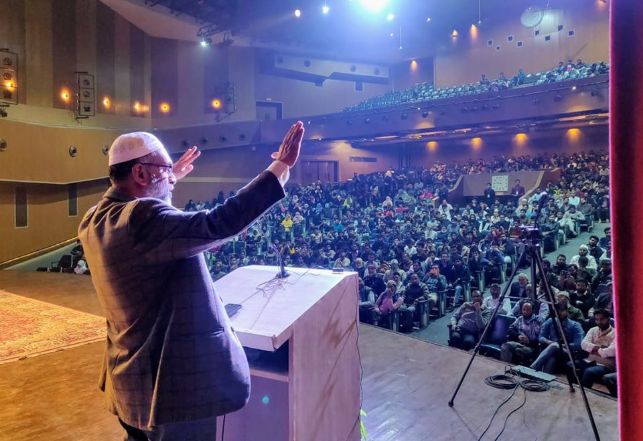
The venue is Kennedy Hall of the prestigious Aligarh Muslim University. The hall was packed even before the arrival of the guests of the program, Muhammad for All Time. The guests on the stage were the Jamaat-e-Islami Hind’s[1] Vice President S. Ameenul Hasan, Islamic Speaker Professor Saud Alam Qasmi, and SIO[2] President Labeed Shafi. But the star speaker according to some in the audience was S. Ameenul Hasan who is also NLP certified professional and motivational speaker.
Ameenul Hasan first won the audience by telling them the person the program was about is the most spoken person on the planet as his name is said in every Muslim call for prayer or adhan around the world. He also talked about how he viewed AMU as a training ground of Muslim leaders of the past and the future and how much he and his family loved AMU tarana.
He then proceeded to talk about some leadership lessons from the Seerah (Biography of the Prophet) in a chronological order. Some of his points are paraphrased below.
- Leadership lessons from early life of the prophet as a shepherd
The Prophet had many leadership lessons during his work in childhood as a shepherd. A shepherd in the desert has to be resourceful and plan pastoral trips. He has to be aware of the surroundings and have to give individual attention to sheep according to their individual nature and shepherd them as a group. A shepherd has to maintain cohesion and ensure the flock does not fight each other. He compared this to the various Muslims groups that fight each other today.
- Spirit of Exploration and Critical thinking from the trip to Syria
The Quran has many verses asking the believers to think, to explore the lands and ponder about the creation. The prophet in his early life had gone on a trade trip to Syria. Such instances give time to explore, to ponder and develop critical abilities. When the Quran asks the believers to think, it is obvious that the prophet is a person to thinks. One was must hone the creativity and critical thinking capabilities. Jb Hasan reminded the audience such an attitude helped medieval Muslim scientists and polymaths to excel. (On a side note such attitude of exploration and critical thinking helped Europe to develop.)
- Wealth and Marriage
Hasan claimed that contrary to some opinions that the prophet was immensely wealthy in his time. He based this on the claim that the prophet gifted 20 camels to his wife as Mehr[3]. He told the women in the audience not to be shy to ask for the mehr they seem fit and he expressed to the men to pay the Mehr befitting their income.
The prophet earned enough money well to his thirties and that was enough for him to survive a longtime, after his hardship, when he started winning wars, he had received 1/5th of the war booty according to the Shariah[4]. The prophet faced some financial hardship during his life time, but he looked after all his wives. Ameenul Hasan’s message was to earn well in the youth and look after the family and then serve the society
- Prophet’s social service during his youth
The prophet formed an alliance in his youth called Hil-ful-fuzul. Jb Hasan recounted in Seerah when the members of this group rescued a woman unjustly kidnapped and detained by one of the powerful Meccan tribal leaders. Through this Jb. Hasan demonstrated the importance of joining in NGOs and service organizations to serve the oppressed and the weak.
- Prophet’s Tribal Engagements
Tribal Diplomacy in Arabia during that time was marked with blood feuds. In order to survive a person would have to be under the protection of one of the tribes in Arabia. An attack on one person was regarded as an attack on the whole tribe. A person who is expelled from a tribe was an easy target. Despites threats and appeals, the prophet did not budge from preaching his message and neither did his uncle who was the tribal chieftain withdraw his protection. As they could not fight the whole tribe; they decided to boycott the whole tribe and those who converted to Islam. It was a complete social and economic boycott. Jb Hasan compared this to #BoycottMuslims of our time. The prophet never stopped preaching. The conditions in their camp were severe. But after three years humanity prevailed and the Muslims won the boycott. But the prophet lost two of his most important people in his life; his uncle and his wife. His other uncle who became the next chieftain tricked the prophet in getting him expelled. He portrayed Islam as an insult to their tribal ancestors. When asked if their forefathers who did Shirk[5] would go to hell, the prophet affirmed yes. Jb Hasan reminded the audience to always be wary of smiling faces to trick you into harming you. It also showed that the prophet was uncompromising in the matters of faith.
When he was expelled from his tribe, he appealed to many relatives and tribes to grant him protection until one granted him protection. It shows us to proceed in the face of insults and rejections until we succeed. This also shows us what we should do in the cases of NRC[6] targeting the citizenship of Muslims.
Jb Hasan reminded of a famous incident where an arch enemy of the prophet went behind the prophet telling all the people who he tried to meet that he was a madman or liar. The prophet never stopped or got tired. But according to Jb Hasan his enemy had to give up. Muslims should be able to be persistent like their prophet.
- Citizenship Question
Despite the polarization, Jb Hasan maintained the hope that Muslims would find alliances on humanity and beyond the barrier of religion. We just have to keep trying. The prophet’s appeal for protection and his subsequent migration to Madinah is a lesson that Muslims have to explore possibilities to survive.
- Grace in Victory
The bloodless conquest of Mecca is a lesson in graceful victory. He even gave the keys to Kabah back to the person who denied him entry to the Kabah.
Conclusion
JIH Vice President S. Ameenul Hasan wants students to plan, critically think and serve the society. He wants students to earn for their living and explore all options in civil society, to be aware of political discourse and dynamics. He wants them to be persistent in their activities. He mentioned in his talk things like NRC, mob lynching, But he never said anything to promote disharmony or hatred between communities unlike some members of the Indian Parliament.
You can watch the video of the program here
[1] Jamaat-e-Islami Hind (JIH) was founded by Maulana Sayyid Abul ‘Ala Maududi It is a Muslim revivalist and reformist organization and does religious and humanitarian service like Human Welfare Foundation
[2] Students Islamic Organization of India-(SIO) It is the student wing of JIH. It is active in campuses across India.
[3] Mehr is a mandatory gift for marriage from the groom to the bride.
[4] Shariah literally means way.
[5] Shirk is the gravest sin in Islam which consists of actions like attributing partners to God.
[6] NRC- National Register of Citizens- First introduced in Assam, it was supposedly to remove all illegal immigrants and refugees from Indian registers as long as, according to Mr. Amit Shah, they do not belong to Hindu, Parsi, Christian, Sikh, Buddhist and Jain Communities.