

Often found buried in school textbooks has been the contribution of Darul Uloom, Deoband towards India’s struggle for independence. The acknowledgment of Deoband is there. Yet it is almost self-effacing as if the historians concerned are acknowledging the feat despite themselves. But Deoband which started as a madrasa in 1866 to spread the pristine teachings of the Quran and the prophet played a crucial role in our freedom struggle.
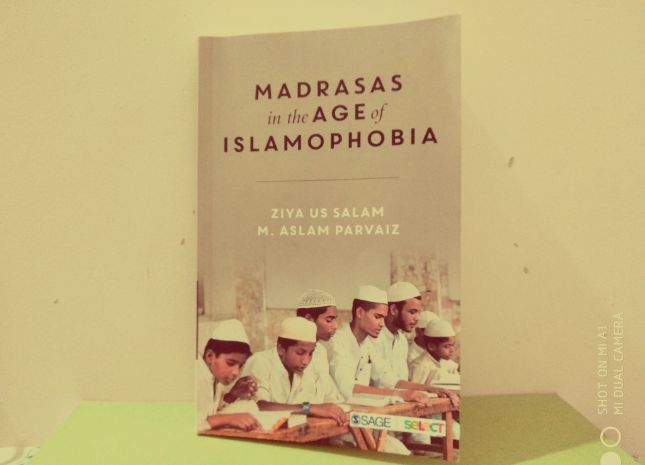
This is an excerpt from “Madrasas in the age of Islamophobia” jointly authored by Ziya Us Salam and M. Aslam Pervaiz. Published by Sage Select, the book discusses the decline of madrasas from being centres of excellence to institutions of rote-learning, the pathetic condition of students inside most modern-day madrasas, and allegations hurled by media and politicians upon them producing radicalized militants/jihadis. The authors present some case studies of those madrasa students who, after graduating from madrasas, went on to join modern universities and colleges to pursue higher studies. Towards the end of the book, they also talk about ways of ‘moderninsing’ madrasas. Divided into ten chapters, it is well-knit together with simple and lucid language.
While it is a known fact that modern-day madrasas in India, excepting some grand madrasas like Deoband and Nadwatul Ulama, are wretched and dingy running on community donations, and barely able to provide basic facilities to its students, many of us know little that in the past these madrasas schooled social reformers such as Rajendra Prasad, Raja Rammohan Roy, Munshi Premchand, and many others.
The Sangh Pravar and the BJP have been making an insidious campaign against madrasas for two decades. Dubbed as dens of terrorism, allegations and false accusations are made against madrasas and their students. Nonetheless, one should not forget, as authors tell us, that madrasas had made a pivotal contribution to the struggle for India’s independence. Maulana Mehmood Hasan, the first student of Deoband which was founded by Maulana Qasim Nanautawi in 1866, was the pioneer behind ‘Reshmi rumal tehreek’ (Silk Letter Movement), along with Maulana Mian Mansoor Ansari and Maulana Ubaidullah Sindhi, to overthrow the British.
Far from being centres of radicalization, they serve an important purpose of educating large masses of poor Muslims. As the authors tell us, many students come to madrasa for free education, free food and accommodation.
A reader can sense authors’ laments over the disconnectedness of madrasas from present day scientific developments and their utterly antiquated syllabi, barring some in Kerala particularly. They call out the lack of holistic understanding of knowledge among Muslims in general and madrasas in particular. Recalling the past and period of the Prophet, they narrate how many of the top early Muslim scientists were not just experts in one or the other natural science but also in the religious sciences. Examples of Al-Kindi and Jabir Ibn Hayyam are moving. The dualism of knowledge into ‘worldly’ and ‘religious’ knowledge has also divided educational institutions. A school or college students does not get Islamic education and on the other hand, a madrasa student does not get comprehensive knowledge. The authors propose for a “model madrasa” where comprehensive education is imparted, where along with knowledge of Quran, students also learn ‘modern’ sciences and languages.
Appreciating as it is, that the book argues against sectarianism seen in various types of madrasas. But, at the end of the book, a reader also feels that the authors appear ‘quite influenced’ by ‘modernist’ idea of education, where they ask to do away with classical books of fiqh, and advocate to change ‘the teaching methodology in the age of smart classrooms and video conferences’.
I enjoyed reading it, and recommend others to. The book is, in a nutshell, a narration of the past, mapping of the present, and perfecting of the future.