

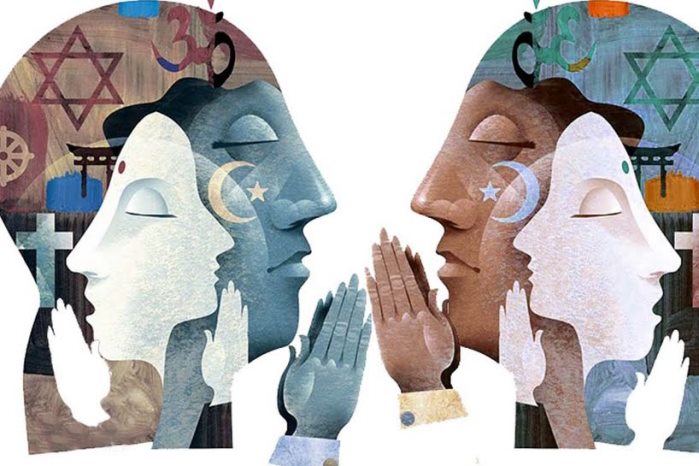
Recently, Karnataka Legislative Assembly passed the Karnataka Right to Freedom of Religion Bill, 2021, commonly known as the anti-conversion Bill. After this, religious conversion is in the news. But then again, when is it not? Every so often, fear-mongering over Christian missionaries, or ‘love jihad’, or mysterious foreign funding pops up in the news cycle and makes its way into drawing-room discussions, WhatsApp rumors and perpetuates the existence of an almost ghoulish atmosphere where it appears that ‘foreign’ invaders, in the name of love, desire, rice or education are attempting to poison the otherwise-serene nation. Recently, Karnataka Legislative Assembly passed the Protection of Right to Freedom of Religion Bill, 2021″, popularly known as the “Anti-conversion Bill” amid uproar and protest by the opposition.
The last few months have been marked by discussions around ‘love jihad’, leading to the introduction of multiple state-level laws attempting to control what is being seen as the allurement and forceful conversion of innocent (Hindu) women. But this is not an event in isolation, but a chapter in the long and complex history of demonizing a very natural historical process – religious shift. Across time and space, people have moved away from the religions of their birth, or found faith, or lost it – and South Asia is no exception. The only difference is the frenzy to control, shape, govern and render illegal some movements: those movements which allow people to turn away from what is being painted as the only correct and rightful religion in the modern imagination of the Indian state.
People, spaces, communities – religious conversion in South Asia, is not a flat plane but rather a winding road with as many alleyways and circuitous turns as one cares to look, unearth and excavate. The archive of conversion, of religious transformation, change and movement, is hard to read and harder to access, but very necessary to explore.
The narratives are aplenty – that of Cheraman Perumal, a king who claimed to see the Prophet Muhammad (peace be upon him) performing the miracle of the splitting of the moon as mentioned in Surah Qamar in his dreams and later converted to Islam, sending on his way to the region travelers like Malik bin Dinar, or the more contemporary struggles of finding a liberatory religion and an escape from caste hierarchy and violence and often paying with one’s lives.
In 2017, the Kerala High Court criminalized the marriage of Hadiya, a convert to Islam and Shafin, annulling it and also exercising its parens patriae jurisdiction over her, claiming that she was coerced and too young to take such decisions for herself.
Many journeys of Religious conversion
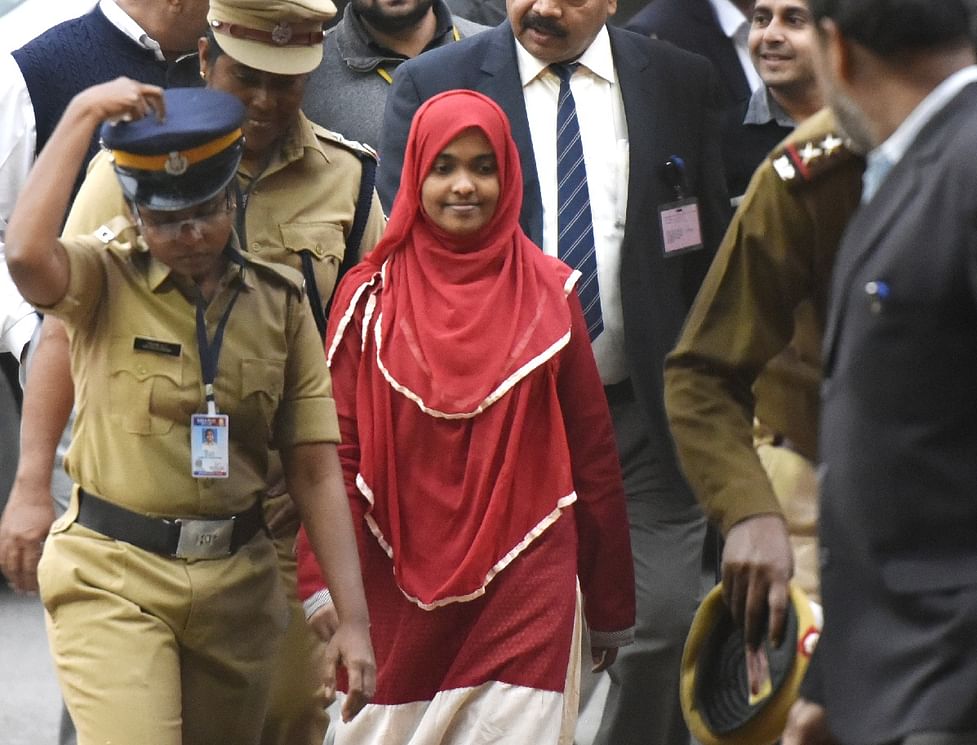
Hadiya’s case remains a cornerstone in the history of conversion, and a representative picture of the existential anxieties of converts in India today. The journey Hadiya undertook, centuries apart from the story of Cheraman Perumal is a journey also in the footsteps of many others, like the Dalit Christians of Kandhamal, whose embrace of Christianity got them dignity and access to the public sphere and sense of sociality which the Hindu caste system so brutally denied, even as many of them paid for it with their lives in 2008.
It can also be read in the footsteps of Faizal in Kerala, who too was killed for embracing Islam in Kerala by the RSS in 2016, or that of the Meos of Mewat, whose transition to Islam marks itself into the landscape of religious transformation of North India, or that of Dr. BR Ambedkar, whose transformation to Buddhism, along with his many followers, shapes a significant part of the collective, religious, and social identity of many Dalits in India today.
The bogey of love jihad and force
How is this immensely complex history connected to what is read as ‘love jihad’ today? To read ‘love jihad’ is to enter into the domain of intersections between anti-Muslim anxiety and bigotry, sexualized fear-mongering about the alleged hyper-masculinity of Muslim men, the refusal to understand the agency of women – all patched together to cover up the central question at the heart of the issue: a fear that many people and communities may reject the religion laid out for them due to the exigencies of birth and societal structure, and move into a different world – whether through the journey of seeking liberation, or spiritual awakening, or even the material and psychological needs of escaping a life of humiliation and indignity.
To silence this journey, many terms are used – like “rice bag convert”, implying that people who embrace Christianity, particularly those coming from Dalit or Adivasi backgrounds, do so merely for a bag of rice and not for any ‘real’ motive. Those using this term, however, refuse to acknowledge that if communities, en masse have left religion for another merely for a bag of rice, there ought to be a serious question on the societal practices of the former.
The events of Mappila rebellions, Meenakshipuram conversions, and other debates in the 20th century can allow us to read conversion not just as a quest for dignity, a rejection of the Hindu social order and the caste system, access to material gain, or as an aspect of broad societal change, but also in the language of ethical renewal and the discourse of piety.
One of the main accusations against anti-caste conversions has been that while there has been a search for dignity or self-respect, the conversions are deemed to be ‘insincere’ or lacking in piety. This accusation has most frequently been thrown at Dalit and tribal Christians who are called ‘rice bag converts’, thus being accused of having not just abandoned the religion of birth too cheaply, but also without any element of religiosity.
This complexity also arises from within proselytization movements, where missionaries and other agents of proselytization have expressed their anxieties over the changes or lack thereof they saw in the ‘natives’, as we read above. But it is a fact to remember as Peter Berger and Sarbeswar Sahoo note, “communities usually do not decide to first do away with their religion and then subsequently start building a new one.” This is a frequent refrain which can be found in the life narratives of converts – that conversion, in the framework of a continuum rather than a break, can look far more like a winding road than a sharp turn, with much doubling back and return even as there is significant shift and movement.
This accusation of coercion, only against certain religious communities, also ignores the fact that many communities, following diverse practices, have been ‘coerced’ (coercion apparently invisible to the makers of the current laws) into being labelled as Hindu when they are not – a claim that has been exposed repeatedly, including in recent times by the Jharkhand chief minister, Hemant Soren, who has argued that tribal people are not Hindus and never were.
Thus, while some forms of apparent coercion have been read into law in the name of illegality, bolstered by Islamophobia and anti-missionary sentiment, others remain deliberately ignored. This exposes the claim that there is a genuine interest in controlling coercion or force in the name of religious conversion and instead, makes it obvious that it is not so much force that is the object of interest, but instead, exercising control over some religions and their followers, whose historical and current existence in India is itself being questioned in the name of illegality, invasion and force, much like the reasoning behind the CAA and NRC laws.
Other accusations, including ‘love jihad’ imply that conversion, particularly when done to Abrahamic religions such as Islam and Christianity, are inherently coerced and a product of allurement (such as through love and desire), inducement (such as through monetary or material means) or the showing the fear of God and the after-life (a clause of the Freedom of Religion laws which can criminalize even basic proselytization and discussions around theology and eschatology).
These discourses, however, are not merely at the realm of society or politics, but have been enshrined into the law much before the current set of ‘love jihad’ legislation came into being – whether in the extant Freedom of Religion laws available in 7 states, or the differentiation between “Indic” and “non-Indic” religions as written into the text of the Hindu Code Bills, or the denial of the reservation to converts to Christianity and Islam but not to Buddhism or Sikhism under the Presidential Order 1950. All these clauses, in effect, do multiple things – create unequal and unfair divisions between certain religions and others, allegedly based on their region of origin (within or outside India), or the nature of proselytization (seen as inherent to Abrahamic religions but not to others), and also simultaneously, criminalize the individual’s right to free movement between faiths, despite the constitutional safeguards of ‘propagation’ of religion as a Fundamental Right.
It is also well-known that the fear-mongering around terms like ‘love jihad’ is not new, but was also well-documented for instance, in the 1920s, in Arya Samaj pamphlets which not only reviled the Prophet (peace be upon him) to stir up trouble but which also sketched the Muslim male as inherently seductive, duplicitous and lustful attempting to lure Hindu women.
In addition, conversion to Islam and Christianity not only becomes an affront to Hindu nationalism (in the name of cultural threat, population decline, love jihad), but is then formulated and legalized in the name of the sovereignty of the nation-state (in the name of public order, morality, terror links, and so on). This relationship is what makes the criminalization of conversion possible in a state that allows for, in principle, religious freedom; by establishing that religious conversion to Islam and Christianity is not merely a concern of a community or Hindu majoritarian demand (which would be harder to justify in law in a secular state), but a concern for the stability, safety and integrity of the nation-state. This could be seen clearly in how Hadiya’s conversion and marriage were dragged into the courts of the NIA, and how ‘public order’ is always invoked to evoke an image of a destabilized society when there are mass conversions.
How does one counter such deliberate misreadings and elisions over what is really, a far more complex picture, where converts are not just tools in the hands of master manipulators, but agents, both for their own religious belief, but also for their communities? It becomes incumbent upon us, as scholars, journalists, or even those with nothing more than a passing interest in faith to actively engage with the question of religion in South Asia, and how it plays out in the public sphere. While legal challenges and political resistance is the need of the hour to counter the possibilities of an ever-expanding net of surveillance and control over the religious shift, it is also important to set aside our biases and assumptions with regards to conversion and see it instead as a process which has shaped the subcontinent itself, in political, economic, social and historical ways.
Religious conversion – its depth and complexity – is being reduced to a few dog-whistle terms which tell us a lot about the fear and anxiety around conversion, but little about the difficult, intimate and often very challenging struggles of finding a new religion and the voyage that follows – state surveillance, familial rejection, the complexity of reshaping one’s life practices, fallouts with birth communities, finding access to public space, and negotiating the inner journey of piety.