

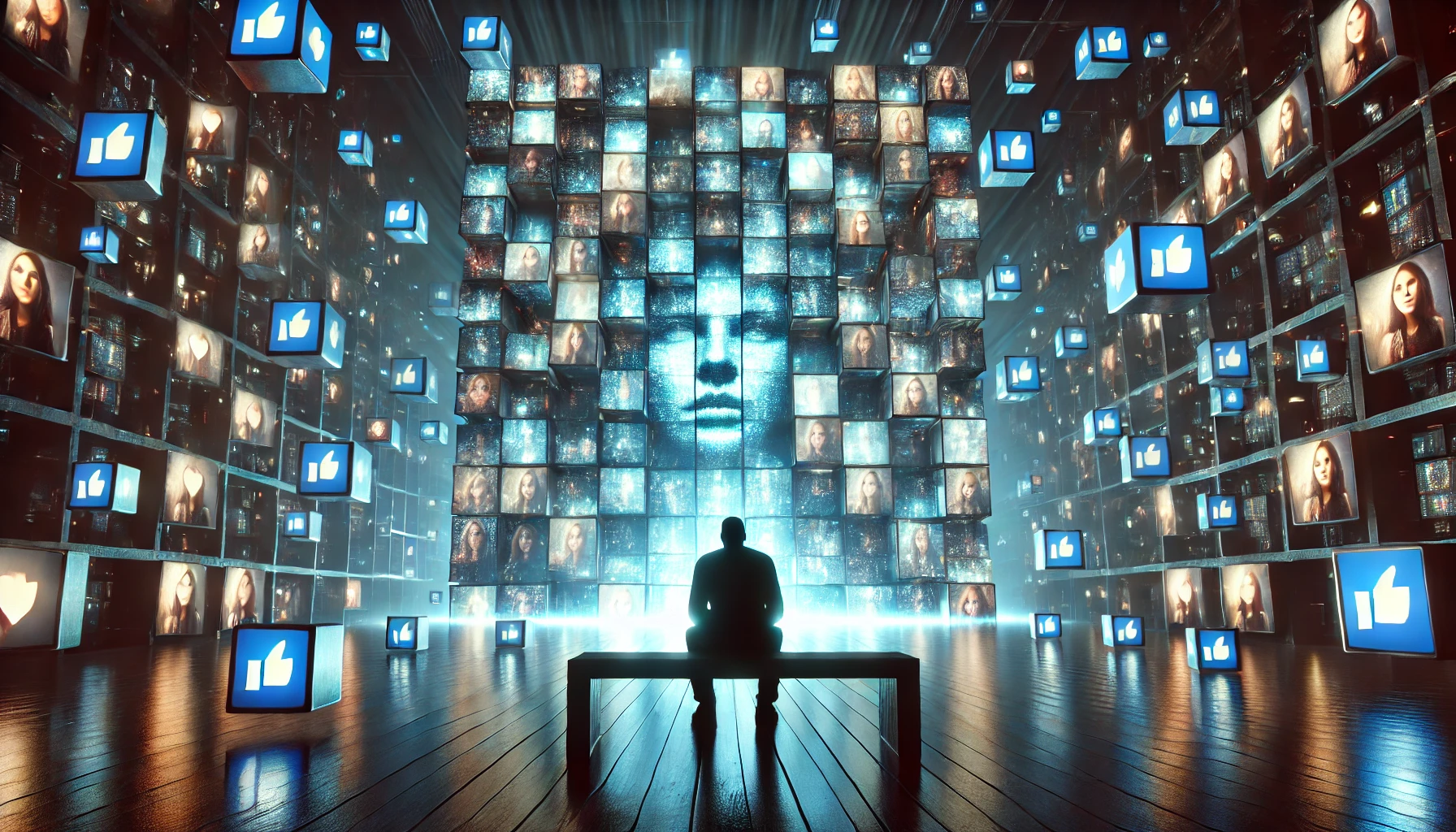
The rise of influencer culture, which has overtaken society, is a strange new phenomenon in human history. The power they wield over the masses is extraordinary. They influence public perception and stoke new conversations. This ability to shape opinions and norms is novel, in the sense that while we have always had personalities, figures, and leaders with similar influence, their prominence was due to their innate contributions to society in their respective fields. However, the sheer barrage of influencers emerging today is an unusual phenomenon. Their achievement is simply that they are famous. Being famous is the end objective. In the words of Byung-Chul Han, in his book The Burnout Society, the shift from a disciplinary society to an achievement society has propelled these so-called influencers into aspirational figures. They dictate the norms, values, and trends of society.
Many influencers also fall into the category of artists, particularly those who have made satire their area of expertise. Satire is said to be so powerful that it can bring even the most powerful dictator to his knees. It serves as a medium to challenge power and spark conversations in society. The rise of stand-up comedy, with artists such as Varun Grover and Kunal Kamra using it creatively as a tool of resistance, is commendable. Artists like Zakir Khan have explored themes of relationships and dating. However, there has also been a mindless imitation of shock-value humor, relying on cuss words for cheap thrills, which is unfortunate. As with all mediums of art and culture, the satire genre, especially at the intersection of social media and influencer phenomena, needs deeper dissection, particularly in the milieu of the controversy surrounding India’s Got Latent show.
Once the dust has settled, it gives us a window to look at the larger questions that this incident has brought to light. They say that history is one of the cornerstones of society. When we cast our eyes, a century behind we see a similar situation with Salvador Dalí and his art. His eccentric art divided people into two camps, one passionately advocating for his creative freedom and the other demanding he be shunned and exiled. We see a similar situation unfolding around India’s Got Talent crew Samay Raina and Ranveer Allahbadia. Here, I’d like to invoke one of the most influential literary figures of the past century, George Orwell, who, in his essay on Salvador Dalí, offers a perspective on how to approach such complex realities.
In this piece, I will apply an Orwellian analysis to the present situation. Orwell, in discussing Salvador Dalí, argues that the real question is not about supporting or condemning the artist, but rather understanding what led him to take up such a stance on Art and his rationale for that expression. The larger point is how society molds individuals into such figures. Thus, I propose the same thesis, that what has prompted individuals to pursue such obscene and filthy conversations. And how as a society, we need to peel off different layers making up this masquerade. Secondly, I would take The Burnout Society as a reference to show how our evolution into an achievement society from a disciplinary society has left its imprint. Thirdly, I would like to bring in Neil Postman’s Amusing Ourselves to Death, and how in the age of image and emojis, entertainment is the only currency that is leaving us morally bankrupt. And lastly, the acceptance and popularity of Hedonism as a philosophy of life have also contributed to this crisis.
Following this line of thought, I propose that rather than simply debating whether to leave the artist alone or charge him under the law, we must critically examine the factors that have led our society to this moral crisis. As elucidated earlier, let us dive deeper into the various facets which would help us unpack things coherently.
Byung-Chul Han’s The Burnout Society is an important book that gives vocabulary to comprehend the present technological society. One of his primary arguments is that we have transitioned from a disciplinary society (as described by Foucault) to an achievement society. Previously, state institutions imposed discipline to enforce obedience and curate our existence. Now, the fundamental shift is marked by projecting ourselves as achievers. The age of social media has accelerated this desire for optics, to appear successful, and to be influential as a raison d’être of existence. There is no quest for meaning, fulfillment, empathy, sense of contribution, etc., which are key traits of an egalitarian society. Unlike before, when influence was a byproduct of competence, today’s sole focus is on achievement itself. There is no longer an external institution disciplining us; instead, our own existence is driven by the need for validation.
Experiencing moments, being present in the now, is ruined by selfies, optics which in itself is the end objective. Today a visit to a restaurant, library, picnic, or even parents is not complete without a social media update. Today, one can even pay for fake social media check-ins at events like Coldplay concerts without actually attending – just to brag. The experience of music, etc. is relegated and unimportant. The experience itself has become secondary to the social proof. In order to achieve stardom, to be an influencer, to get eyeballs in the form of views, likes, and shares, there is no moral binding that is adhered to. Achievement is the ultimate objective, morals, values, etc., everything is left beyond. We need to have a serious deliberation, wherein influencers like Andrew Tate exploit this reality, brainwashing youth with short, decontextualized clips, while critical thinking and common sense fade away. Marshall McLuhan rightly said that The medium is the message. Ignoring this warning is perilous. This transformation is indeed dangerous and sets a bad precedent. Abuse, nudity, taboo subjects, and violence are all justified in the pursuit of influence and achievement, disrupting our natural disposition.
Neil Postman’s Amusing Ourselves to Death is one more important work to understand the new evolving society. He argues that in the age of images and optics, entertainment dictates public discourse. When TRP ratings and viewership numbers become the ultimate touchstone, art, aesthetics, and intellectual integrity suffer. This is a very dangerous precedent and has infiltrated every aspect of life; religion, politics, education, everything has succumbed to this monster of entertainment. So to be funny, opening any can of worms is justified. Television debates have transformed into theatrical dramas filled with abuses and verbal jousts. Reality shows, which capitalize on emotional manipulation, dominate public consciousness.
This phenomenon explains why figures like Elvish Yadav and Munawar Faruqui are celebrated as the youth’s face, while Sameer, a rat miner who saved over 42 trapped workers in Uttarakhand, remains unemployed. Celebrity influencers like Dolly Chaiwala attract mobs of fans at airports, while national hockey players go unrecognized (are sportspersons ideal or role model is up for discussion). The attempt by Ranveer Allahabadia with that question was to be entertaining. Now the real question is in this age of optics, how do we unshackle ourselves from the stronghold of celebrity influencers who have had an overarching influence on our lives? The overarching reach of social media and technology, if unchecked and unregulated, has all the ingredients for the next Hiroshima.
Hedonism as a lifestyle—Eat, Sleep, Retweet (Repeat)—has become the new norm. Indulging in whims and desires without a moral compass is a recipe for disaster. The rising breed of influencers are true messiahs of this hedonistic culture. When questioned, they say that they crack jokes to make people laugh and entertain, and inadvertently that fills their pockets. They are not concerned with any larger responsibility of an artist who plays a pivotal role in society to push the boundaries of conversation. Eleanor Roosevelt’s quote rings true: Great minds discuss ideas, average minds discuss events, small minds discuss people. If we look critically at the present discourse, it is about raw emotions, sensationalism, sexism, indecent, abuse, etc with entertainment as the center and the aspiration to be an achiever, which we have discussed above.
Gone are the days when artists aspired to be Orwell, Dickens, Premchand, Iqbal, Tagore, Kuvempu, Harishankar Parsai, or Arundhati Roy, writers who used their craft to beautify the society, for catharsis, for justice, for expression. Instead, we now see a self-centered, narcissistic, and polarized society, where moral erosion has fueled hate, vitriol, and intolerance. My larger point is that hedonistic overdrive has reclused the individual from any moral responsibilities, which in turn has infected society. The Latent Show controversy has merely exposed what has been brewing for years.
This is a very sensitive topic and a topic that is very close to my heart wherein technology, art, culture, and social reform meet at a crossroads which will define the trajectory of Human civilization. I have tried to comprehend by using Orwell as a reference who says, such incidents need to be looked beyond the individual lens as it is the expression of a collective malaise. We have explored how the shift toward being achievers has disconnected us from our natural disposition, how entertainment-driven discourse has led to a moral crisis, and how hedonism has amplified this downward spiral. Another urgent question remains: the decline of true heroes and role models who can guide society toward a better path.
And finally, how do we as a society have meaningful conversations, that initiate new conversations, hold a mirror to power, hold accountable the violence and evil perpetuated, and envision new realities. A healthy society is marked by dialogue, deliberation, and persistence, rooted in ethos and values. These ethos and values are derived from conversations in society. Thus, let us dismantle the achievement shackle, unburden the entertainment overdose, and proceed with common sense and criticality!
Until they become conscious, they will never rebel. And until after they have rebelled, they cannot become conscious. — Orwell