

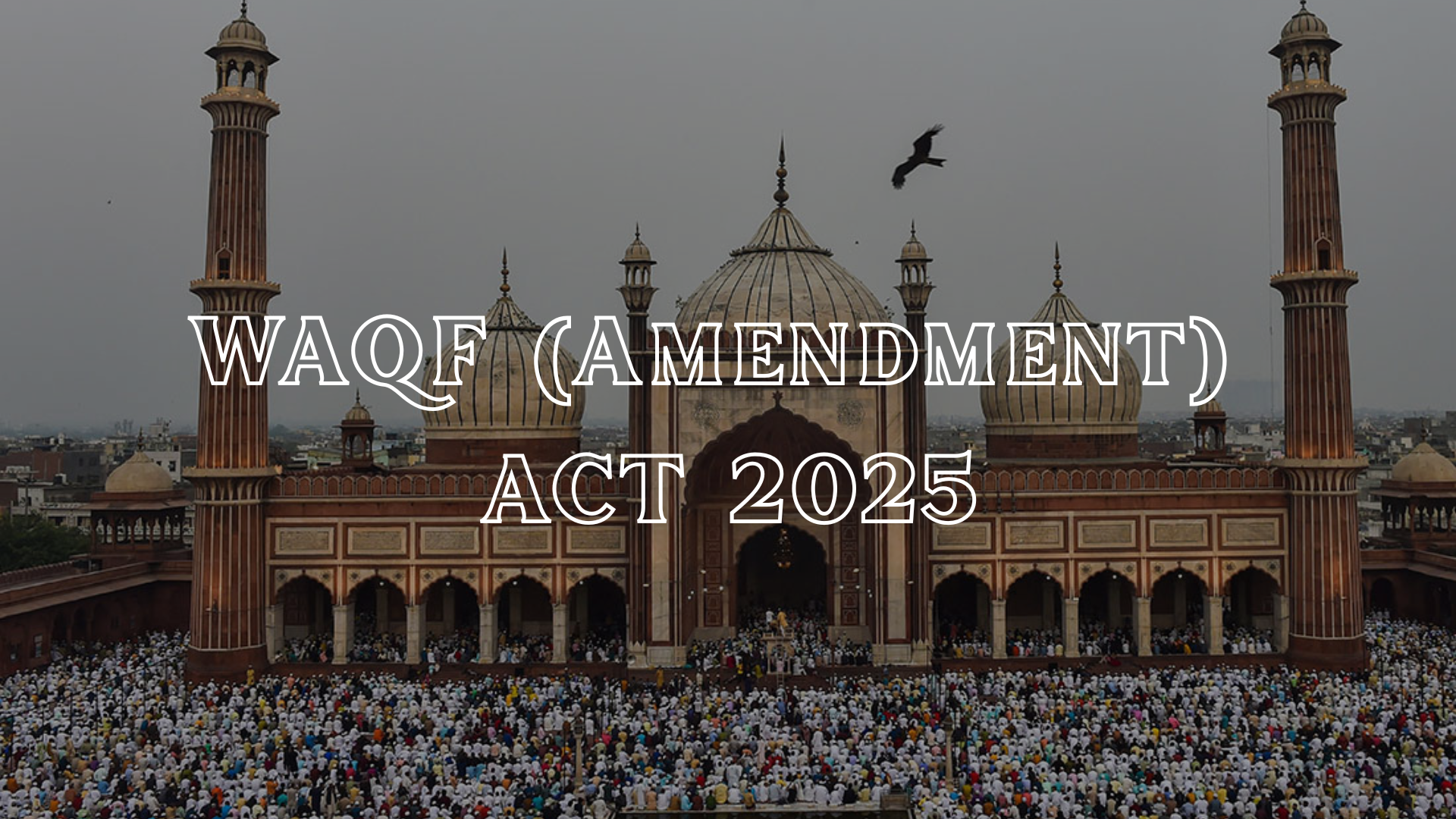
Repeat a lie often enough, and it is perceived as the truth” and under the current regime in India, it seems that repeating a lie often enough turns it into a law. On the consecutive nights of April 2nd and 3rd, while the world slept peacefully, the Indian Parliament stayed awake to pass the Waqf Amendment Bill, 2025 despite strong objections from the opposition in both houses of the parliament.
Now enacted into law, the bill pertains to Waqf, an institution that is purely religious in nature, created by Muslims for Muslims. The irony lies in the fact that the government moved forward despite unanimous opposition from the Muslim community, which raised its concerns through various platforms.
Though presented as a reform, even a brief reading of the amendments reveals that this new law will, in the long run, serve as yet another tool to marginalize Indian Muslims. Numerous reports already highlight the community’s vulnerability across multiple fronts, and this legislation now opens new doors to systematically target its religious and community institutions.
That’s why in Lok Sabha when Asaduddin Owaisi said, ‘This Bill is a declaration of war against the largest minority in India, it is an attack not just on my body, but on my freedom, my citizenship, my mosques, madrasas, and khanqas,’ he wasn’t exaggerating. With most religious institutions located on Waqf land, they are now more exposed to encroachment by both government and non-government entities.
As mentioned, Waqf is purely a religious endowment which signifies the perpetual dedication of property solely for religious, charitable, or educational purposes. It denotes withdrawing property from private ownership and consecrating it to divine stewardship. Once declared as waqf, ownership is relinquished entirely; the asset becomes inviolable, immune to sale, inheritance, or seizure. Its use is strictly confined to the purpose intended by the donor, reflecting a sacred trust between the individual and God. Even if the original objective becomes unfeasible, its benefit must continue in a related, pious direction. Jurists like Ameer Ali affirm its legal and spiritual sanctity, while scholars like Schacht and Kozlowski underline its unique evolution and irrevocability. At its core, waqf remains a solemn, unalterable act of religious devotion i.e. once a waqf always a waqf.
Once validly constituted, waqf becomes a juristic entity with a distinct legal personality, capable of owning property and engaging in legal proceedings. Rooted in Islamic tradition, it signifies a perpetual dedication of assets by a settlor under a clear and lawful title. The income generated is solely devoted to religious and charitable purposes. Managed by a custodian or authorized body, its sanctity and purpose are preserved eternally, reflecting an unbroken commitment to divine service and the community’s welfare.
It is important to be clear, that the purpose of Waqf is purely religious, even the charitable and educational purposes that may extend to all human beings irrespective of any identity is also a religious act. It is a clear concept in Islamic jurisprudence that charity is as intimate to Islam as prayer and fasting are.
The defining feature that separates a constitutional democracy from a majoritarian autocracy is its protection of minority rights. In a mere numerical democracy, the majority dictates policy, often at the expense of minority voices. But a constitutional democracy is grounded in the grundnorm—a foundational legal norm or supreme law, which in India is the Constitution. It ensures that governance is not driven by numbers alone but by principles of justice, equality, and dignity for all citizens.
In such a system, the discourse of rights, liberty, and freedom thrives only when minorities feel equally protected. The litmus test of democratic health lies in how it treats its most vulnerable, not its most powerful. A robust democracy values checks and balances, where each branch of government holds the other accountable, preventing overreach. In a constitutional democracy, everyone including minorities has an equal say in all important matters. However, the government while amending Waqf law, showed no regard for the voice of the very community to which Waqf inherently belongs. This must be concerning how specific matters of a community are being interfered with without their consent and consultation in a country that aims to work on constitutional principles.
In India, colorable legislation—laws that appear constitutional but are enacted with hidden, often malicious intent—are scrutinized and struck down. Principles like intelligible differentia, used in Article 14 for reasonable classification, ensure that laws are not arbitrarily framed but follow clear, justifiable distinctions. This legal conscience is what transforms democracy from mere rule by the majority into governance by constitutional morality. Enactment of any law that undermines and ignores the will of minorities, particularly about issues that are related to them is a step from democracy to majoritarian rule, this is why the Waqf Amendment Act, 2025 should be a matter of concern for all those who wish to see democracy thriving in India.
The Indian Constitution guarantees the right to religious freedom under Articles 25 and 26, allowing every religious denomination to manage its religious and charitable institutions, subject to public order, morality, and health. Waqf, as a purely Islamic religious endowment, is protected under these provisions. Judicial interpretations have consistently upheld its sanctity while permitting state regulation only of its secular aspects. In Shirur Mutt (1954), the Supreme Court drew a clear distinction between religious practices and secular management, affirming that the State cannot interfere in religious affairs. In Ratilal Gandhi and Govindlalji Maharaj, the Court reiterated this protection, emphasizing that the administration of religious properties may be regulated but not religious functions. In Sayyed Ali (1998), the Supreme Court held that waqf property, once dedicated, remains perpetually sacred and must be managed accordingly. Thus, Indian constitutional law upholds waqf as a sacred institution grounded in religious duty, allowing state regulation only to preserve its integrity, not to undermine its religious or charitable purpose. This balance ensures both religious freedom and institutional accountability.
The Waqf (Amendment) Act, 2025 has sparked widespread concern over potential state overreach into Muslim religious affairs. The Act introduces provisions that significantly alter the composition and functioning of Waqf Boards, challenging the constitutional guarantees under Articles 25 and 26. One of the most contentious proposals is the inclusion of non-Muslim members in Waqf Boards, which is a direct intrusion into a religiously governed institution. This move will dilute Muslim control over their religious endowments and erode the community’s autonomy in managing sacred trusts meant solely for Islamic charitable and religious purposes. Further, this is an arbitrary provision that has a poor and malicious motive. It defies logic, why a non-Muslim should be part of a purely Islamic institution like Waqf—just as it would be unreasonable to expect a Muslim to be part of a Mandir or Gurdwara committee. Religious institutions should be managed by members of their own faith, as they best understand the values, traditions, and responsibilities associated with them.
Further, it is a fundamental right of Muslims to manage and control their religious institutions. The inclusion of non-Muslims in Muslim religious institutions is an infringement of this right, which is enshrined in the Constitution. It is also arbitrary, as religious institutions of other communities are typically community-specific, and individuals from outside those communities are generally barred from participating in the management and ownership of such institutions. However, in the case of Waqf, non-Muslims are being forcibly included, which undermines the autonomy of these institutions. Religious institutions of the Hindu community even exclude Sikhs, Jains, and Buddhists from such memberships—despite the fact that, by definition under Article 25 of the Constitution, they are also considered Hindus. Yet, the government seeks to normalize the control of Muslim institutions by non-Muslims under the guise of it being beneficial for the community. This obsession of the current regime to include non-Muslims in all Muslim institutions is deeply questionable. They claim that this amendment aims to make Waqf boards more efficient—but how can the mere inclusion of individuals from other communities, by default, result in greater efficiency?
Another alarming provision is the replacement of the independent Survey Commissioner with government-appointed officials to oversee the registration and administration of Waqf properties. Such an executive will be at the direct disposal of the government and in cases where there is a dispute between the Waqf board and the state, intervention of such officials would definitely leave a large scope of biasness. Property disputes are something to be decided by the judicial or quasi-judicial bodies and there is a clear principle of natural justice that nobody can be a judge in his own cause but here, a case against the government will be decided by an official of the government appointed by the government. This shift not only centralizes authority but also opens the door to bureaucratic manipulation, which will increase encroachments, misclassification, and mismanagement of Waqf assets. By expanding state control and undermining institutional independence, the Act poses a serious threat to the sanctity, perpetuity, and religious character of Waqf. Such amendments violate both the spirit and letter of constitutional protections, it represents an attempt to dilute a fundamentally religious institution under the guise of administrative reform.
This Amendment has also abolished the concept of Waqf by user, which that time and again affirmed by the Supreme Court as a part of Indian jurisprudence. Interestingly, this is not something related to religion rather is a concept of property law and holds validity in general cases even in all other religious endowments including Hindu and Christian endowments this concept is valid. How can there be different principles for Muslims and the rest of religions?
Every regulatory and statutory authority in India has some flaws that need reform to enhance efficiency and streamline functioning. However, such reforms must not come at the cost of undermining the delegated powers enshrined in the Constitution. The said Act, rather than being a measure of constructive reform, strikes at the core of Article 25—eroding the rights it guarantees to religious minorities. More gravely, it chips away at the foundational pluralism that defines the Indian Republic. Reforms, by its very essence, must be a pursuit of improvement—not a veiled attempt to dilute constitutionally protected rights.
The saying, “propaganda is to a democracy what violence is to a dictatorship,” aptly captures the socio-political climate of contemporary India—especially in the context of religious endowments. The Waqf, a centuries-old Islamic institution rooted in charity and divine trust, has increasingly become the subject of misrepresentation and media-driven vilification. Propaganda has not only questioned the intent and legitimacy of waqf but also falsely framed it as a land-hoarding apparatus, often labeling it the “third-largest landowner in India” without credible data to support this sweeping claim. In a diversified country like India where Hindus are in majority consisting of 80% population, and where the landscape is dotted with innumerable temples- ranging from grand structures to small shrines, including those found on roadsides and even within government premises, it is astonishing as well as highly ironic to say there is no exact data on land holding by Hindu religious endowments. To counter the false and frivolous claims that waqf is the third largest landholder, it is the demand of the hour, and it is also in the best interest of justice and transparency, to have a nationwide survey and detailed report of every religious endowment without any discrimination. Only then can a fair and factual discourse be established.
What is often overlooked in public discourse is that religious endowments are not exclusive to one community—they exist across all major faiths in India. For instance, Hindu religious endowments in just four southern states—Tamil Nadu, Andhra Pradesh, Karnataka, and Kerala—collectively manage over 4 lakh temples and more than 10 lakh acres of land, according to available reports. Now, imagine if comprehensive data were available for larger northern and central states like Uttar Pradesh, Bihar, and Madhya Pradesh. The scale of property managed by Hindu religious endowments alone would be far beyond current estimates. This perspective is crucial when discussing waqf properties, which are often singled out in public narratives, despite being part of a broader and historically rooted system of religious endowments in India. Similarly, Christian institutions, especially churches and missionary bodies, hold vast tracts of land, particularly in states like Kerala, Goa, and northeastern regions. Jain, Sikh, and Buddhist endowments also operate under similar principles of permanent religious or charitable dedication.
The singling out of waqf as a “land occupier” reflects a targeted narrative rather than a factual assessment. Instead of fostering suspicion, there is a need to recognize waqf as part of a larger ecosystem of religious endowments in India—equal in legitimacy, historical continuity, and legal sanctity.
The new law, which claims to address Waqf-related issues, is more likely to worsen them. It stands in contradiction to what is being promised. The slogans of empowering women and ‘Pasmanda Muslims’ through Waqf are hollow, as the amendment fails to specify how it would meaningfully benefit any segment of the Muslim community. On the contrary, the erosion of Waqf’s autonomy will only breed internal conflict—and no institution can thrive amid internal discord.
The arbitrary provisions in the amendment open the door for both state and non-state actors to encroach upon Waqf land, impacting all Muslims, be Pasmanda or otherwise, men and women alike. If the controversial provisions of this law are not reversed or struck down by the apex court, we may in the future witness hundreds or even thousands of graveyards, mosques, madrasas, and khanqas under threat.
This is the reason we see restlessness in the community leaders and the people. Many organizations and individuals have already challenged the law in the Supreme Court whereas many community groups have called for street protests against this arbitrary law. In Uttar Pradesh, the government has begun cracking down on all kinds of protests against the Waqf law. Only in Muzaffarnagar, authorities have served notices to 300 protesters, asking for ₹2 lakh bond each after identifying them through CCTV. What could be worse than this, firstly law-making institutions pass arbitrary laws without considering the concerns of those who will be affected by it, and then law enforcement institutions attack those with draconian sanctions who voice against it, rather even against those who wear an armband. If this is what the government means by ’empowerment’ of Muslims, then yes—the Waqf Amendment, 2025, is indeed for empowerment, but not of the community it claims to serve.