

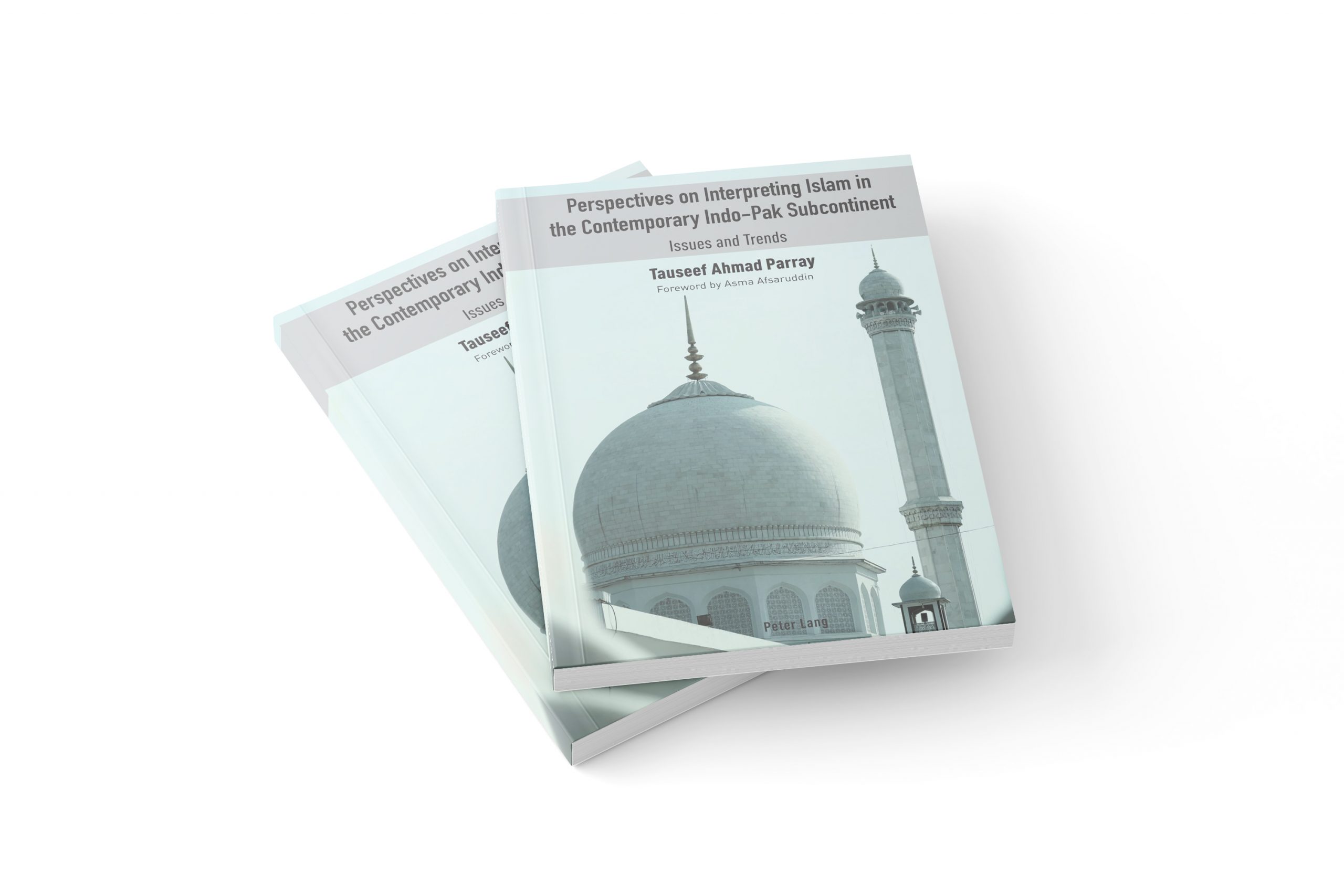
~ Dr. Parray’s latest book is a valuable resource on the 21st century Muslim intellectual trends and currents of the Subcontinent~
Historically, the Indo-Pak Subcontinent (or more broadly the entire South Asia) has served as a vibrant centre of Islamic intellectual thought characterized by its rich and evolving engagement with both tradition and modernity through diverse scholarly approaches. In the 18th century, it was Shah Waliullah Dehalvi who pioneered what later came to be known as “Muslim reformist thought/ reformism”. In the subsequent centuries, this legacy was advanced by a wide range of scholars with diverse ideological orientations, who contributed to a whole range of subjects, including Qur’anic exegesis, Prophetic biography, legal thought, Sufism, politics, gender, and other aspects.
To narrate the trials and triumphs of this legacy, numerous works have been published in the past; however, there was a need for a book focusing on the key figures and debates of the 21st century. The book under review fills that gap. It stands as a significant contribution to highlight this legacy, offering an analysis of modern Subcontinental Islamic scholarship and its global relevance. It is authored by Dr. Tauseef Ahmad Parray, who is working as an Assistant Professor (Islamic Studies) in the J&K’s Higher Education Department. An emerging scholar deeply familiar with the region’s intellectual history, he draws inspiration mainly from two recent works: Asma Afsaruddin’s Contemporary Issues in Islam (2015) and Carool Kersten’s Contemporary Thought in the Muslim World (2019), while providing fresh insights into the ongoing interplay between divine revelation and contemporary challenges.
Comprising six substantive chapters, preceded by a Preface (pp. xi-xii) and Introduction (pp. 1–11), and ending with a rich bibliography (pp. 203–231), and an index (pp. 233–240), the primary objective of this book is to examine “the recent trends and tenors that have taken place in the academic discourses on Islam and things Islamic with respect to the contributions of Muslim scholars of the Subcontinent” (p. 5).
Structured thematically, the book examines key domains such as Qur’anic studies, the Prophetic biography (Seerah), legal thought, tradition-modernity encounter, and engages with pressing debates on democracy and gender.
Chapters 1 and 2 engage with contemporary trends in Qur’anic and Seerah studies by evaluating the contributions of two prominent contemporary Indian Muslim scholars, Abdur Raheem Kidwai (b. 1956) and Muhammad Yasin Mazhar Siddiqui (d. 2020), respectively, particularly focusing on the emerging genre of “thematic studies”. The first chapter offers a descriptive and analytical account of Kidwai’s works, focusing on his engagement with key Qur’anic terms, critical assessments of English translations, and his effort to extract practical, daily guidance from the Qur’anic text. These contributions are commended for their methodological clarity, accessible style, and sensitivity to gender-neutral language. The second chapter offers an in-depth exploration of Professor Siddiqui’s significant contributions to 21st-century Seerah studies, by focusing on some selected works highlighting socio-political, legal, and economic dimensions of the Seerah. His works are marked by analytical depth, objectivity, fairness, and a robust methodological framework.
The second thematic section of the book effectively underscores the intellectual legacy of South Asian Muslim scholars—from Shah Wali Allah in the 18th century, to Sir Sayyid, Iqbal, and Fazlur Rahman in the 19th and 20th centuries, which has culminated in the 21st century with contemporary figures like Nejatullah Siddiqi and Khalid Masud. The third chapter focuses on pivotal concepts such as Islah (reform), Ihya (revival), Tajdid (renewal), Maslaha (public welfare), Ijtihad (independent reasoning), and Ijma (consensus) as mediating tools in the interaction between tradition and modernity. Rejecting the binary opposition between tradition and modernity, it persuasively argues that these categories are not mutually exclusive but can be integrated in constructive ways (p. 67). This aligns with the broader view that Islam, when properly understood, advocates change, dynamism, and progress (pp. 70–71).
The fourth chapter explores Maqasid al-Shari‘ah as a significant dimension of modern Islamic reformist thought by focusing on the thoughts of Professor Nejatullah Siddiqi (d. 2022). His contribution marks a significant milestone in transforming this discourse to a more dynamic, context-sensitive, and purpose-oriented legal framework (p. 105). He uses Ijtihad as a vital tool for interpreting Maqasid in response to complex modern realities and issues, including globalization, social justice, minority rights, and weapons of mass destruction (pp. 106, 109).
The book’s final thematic section engages with democracy and gender: two highly contested and pressing issues in contemporary Islamic thought. In the fifth chapter, Parray critically examines Islam-democracy nexus by focusing on the contributions of some key thinkers associated with influential South Asian movements, both traditional and revivalist, and how they have conceptualized and responded to this discourse, especially through the reinterpretations of Shura or mutual consultation (Quran, 3: 159 and 42: 38). Central to Parray’s analysis is the argument that within the Subcontinent context, this discourse is neither monolithic nor static; but instead reflects a rich diversity of perspectives and exhibits significant shifts and transformation over time.
The sixth and final chapter focuses on contemporary Indian Muslim scholarship on Islam and gender, critically engaging with both traditionalist and progressive interpretations. Parray examines select Urdu and English works authored by Maulana Wahiduddin Khan, Professor Kidwai, and young native scholars like Zaira Ashraf Khan. These contributions collectively aim to “draw out the real position and place as well as features of the Muslim woman’s character as outlined in the Qur’an and Sunnah” while arguing that many perceived “Islamic rulings” concerning women are, in fact, products of “social traditions” and “cultural taboos” (pp. 166, 201).
Collectively, Perspectives on Interpreting Islam is a thoughtful and thematically rich contribution that successfully foregrounds Subcontinent’s Islamic scholarship within the broader academic discourse. The book reflects Parray’s scholarly commitment to exploring how Muslim intellectuals from the Subcontinent have dealt with reconciling Islamic tradition and modern challenges. In her perceptive Foreword, Professor Asma Afsaruddin (Indiana University, Bloomington, USA) underscores that Parray’s book “sheds light on overlooked 21st-century South Asian Muslim scholars” whose efforts to reinterpret Islam for modern realities remain marginalized in Western academia; thus, filling this “lacuna admirably” (pp. ix-x).
Despite its valuable contributions, the book exhibits certain methodological limitations that constrain its analytical scope. A primary concern is Parray’s selective focus on a narrow corpus of texts and thinkers, which, while significant, raises questions about representational balance within Subcontinental Islamic scholarship. By concentrating predominantly on a handful of prominent figures, the analysis overlooks other contemporary scholars in the region engaging with parallel intellectual concerns. Furthermore, the absence of comparative engagement with thinkers beyond South Asia limits its ability to contextualize these developments within broader Islamic thought. The high price of the book is also a concern.
Nevertheless, Dr. Parray’s book is a valuable resource for scholars and students of Islamic studies, especially those interested in the intellectual trends and currents shaping 21st-century South Asian Muslim thought. By shedding light on underrepresented voices and drawing attention to themes that are both contested and crucial, Parray contributes meaningfully to the renewal and relevance of Islamic thought in a rapidly changing world.
Aadil Hussain Malik, a native of Danwethpora, Kokernag (Anantnag), is pursuing a Ph.D. in Islamic Studies from Aligarh Muslim University, India. Email: [email protected]