

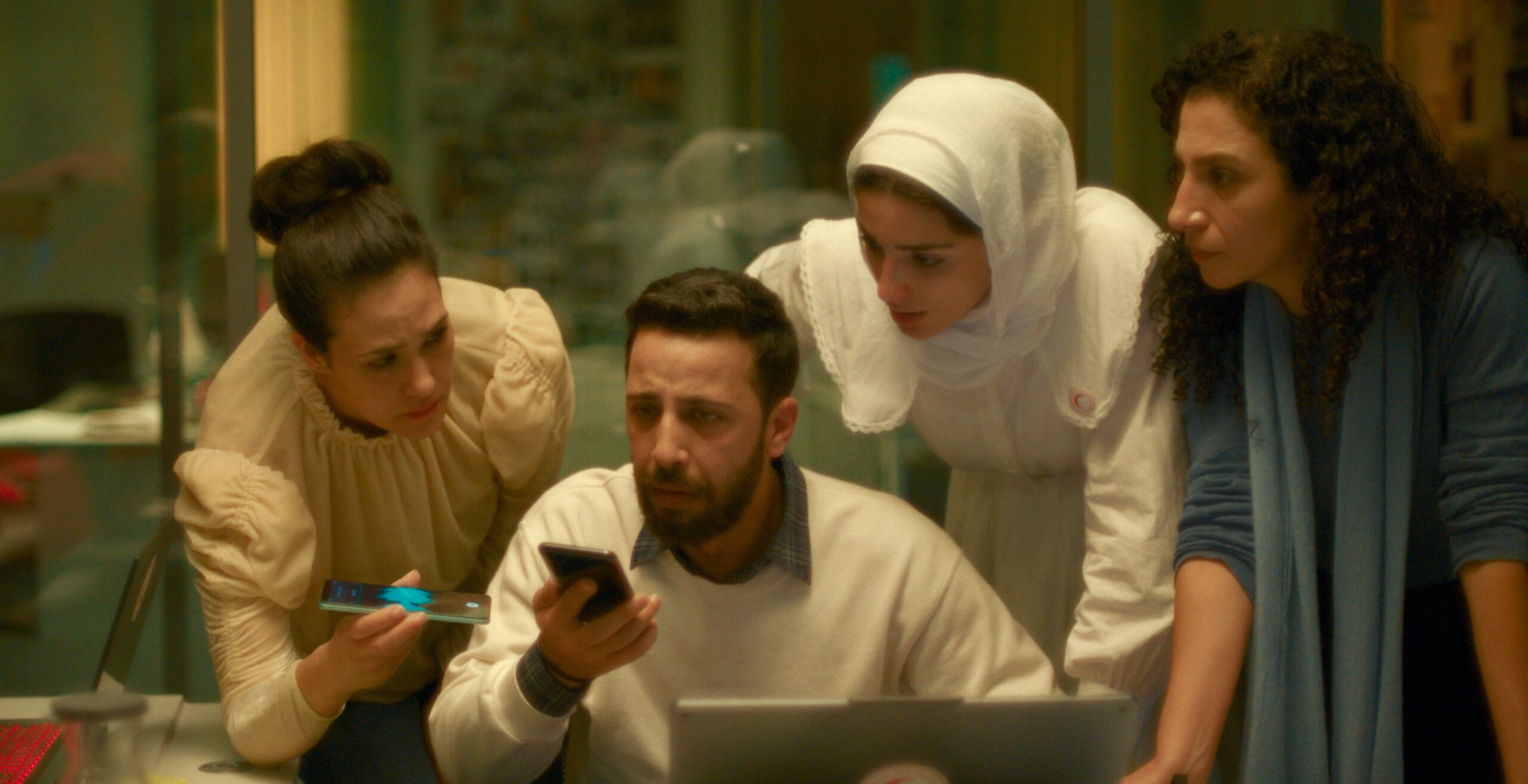
The Voice of Hind Rajab, a film by the Tunisian director Kaouther Ben Hania, demands attention, particularly now, as the CBFC has banned it from theatrical release in India.The film is about a six year old girl who was killed by Israeli forces in 2024.
The film shows how the voice of a little girl can act as a way of understanding the darkest and most brutal moments of genocide.The minimal setting is in the office of Palestine Red Crescent Society (PRCS), and the number of characters is small. But the themes carried by each symbolic element are not on a small scale. The trembling voice of Hind Rajab echoes in the walls of silence built upon the hypocritical humanitarian laws.
The title of the film ‘The Voice of Hind Rajab‘ puts forth two protagonists primarily – the ‘voice’ and then ‘Hind Rajab’. Hind Rajab, a child killed at six years old. Her real pictures are shown in different parts of the film. Not only hers, but pictures and videos of others too, to build the emotional weight on the audience. The re-creation of lived reality in the artistic form of docu-fiction draws out something close to catharsis, but Ben Hania earns it rather than simply claiming it.
The director intentionally chose not to visually depict the character of Hind Rajab. Any other child of her age could easily carry her role. But how could someone replace Hind when her childhood was not the same as other children’s? She mentioned the name of her school as ‘A Happy Childhood’. It seems satirical at first sight to name a school of children whose childhood is constantly being destroyed in the midst of genocide. More than that, it shows their manifestation of hope and desire to live a happy life. For now, their dream is only alive in the names, as the names of their school.
But does she truly belong to the category of ‘child’ as per the definition given by the authorities whose hands bear the stain of her murder? They might categorise her as part of collateral damage, damaging lives of thousands while giving vacuous reasons.
Her voice is enough to challenge them all. From the very beginning to the end, it is her voice that carries the audience through the entire system of justifications made to make the sufferings of the victims — Palestinians — tangled and inextricable within the loop.I watched the film at a screening. During the discussion, the moderator indicated the director’s choice to portray the life of Hind through the point of view of Palestine Red Crescent volunteers, as it is the most relatable emotional phase we each go through when we watch clips of children’s ruptured and murdered bodies from Gaza. Characters like Rana Hassan, Omar, Mahdi and Nisreen mirrored us at different levels.
For me, the clearest portrait of how the world responds to the genocide executed by Zionists is in a minute scene. It lasts for one minute at most. In that scene, while others in the PRCS office were in a hurry and tense to rescue Hind, a character came with his resignation. He wasn’t able to carry the turmoil of hearing the harsh realities of genocide, even for one day, so he quit. Mahdi was raising questions against his abandonment, for his own selfish peace amidst the bloodshed happening around. That scene still pierces me. The character’s face was not revealed, an intentional choice that allows us to imagine our own face in that place. While humans are suffering without an end, there are people like Rana and Omar who stand to do their part for the humanitarian cause. But the remaining part of the world is either quitting soon or accelerating genocide.
The film won the Grand Jury Prize at Venice, where it received a standing ovation reported as the longest in the festival’s recent history. It was nominated for the Academy Award for Best International Feature Film. The film might not get the recognition it deserves. The free will of people to watch a film is banned in today’s Indian democracy.
The Voice of Hind Rajab is never meant for entertainment and it doesn’t deserve to be.
Hind Rajab is still vocal through the film. If we are not listening to her, how could we question our own positionality in her death.