

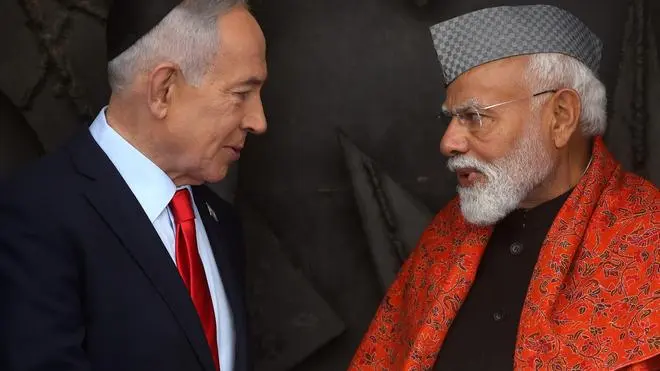
Prime Minister Narendra Modi’s recent visit to Israel further underscores the profound transformation in India–Israel relations that has unfolded over the past decade. Although India recognized Israel in 1950 and established full diplomatic relations in 1992 under Prime Minister P. V. Narasimha Rao, the relationship remained politically cautious and diplomatically restrained for many years. This restraint was shaped by India’s longstanding support for the Palestinian cause, its deep economic and energy ties with Arab states, and its broader moral and political commitments as a leading voice of the Non-Aligned Movement.
Modi’s first visit to Israel in 2017 marked a decisive turning point, signaling a shift away from India’s traditional “hyphenated” approach, in which its relations with Israel were closely linked to its engagement with Palestine. Previously, India maintained a careful diplomatic balance, ensuring that any engagement with Israel was accompanied by visible support for Palestinian leadership and statehood. In keeping with this practice, Palestinian Authority President Mahmoud Abbas visited India shortly before Modi’s Israel trip, and Modi later visited Ramallah separately to preserve the appearance of diplomatic equilibrium.
Yet, the political symbolism and sequencing of events suggested a deeper structural shift. For the first time, an Indian Prime Minister travelled directly to Israel without integrating the visit into a joint diplomatic framework involving Palestine. This was more than a matter of protocol; it was a deliberate political signal that India was prepared to engage Israel on its own strategic terms. Furthermore, India’s public criticism of Hamas reflected a departure from its traditionally cautious and balanced rhetoric on the Palestinian question. Taken together, these developments indicate a transition in India’s foreign policy from a hyphenated to a de-hyphenated framework, where relations with Israel and Palestine are no longer treated as diplomatically inseparable, but as distinct and independent strategic engagements.
Ideological Messaging and the Politics of Zionism and Hindutva
The growing relationship between India and Israel cannot be understood solely through strategic, economic, or military cooperation, as it also reflects an important ideological dimension rooted in the convergence of nationalist narratives. In the case of Israel, Zionism emerged in the late nineteenth century as a nationalist movement in response to widespread Jewish persecution and anti-Semitism in Europe. Led by Theodor Herzl, Zionism advocated the creation of a secure homeland for Jews, arguing that they could not achieve safety and political dignity as minorities in European states. While early Zionist debates considered multiple locations, the Balfour Declaration of 1916 accelerated Jewish migration to Palestine and legitimized the idea of a Jewish national home there. Zionism framed this project as a historical return to an ancestral homeland, and after the establishment of Israel in 1948, it evolved into a state-centered ideology that emphasized territorial consolidation, national security, and the protection of Jewish identity. Over time, concepts such as “Eretz Israel” or the “Greater Israel” became part of nationalist discourse, reinforcing territorial claims and contributing to the ongoing conflict with Palestinians, who experienced displacement, dispossession, and military occupation.
In the Indian context, the rise of Hindutva as a political ideology similarly reflects an attempt to redefine national identity along civilizational and cultural lines. Hindutva, articulated most prominently by Vinayak Damodar Savarkar in the early twentieth century, emphasized the idea that India is fundamentally a Hindu civilization, and that those whose religious and cultural origins lie within the Indian subcontinent form the core of the nation. Savarkar’s concept of “Pitribhumi” (fatherland) and “Punyabhumi” (holy land) suggested that national belonging was closely tied to religious and cultural geography. Although India constitutionally adopted secularism after independence, the growing political influence of Hindutva has reshaped public discourse on nationalism, identity, and security. This ideological shift has coincided with a stronger strategic and diplomatic alignment with Israel, particularly in areas such as defense cooperation, counterterrorism, and intelligence sharing.
The ideological convergence between Zionism and Hindutva lies in their shared emphasis on civilizational nationalism, historical victimhood, and the need for a strong state to protect national identity. Both ideologies portray the nation as rooted in an ancient cultural and religious heritage, and both have used narratives of past persecution to justify contemporary political and security policies. This convergence has contributed to closer political ties between India and Israel, not only at the level of state interests but also in terms of ideological affinity. As a result, the India–Israel partnership increasingly reflects a combination of strategic pragmatism and ideological alignment, shaping the nature and direction of their bilateral relations in the contemporary geopolitical context.
The Jerusalem Conundrum: A Shift in Stance
India has historically maintained a consistent position in support of the two-state solution, recognizing East Jerusalem as the legitimate capital of a future Palestine. This stance has been repeatedly affirmed by India across international forums, including the United Nations, reflecting its longstanding commitment to international law and Palestinian self-determination. However, the symbolic and political choices surrounding Prime Minister Narendra Modi’s recent visit suggest a subtle but meaningful shift in diplomatic signaling.
Notably, Modi’s presence in Jerusalem, rather than limiting official engagements to Tel Aviv, where most foreign embassies were historically located, carried significant geopolitical symbolism. His stay at the historic King David Hotel further reinforced this symbolism. The hotel itself occupies a controversial place in history: it once served as the British administrative headquarters during the Mandate period before being bombed in 1946 by the Jewish militia group Irgun, an event that became a defining moment in Israel’s struggle for statehood. Today, the King David Hotel functions not merely as a luxury accommodation but as a site deeply embedded in Israel’s national historical narrative.
The choice of this location was not politically neutral. It echoed similar symbolic gestures by global leaders, including Joe Biden, who also stayed at the same hotel during his visit, reinforcing the broader Western diplomatic acceptance of Jerusalem as Israel’s political center. This shift was further consolidated when the United States formally relocated its embassy from Tel Aviv to Jerusalem, signaling a major departure from previous international consensus.
In this context, Modi’s presence in Jerusalem and his stay at the King David Hotel can be interpreted as part of a broader diplomatic messaging process—one that subtly aligns India’s political symbolism with Israel’s claim over Jerusalem, even while formally maintaining support for the two-state solution. Such symbolic gestures, while not altering official policy declarations, contribute to reshaping international perceptions and reflect the evolving priorities of India’s strategic and political engagement with Israel.
Regional Fallout: The Shia–Sunni Trap and the Hexagon Alliance
Beyond bilateral cooperation, Prime Minister Benjamin Netanyahu’s strategic vision reflects a broader regional realignment in which India is increasingly viewed as a key geopolitical partner. In his public remarks, Netanyahu referred to the idea of a wider strategic framework often described as a “hexagon alliance” bringing together Israel, Greece, Cyprus, and India, alongside other regional and Western partners. This emerging alignment is driven by shared security concerns and the objective of counterbalancing both state and non-state actors across West Asia.
Within this strategic outlook, Israel perceives threats from multiple axes. On one side are Iran and its affiliated non-state actors, including Hezbollah and the Houthis, which Israel views as part of a broader Shia resistance network led by Iran. On the other hand, complex geopolitical tensions involving Sunni-majority states such as Saudi Arabia, Turkey, and Pakistan also shape the region’s strategic environment, even as some of these countries simultaneously maintain pragmatic relations with Israel and its Western allies.
For India, deeper integration into such a strategic alignment carries significant diplomatic risks. Historically, India has maintained balanced relations across sectarian and geopolitical divides in West Asia. Iran, in particular, has been a longstanding strategic partner, supporting India on sensitive geopolitical issues, including Kashmir, and facilitating India’s access to Afghanistan and Central Asia through connectivity initiatives such as the Chabahar port. A visible tilt toward an Israel-centric regional bloc could strain these ties and undermine India’s carefully cultivated strategic autonomy.
At the same time, India’s strong relations with Saudi Arabia add another layer of complexity. Saudi Arabia has not only been a key energy supplier but also a major destination for Indian migrant workers, making it a critical hub for remittances that contribute significantly to India’s economy. Any perception that India is aligning itself too closely with a particular regional security bloc could complicate its relations with key Gulf partners.
The Partnership: What Did India Gain?
A closer examination of the recent India–Israel engagements suggests that the visit did not produce any fundamentally new strategic breakthroughs, but rather reinforced cooperation in sectors that have already formed the backbone of bilateral relations. Key areas such as agricultural irrigation, defence cooperation, and technological collaboration continued to dominate the discussions. Israel’s expertise in drip irrigation and water management has long been valuable for India, particularly in addressing agricultural sustainability and water scarcity, and this visit largely reaffirmed those existing commitments rather than introducing new frameworks.
In the defence sector, India and Israel have maintained a robust partnership for decades, with Israel supplying surveillance systems, drones, radar technologies, and missile platforms. However, recent discussions did not indicate any major structural shift in defence cooperation. For instance, systems such as the Iron Dome interceptor are often highlighted as potential assets for India. Yet, given India’s vast geographical expanse, diverse terrain, and complex security challenges along multiple borders, the direct applicability of Iron Dome may be limited. The system was specifically designed to counter short-range rocket threats in geographically confined areas, whereas India’s security environment requires broader and more adaptable air defence solutions.
That said, it is possible that discussions focused on technological cooperation in strengthening India’s indigenous defence capabilities, particularly in relation to platforms such as the HAL Tejas. Collaboration in avionics, electronic warfare systems, and surveillance integration would align with India’s broader objective of achieving defence self-reliance under its domestic production initiatives.
In addition, labour mobility emerged as another area of engagement, with discussions centered on expanding opportunities for Indian workers in Israel. While this may open new economic avenues for India’s workforce, it represents more of an auxiliary development rather than a transformative strategic gain.
Conclusion
Prime Minister Narendra Modi’s recent visit to Israel can be interpreted not merely as a diplomatic engagement but as a powerful act of ideological messaging and symbolic political expression. The use of slogans such as “Shalom–Namaste” and the civilizational tone of the Prime Minister’s address elevated the visit beyond strategic cooperation and into the realm of cultural and ideological affinity. When the Prime Minister described India as a “motherland” and Israel as a “fatherland,” he invoked a civilizational framework that sought to construct a deeper historical and emotional bond between the two nations. His statement — “We feel your pain, share your grief. India stands with Israel firmly, with full conviction in this moment and beyond. No cause can justify the murder of civilians; nothing can justify terrorism.” — signaled an unambiguous moral and political solidarity with Israel.
However, this firm’s support also raises important questions. Israeli Prime Minister Benjamin Netanyahu has faced international scrutiny over allegations of war crimes related to military operations in Gaza, as well as multiple corruption cases domestically. The humanitarian crisis in Gaza, including the deaths of large numbers of civilians, particularly women and children, has drawn widespread global criticism. Yet, there was no visible public commentary from the Indian leadership addressing these concerns. This silence has led to debates about whether India’s traditional balanced position in West Asia is gradually shifting toward a more openly aligned stance.
The timing of the visit also adds to its symbolic political significance. Much like the “Howdy Modi” event in the United States ahead of American elections, this visit occurred in a politically sensitive period for Israel, with upcoming elections in which Netanyahu has been facing domestic political challenges. At a time when Israel has been experiencing increasing global criticism and partial diplomatic isolation, public support from a major regional and emerging global power like India carries substantial geopolitical weight.
References:
Essa, A. (2019). Hostile homelands: The new alliance between India and Israel. Pluto Press.
Prasad, J., & Rajiv, S. S. C. (Eds.). (2016). India and Israel: The making of a strategic partnership. Routledge.
Shlaim, A. (2025). Genocide in Gaza: Israel’s long war on Palestine. Verso.
Srivastava, R. K. (1970). India-Israel Relations. The Indian Journal of Political Science, 31(3), 238-264.
Kumaraswamy, P. R. (2010). India’s Israel policy. Columbia University Press.
Johny, S. (2024). Original sins: Israel, Palestine and the revenge of old West Asia. Westland Books.
Pappé, I. (2017). Ten myths about Israel. Verso.
The Indian Express. (2026, 02, 28). PM’s Israel visit frames a Delhi shift. The Indian Express.
The Hindu. (2026, 02, 27). Taking sides: On Prime Minister Narendra Modi’s visit to Israel. The Hindu.
Haaretz. (2026, 02, 26). Indian Prime Minister Modi on visit to Israel: Cooperation between the two countries in fields of trade and services will be expanded. Haaretz.
The Jerusalem Post. (2026, 02, 25). What to expect as India’s Modi visits Israel for first time since 2017 – Explainer. The Jerusalem Post.