

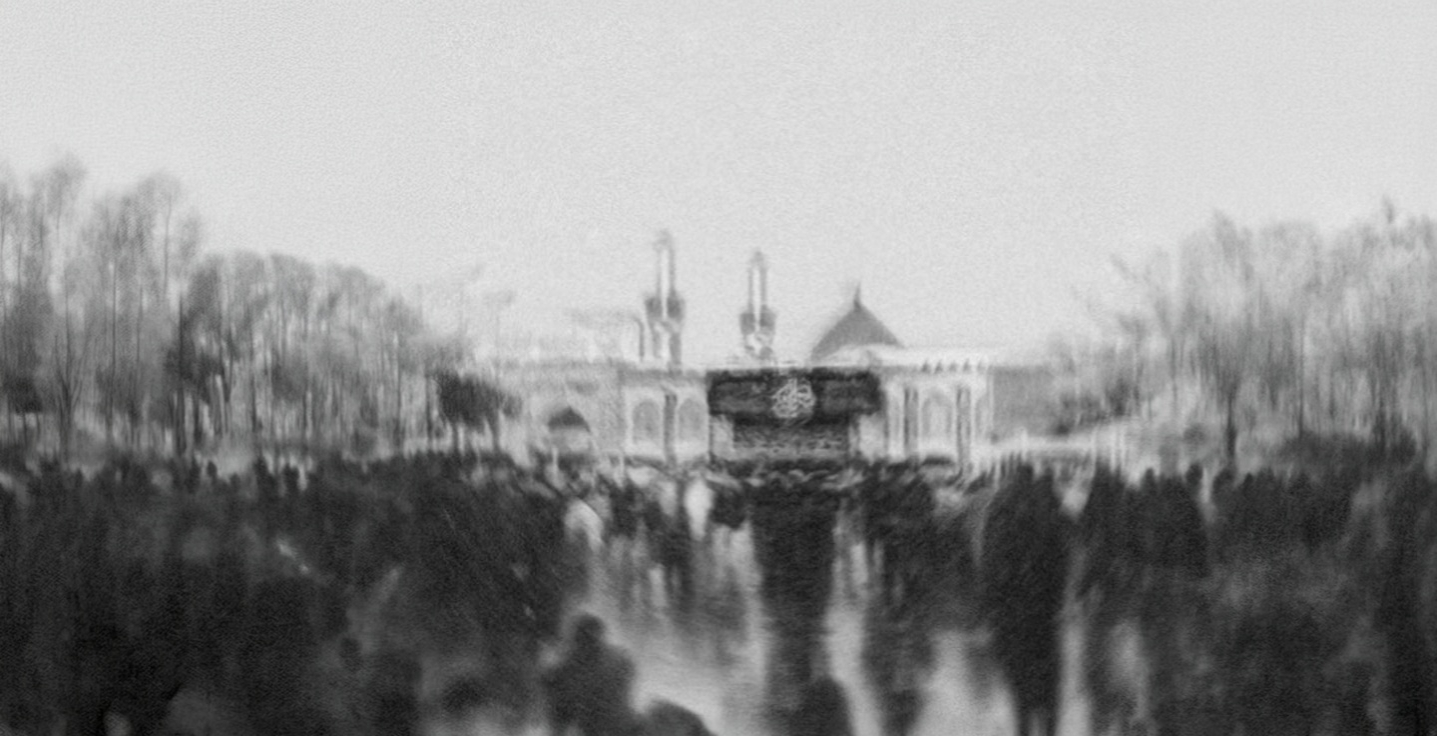
Some events in literary history transcend their spatio-temporal boundaries and transform into metaphors, going on to generate new meanings in every age that follows. Karbala in Urdu poetry is one such event. It would not be an exaggeration to say that in the collective consciousness of Urdu poetry, Karbala is not merely a historical occurrence but a living aesthetic, moral, and intellectual reference point.
In poetry, metaphor is considered the very mark of a work’s artistic ascent. When a metaphor outgrows its initial meaning, it becomes a symbol, an allusion, a fragment of cultural memory. Karbala occupies precisely this position in Urdu poetry. Here, it is not merely a war or a tragedy: the atmosphere surrounding it, its full scenario, and all its characters together hold a vast world of meaning. The conflict between truth and falsehood, loyalty and betrayal, sacrifice and coercion, thirst and the Euphrates, the tent and the spear, Imam Husain (RA) and Hazrat Zainab (RA), together these form a poetic system that has sustained and animated Urdu poetry for centuries.
Since Urdu is a language born from the womb of Indo-Islamic civilisation, the event of Karbala has been part of its literary consciousness from the very beginning. The entire tradition of the marsiya, the elegy, took shape around this event. Though the elegy began as a genre praising the qualities of the deceased, as it took root in Urdu, its centre shifted almost entirely to Karbala. Mir Anis and Mirza Dabir gave this tradition such artistic height that Karbala ceased to be merely a religious or historical subject and became part of the creative core of Urdu poetry itself.
Over time, the metaphor of Karbala took on new layers of meaning. The Euphrates became a symbol of deprivation; thirst, a metaphor for the search after truth and justice; the tent, a figure for a force that is outwardly weak but unshakeable in principle; the spear, a symbol of oppression and tyranny; blood, a metaphor for sacrifice and moral victory; and Hazrat Zainab (RA) emerged as a symbol of steadfastness and of the narrative of resistance itself. This is why the metaphor of Karbala continues to offer poets, in every age, a language powerful enough to speak to the troubles of their own time.
It is characteristic of great poetry that it keeps generating new meaning in every era, and the meaning of Karbala is of the same nature. Each age looks at Karbala anew, through its own circumstances, its own political and social context, its own moral questions. This is why Karbala in Urdu poetry is not a fixed historical reference but a living, constantly renewing metaphor.
In recent times, as tensions between Iran and the United States intensified and Iran threatened to close the Strait of Hormuz, an old line from Urdu marsiya, “the river is ours,” returned to people’s lips carrying new and deeper weight. It is no longer a claim to a mere waterway. In today’s political climate, where governments act with growing impunity, where cruelty trades briskly, where basic human rights are trampled, and power is wielded blindly, the whole metaphor of Karbala resurfaces before us in an altogether new form. Urdu poets have turned to the symbol of Karbala with renewed force against this tyranny and the oppressions of our own age.
Against the backdrop of the present regional conflict, the Iran war, and above all the martyrdom of Ayatollah Khamenei, this timeless couplet by Iftikhar Arif has gained fresh currency and become, once again, the subject on everyone’s lips:
Husain tum nahin rahe, tumhara ghar nahin raha
Magar tumhare baad zalimon ka dar nahin raha
Husain, you are no more, nor is your home any more
Yet after you, even the oppressors’ fear is no more.
This couplet shows that the reference to Karbala in Urdu poetry is not simply a historical memory but an enduring, living passion for standing against oppression and breaking the chains of fear — one that emboldens the wronged before the pharaohs of every age.
Consider, too, the lines of contemporary poet Farhat Ehsaas:
Koi darya ki taraf jaane ko tayyar nahin
Haath sab ke hain magar koi alamdaar nahin
No one is willing to walk toward the river
Hands belong to everyone, but no one is the flag-bearer.
Here, both the river and the flag-bearer are drawn from Karbala’s symbolic register, but the poet uses them to describe the moral apathy and absence of leadership in society today. Zia Farooqi strikes a related note:
Shaoor-e-tishnagi ek roz mein pukhta nahin hota
Mere honton ne sadiyon Karbala ki khaak choomi hai
The consciousness of thirst is not perfected in a single day
For centuries, my lips have kissed the dust of Karbala.
Here, thirst becomes more than physical thirst: it is a metaphor for consciousness, awareness, the search for truth. The poet binds the dust of Karbala to his own intellectual and spiritual formation.
Mustafa Zaidi strikes another similar note:
Main usi koh-safat khoon ki ek boond hoon jo
Reg-zar-e-Najaf o khaak-e-Khurasan se mila
I am a single drop of that mountain-natured blood which
Mingled with the sands of Najaf and the dust of Khorasan.
Here, blood, Najaf, and Khorasan are not mere places or objects but symbols of a historical and cultural continuity. The poet locates his own identity within this lineage of resistance, sacrifice, and loyalty.
Nandan Pandey’s couplet brings the metaphor of Karbala into view from yet another angle:
Khinch laayi janib-e-darya hamen bhi tishnagi
Ab gulu-e-khushk ka khanjar pe ram hone ko hai
Thirst, too, has drawn us toward the river
Now the parched throat is about to be quenched by the dagger
In this couplet, thirst, river, and dagger together compose a scene that recalls Karbala while also taking on a universal shape of human tragedy.
In Munir Niazi’s verse, too, the atmosphere of Karbala seems to fit the circumstances of his own age:
Zawal-e-asr hai Kufe mein aur gadagar hain
Khula nahin koi dar baab-e-iltija ke siva
It is dusk in Kufa, and there is none but beggars
No door is open except the door of supplication
Kufa here becomes not merely a historical place but a symbol of collective apathy and moral decline.
Ahmad Faraz distils what is perhaps the most important lesson of Karbala, principled refusal, into a single couplet:
Jab bhi zameer-o-zarf ka sauda ho dosto
Qaaem raho Husain ke inkaar ki tarah
Whenever conscience and dignity are put up for bargain
Friends, stand as firm as Husain’s refusal
This couplet binds the metaphor of Karbala to the ethics of the present: for Faraz, the real question is never one of power, but of conscience.
In the poetry of Iftikhar Arif and Parveen Shakir, too, the imagery of chains, imprisonment, and release is bound to this same Karbala consciousness, one that proclaims the inner freedom of the human being even in the face of captivity.
This is why Karbala remains alive in Urdu poetry. The secret of its life lies in its continuous spiritual renewal: every age turns to Karbala with its own questions and draws new interpretations from it. Urdu poetry has lifted this event off the pages of history and turned it into the enduring voice of human conscience. Perhaps this is why Karbala is not an event but a metaphor — and a metaphor of this kind does not age with time but goes on generating new meaning in every era.