

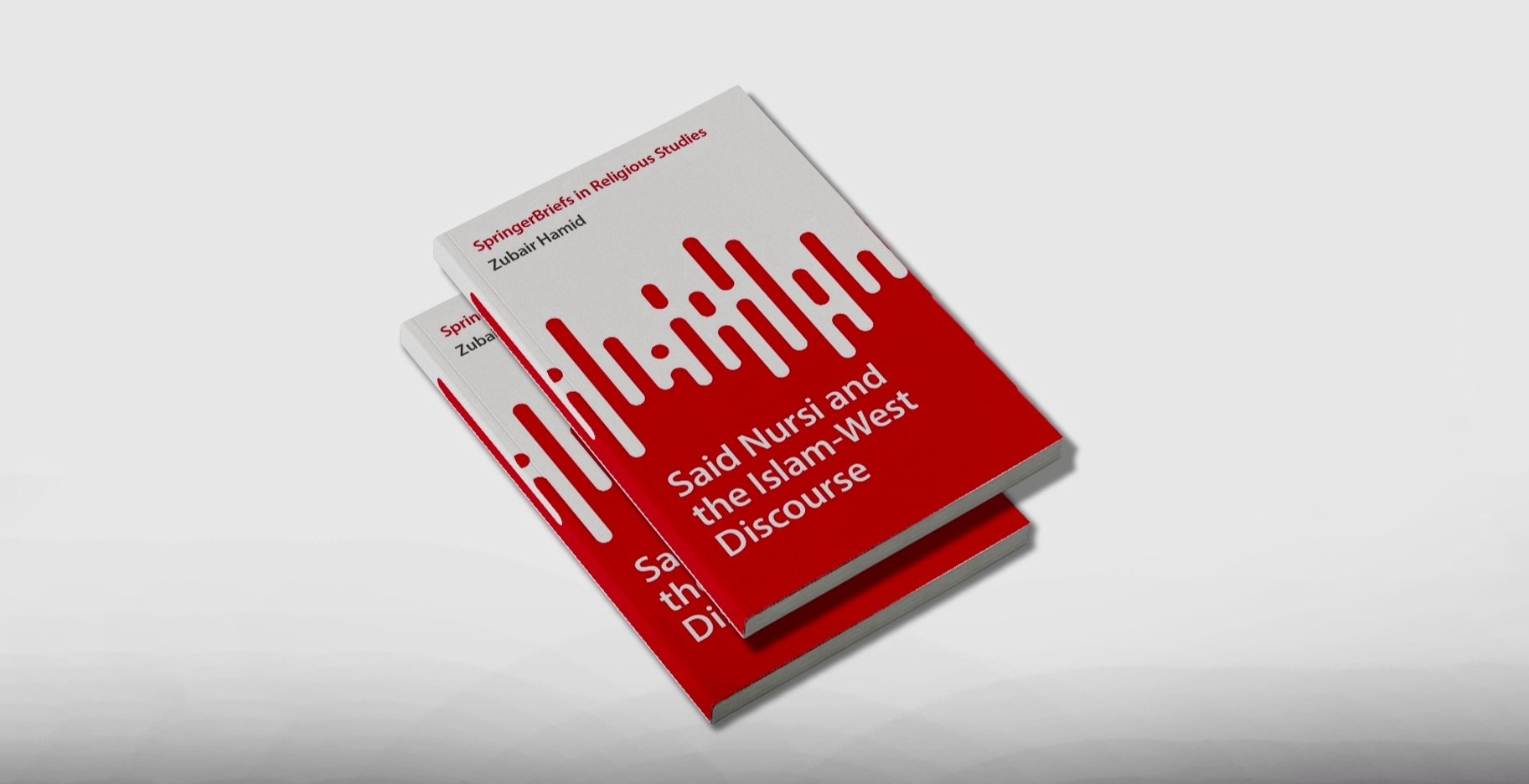
Zubair Hamid, Said Nursi and the Islam-West Discourse (Switzerland: Springer Nature, 2026), pp. xix+113, ISBN: 9783032148070, Paperback.
The encounter between Islam and the West has generated a substantial body of scholarship concerned with questions of power, representation, intellectual exchange, and religious identity. From Norman Daniel’s analysis of medieval Christian perceptions of Islam and Edward Said’s critique of Orientalist knowledge production to more recent attempts by scholars such as Bernard Lewis, John L. Esposito and Karen Armstrong to foreground dialogue and mutual influence, the field has moved well beyond simplistic narratives of conflict and confrontation. Muslim intellectuals, too, have wrestled with the challenge of Western modernity, producing a wide spectrum of responses ranging from reformist accommodation to civilizational critique. One such prominent voice is Bediüzzaman Said Nursi (1876-1960)—an influential yet underexplored Muslim intellectual of the twentieth century. It is within this broader conversation that Zubair Hamid’s Said Nursi and the Islam-West Discourse positions itself.
Published in Springer Nature’s SpringerBriefs in Religious Studies series, the book examines the thought of Said Nursi and argues that his engagement with the West represents a distinct intellectual path between rejection and assimilation. It is authored by Zubair Hamid, a Kashmir-based young academician with PhD in Islamic Studies from Aligarh Muslim University. His central contention is that Nursi responded to Western modernity not through political resistance or cultural withdrawal, but through a reconstruction of faith capable of addressing the philosophical and moral challenges of the modern age. The foreword by Ian S. Markham and endorsements by scholars including Alparslan Açıkgenç and Elmira Akhmetova situate the book within the growing international scholarship on Nursi and highlight its contribution to contemporary discussions of religion, modernity, and intercultural dialogue.
The book is divided into four chapters. The first chapter (pp. 1-24) offers a historical overview of Islam-West relations, tracing the development of the discourse from early encounters to colonialism and modern revivalist movements. Zubair Hamid rightly stresses that relations between Muslims and the West cannot be reduced to a history of hostility alone, drawing attention to intellectual, economic, and cultural exchanges that complicate civilizational narratives. While much of this material will be familiar to specialists, it provides a useful framework for understanding the intellectual context in which Nursi emerged. The second chapter (pp. 25-48) surveys major Muslim responses to Western modernity through discussions of figures such as Jamal al-Din al-Afghani, Muhammad Abduh, Muhammad Iqbal, Ali Shariati, Namik Kemal, Said Halim Pasha, and Ziya Gökalp. This comparative dimension is among the strengths of the study, allowing readers to situate Nursi within a wider tradition of Muslim reflection on modernity. At the same time, the treatment occasionally remains descriptive. A more sustained comparison between Nursi and the thinkers discussed here would have helped sharpen the claims of the book regarding his intellectual distinctiveness.
The third chapter (pp. 49-76) turns to life and intellectual legacy of Nursi, situating him within the upheavals of late Ottoman decline and the secularizing reforms of the Turkish Republic. The author presents Nursi neither as a reactionary traditionalist nor as an advocate of wholesale Westernization. Rather, he emerges as a religious reformer concerned with preserving faith under conditions of profound social and intellectual change. This chapter succeeds in connecting biography to intellectual development and demonstrates how the historical circumstances of Nursi’s life influenced his later writings. The principal contribution of the book lies in its discussion of Nuri’s Risale-i Nur and his understanding of Western civilization in the fourth chapter (pp. 77-106). The author argues that Nursi distinguished between the scientific and technological achievements of the West, which he regarded as valuable, and the philosophical assumptions of materialism and secularism, which he believed undermined spiritual and moral life. This distinction enables Zubair Hamid to move beyond the common tendency to classify Muslim thinkers as either pro-Western or anti-Western. Nursi’s position appears instead as one of selective engagement, grounded in a confidence that religious faith and reason are not inherently opposed.
Particularly noteworthy is author’s attention to Nursi’s method. Rather than focusing exclusively on doctrinal content, he highlights Nursi’s use of analogy, narrative, rational argument, and Qur’anic interpretation to address skepticism and unbelief. The analysis demonstrates that Nursi’s venture was not simply defensive but constructive, seeking to articulate a religious worldview capable of engaging the intellectual currents of modernity. The study is informed by a wide range of secondary scholarship and reflects the familiarity of the author with major contributions to Nursi studies. Nevertheless, the book occasionally relies more on synthesis than critical intervention. Although author successfully presents Nursi’s ideas and situates them within existing scholarship, there are moments when readers may wish for a more sustained engagement with unresolved questions and tensions within Nursi’s thought itself.
A further issue concerns the category of “the West,” which remains somewhat under-examined throughout the study. While Zubair Hamid acknowledges diversity within Western civilization, the analytical framework often treats the West as a relatively coherent intellectual entity. Greater attention to competing philosophical, theological, and political traditions within Western thought would have added further nuance to the discussion. Similarly, the sections dealing with Christianity and Muslim-Christian cooperation, though valuable, would have benefited from deeper engagement with contemporary Christian theological scholarship.
These criticisms, however, should not obscure the significance of the contribution of the book. Zubair Hamid succeeds in demonstrating that Said Nursi deserves to be read not only as a Turkish religious scholar responding to secularization, but also as an important participant in wider debates concerning religion, modernity, and civilization. By foregrounding Nursi’s attempt to reconcile faith, reason, and ethical responsibility, Zubair Hamid’s Said Nursi and the Islam-West Discourse offers a perspective that avoids both civilizational antagonism and uncritical accommodation. It will be of interest to scholars of Islamic thought, Nusri studies, modern Muslim intellectual history, Turkish studies, interfaith relations, and the study of religion in the modern world.