

Chashm-e-Sayyid nigran hai ke phir uthe shayad,koi deewana Aligarh ke bayabano se
As AMUSU elections approach and debates surrounding leadership and Muslim identity begin to evolve, we must dig deeper into the very foundations of our identity. What truly defines us? Is it our linguistic affiliations, regional backgrounds, gender, or the district cultural traditions that Muslims are practicing through generations? While each of these identities shape our individual and collective experiences, there is something that transcends these differences and bind us together. That unifying force is faith. It is not merely one among the many dimensions of Muslim Identity; it is the doctrine through which our identity acquires meaning, our collective consciousness.
In an environment shaped by competing ideologies, identities, and political interest, Iman, “faith”, constitutes the foundation of our collective consciousness. Beyond any regionalism, social identities, political inclinations, and ideological disagreements, it is faith that provides a fundamental point of convergence. It is the consciousness that connects students at AMU and Jamia together, and with those in Syria, Yemen, Afghanistan, and beyond. Their circumstances may differ, but faith offers a common foundation for solidarity that transcends geographical boundaries.
It is the foundation through which one can examines political realities through its own ethical and intellectual tradition. If Muslim Identity politics is to move beyond fragmented representation towards a more coherent collective vision, it must begin by asking what its faith demands of it.
If faith binds Muslims through a shared identity, what role should the university and its student politics play in developing that identity into a conscious political project? When negotiating space for Muslims, what kind of mobilization should happen that centers the role of faith? Is it enough for faith to serve as a source of unity, or must that unity find expression through the idea of the ummah and develop into a conscious political vision? Perhaps these are not separate questions but interconnected dimensions of the same process: faith provides a shared foundation, the ummah articulates a sense of collective belonging, and political consciousness gives that belonging direction and purpose. The question is then not merely how Muslim representation can be secured on campus, but what political vision should inform it and what collective aspirations it should seek to fulfill.
The Question of Muslim Representation
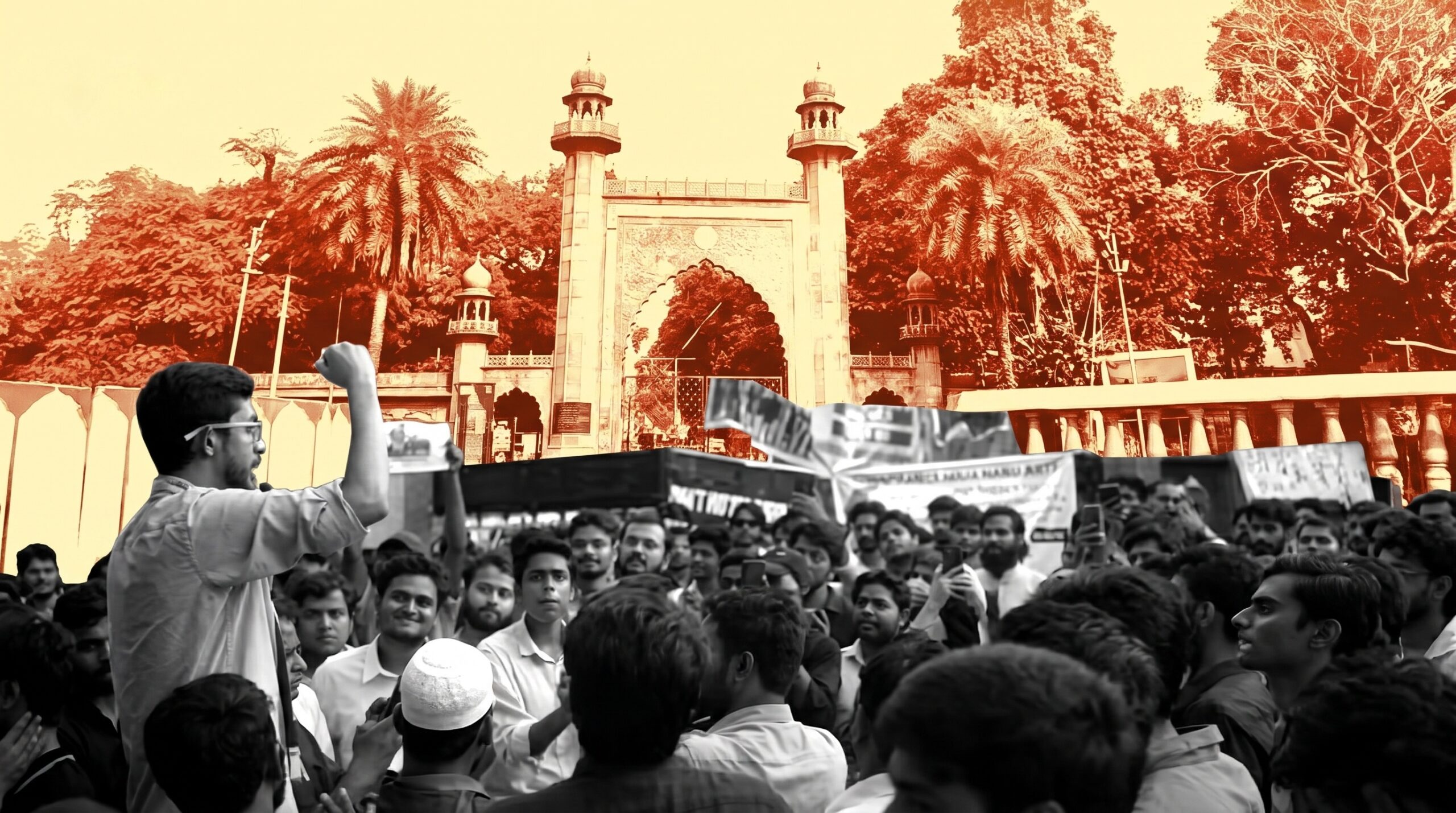
For years, the Aligarh Muslim University Students’ Union(AMUSU) has served as an important site of Muslim political representation and consciousness. Beyond functioning as an independent student body through which students can channelize their demands and grievances, it occupies a wider political space in which questions of Muslim identity, belonging, and collective agency can be articulated. Yet, an important question remains: should the purpose of this representation be confined to institutional concerns, or can it serve a larger purpose in the struggle for Muslim political representation, both within the university and in the wider context?
Representation must be examined beyond electoral victory. A candidate may win an election through regional affiliations, personal popularity, ideological alliances, or other forms of mobilization. Electoral success, however, does not necessarily translate into a substantive political vision. If the deeper questions of Muslim identity and faith remain absent from political consciousness, does it amount to anything more than representation within the existing institutional framework, without questioning the broader structures that shape the community’s political position?
Ali Shariati, viewed students as the primary drivers of political change, anti-colonial resistance, and social revolution in Iran. He envisioned intellectually awakened individuals as agents capable of interpreting their society’s historical circumstances, challenging oppressive structures, and contributing to social transformation. This perspective invites us to consider whether university students should remain confined to electoral competition or cultivate a deeper political consciousness that connects their immediate institutional concerns with wider questions of justice, power, and collective responsibility.
Another question arises is how far an external ideology should be taken into consideration when it comes to Muslim representation? The non-critical adoption of any external ideological framework as the primary foundation of Muslim political consciousness risks displacing the very intellectual and ethical tradition through which that identity seeks to understand itself. The challenge, therefore, is not to disengage from wider political thought, but to engage with it critically while developing a political vision grounded in Faith.
The Ideological Language of Muslim Representation
The question of ideological language becomes particularly significant when we consider the historical purpose of AMU. It cannot be understood merely as an institution where students acquire degrees and professional qualifications. It has always been a space that raises questions concerning justice, dignity, community, and political power. Its importance lies not only in knowledge and infrastructure but also in the kind of intellectuals it has the potential to produce. Those were the individuals who do not simply interpret the world as it exists but critically question the structures through which it is governed.
In Secular Translations: Nation-State, Modern Self, and Calculative Reason, Talal Asad examines the historical relationship between secularism, the modern state, and the ways in which human beings become legible to political authority. His work invites us to consider how administrative categories, legal classifications, and calculative forms of reasoning can reduce complex human experiences to categories that the state can regulate and govern. This offers an important point of reflection: can a political language entirely confined to the vocabulary of secular governance adequately articulate the religious commitments, collective experiences, and aspirations to Muslim students?
Language plays a crucial role in shaping political consciousness. It determines how people understand their circumstances, identify their adversaries, articulate their demands, and imagine the possibilities of collective action. Political language is never entirely neutral; it emerges from historical experiences, ideological commitments, and relations of power.
Muslim students must develop a language of their own, one that emerges from their faith, history, and collective consciousness, rather than uncritically borrowing framework from the external ideologies, no external ideology can substitute for an independent ideological foundation rooted in Islam. A movement that lacks such a foundation risk becoming reactive, shaped by the agendas and vocabulary of others rather than by its own principles and political aspirations. A revolutionary movement, after all, requires more than collective anger or shared sense of injustice; it requires a coherent ideological basis that gives direction to its struggle and meaning to its objectives.
AMU as a space of belonging: The Politics of Muslim Identity
A university is not merely an institution of knowledge; it is also a social space in which identities are negotiated, revolutions happen, and socio-political development takes place. For Muslims, worldwide, particularly in a post-War on Terror world, where Muslim identity and religious practices have increasingly become subjects of political scrutiny, the question of belonging concerns the freedom to practice one’s faith without having to constantly explain, defend, or justify it.
In this context, Aligarh Muslim University occupies a distinctive position. Its significance lies not only on its historical association with Muslim education and political consciousness, but also in its potential to provide a space where Muslim students can inhabit their religious identities without experiencing them as a source of social estrangement. This does not mean that AMU is free from internal hierarchies, contradictions, or exclusions. Rather, it suggests that the university’s cultural environment can offer a form of belonging that may be difficult to find somewhere else.
A conversation with one of my friends studying in Delhi University bought this distinction into sharper focus for me. As a Hijabi Woman, she described the discomfort of being subjected to particular gazes and the feeling of having her religious choices interpreted through assumptions about extremism. One incident stood out: when she declined to shake hands with a male senior student because of her religious convictions, she found herself being judged not only by him but also by her female friends. A personal religious boundary became a basis for questioning her social outlook and labelling her as extremist.
Listening to her experience made me reflect on the space I inhabit at AMU. Here, the practice of greeting seniors with salaam, for instance, exists as a familiar part of the university’s social culture. Religious expressions do not necessarily have to be introduced as explanations of one’s identity; they can form part of the ordinary rhythms of everyday life. For me, this raised a fundamental question: what does it mean to belong to a university where one’s faith is not automatically treated as an obstacle to social participation? The value of such space lies not in its insulation from difference, but in its capacity to make religious belonging an ordinary, rather than a constant part of university life.
However, the existence of such space should never be mistaken for its permanence. Institutional cultures are shaped by political circumstances, administrative decisions, and the presence or absence of collective student agency. The absence of an independent student’s body between the years 2019-26 makes this question particularly significant. When students lack an independent collective platform through which to articulate their concerns, the ability to defend the cultural and political space they inhabit may become increasingly constrained, a space that offers belonging is not necessarily a space whose conditions of belonging are guaranteed.
This becomes especially important when we consider how institutions invoke secularism. Secular governance is often presented as neutral, but the relationship between secularism and religious expression is more complicated. Talal Asad argues, secularism does not simply separate religion from politics; it also participates in defining what religion is permitted to look like in public life. By reading it in the context of Muslim students, this invites us to question whether religious practices are genuinely accommodated or merely tolerated so long as they remain within boundaries established by dominant social norms.
The question, then, is not whether AMU should become a space closed to criticism or insulated from the wider world. It is whether its students can retain the agency to shape the terms on which their faith, culture, and collective identity find expression within the university. Representation cannot end with the election of Muslim candidates or the presence of Muslim faces in positions of authority. If AMU is to remain a space in which Muslim students can live their faith without being compelled to justify their very presence, its political life must be capable of defending that possibility. The question is not simply who represents Muslim students, but what vision of Muslim life and political responsibility that representation seeks to sustain.
Towards a Faith-Centered Political Consciousness
Faith must shape how power is exercised, how differences are negotiated, how authority is questioned, and how collective responsibilities are fulfilled. That is why the role of students in politics is very important, where students have many roles that affect the situation in politics as agents of socio-political development.
The question of Muslim representation at AMU, therefore, cannot be confined to the acquisition of electoral power or just the presence of Muslim students in positions of authority. It must extend to the consciousness that informs this representation, the language through which it articulates its demands, and the values that guide its engagement with power. If faith is to serve as a source of transformation, it cannot remain confined to personal belief or symbolic expressions of identity. It must become a foundation for collective responsibility, intellectual awakening, and political action.
Politics rooted in faith must be measured not just by religious identity of those who occupy positions of power, but by the ethical commitments that shape their exercise of that power. It must cultivate justice, accountability, solidarity, and the courage to question the state in its own name. Without such a foundation, Muslim representation risks become another competition for institutional power, detached from the very consciousness that gives it meaning. The future of Muslim Identity politics, therefore, depends on whether faith can be translated into a collective political ethic; one that moves beyond symbolic identity, refuses the fragmentation of Muslim consciousness into competing interests, and enables students to become active participants in shaping their own political reality.