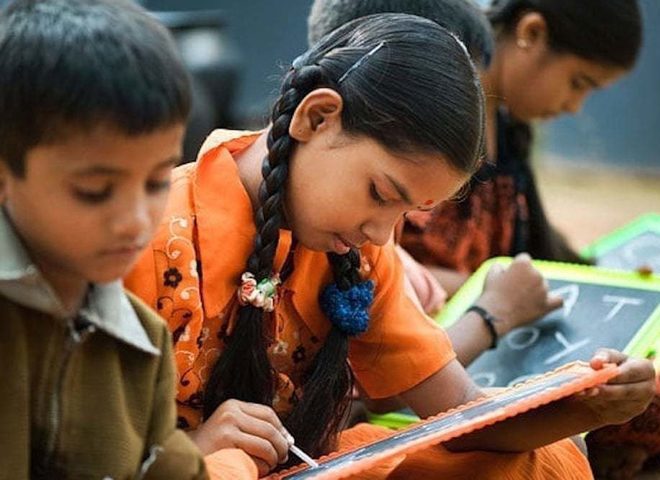
Education has always played a leading role in developing a person’s perspective of looking at life. Nelson Mandela once stated that education is the weapon to change the world. Education is one of the main factors for every individual. Most of the time children are deprived of their right to education due to financial issues or family restrictions. Right to education is a grave concern mostly among girl child. This was and still is one of the major issues in India. Though the country took a step of Right of Children to Free and Compulsory Education Act in the year 2009, we can still see many around us to whom this act has not reached yet. The government and other non-governmental organizations as well are taking up many measures to fulfill the dream of every child thinking about school and education.
Apart from making sure about compulsory education for children between the age group of 6 to 14 the government also checks upon their yearly improvements. This analysis keeps them updated about the literacy level of the country and also will help them in taking up further measures in improving the educational standards of the children and helping them climb a step ahead than they are.
Annual Status of Education Report (ASER) is one such large scale data survey which has been conducted twice so far, the latest being in 2018. The ASER survey provides findings about the enrollment status of children, and their reading and basic arithmetic abilities. It also gives us information on infrastructure of school buildings.
A total of 546,527 children in the age group of 3-16 years were surveyed in the year 2018. The survey found that more than 95% of overall students of age group 6 to 14 have been enrolled in schools in the year 2018. As the percentage of students enrolled has increased gradually the percentage of students not being enrolled in schools have decreased and were below 3% in the year 2018.
Apart from the overall student enrollment, there is also a very huge change even in girl’s enrollment in schools. Earlier women and girls who were considered to sit back at home and look after the family were deprived of their right to education. In the last decade heavy measures were taken on the issue and a drastic positive change has been witnessed. The proportion of girls of age 11- 14 out of school in the year 2006 nationally was more than 10.3%, and in most of the states the count exceeded this proportion. In the year 2018, this proportion has decreased to stand below 5%. Only in four states this proportion stands higher than 5%. This change witnessed after a decade was the result of efforts of many to develop a literate nation.
In the year 2008, the count of girls of age 15-16 not enrolled in schools were more than 20%. There is a huge difference in this proportion as well in the past decade where it has reduced to 13.5%.
As there are major differences in the enrollment of students into educational institutions, there are also differences even in the proportions of the private school enrollment. In the past decade though the private schools got an increase in the number of students enrolled of the age group 6-14, there is not much change in it from past four years. Until 2014 for a decade the proportion of students been enrolled in private schools were 30.6%, and this count has increased by only 2% by the year 2018. In states such as north-east other than Mizoram and in Jammu and Kashmir, Bihar, Gujarat and Himachal Pradesh, the survey has found an increase of 2% in the proportion of students being enrolled in private schools from 2016 to 2018. Parallel to this in states like Rajasthan, Uttar Pradesh, and Kerala a decline of 2% was recorded.
Apart from enrollment status, the ASER also collects information on the reading and arithmetic abilities of children enrolled in different classes. The ASER reading test assesses whether a child can read letters, words, a simple paragraph at Std I level of difficulty, or a ‘story’ at Std II level of difficulty. ASER found that of all children enrolled in Std VIII in India, about 73% can read at least a Std II level text. This number has remained unchanged from 2016. However, reading abilities vary markedly between government school children and private school children. Of all Std VIII children enrolled in government school, only 69% can read Std II level text, while this percentage for private school is 82%. This learning difference is an indicator of poor quality of education in government schools, an oft-repeated observation by many.
The ASER arithmetic test assesses whether a child can recognize numbers from 1 to 9, recognize numbers from 10 to 99, do a 2-digit numerical subtraction problem with borrowing, or correctly solve a numerical division problem (3- digit by 1-digit). For children enrolled in Std III, the Report found that 7.6% can’t even recognize numbers 1-9, 26.9% can recognize numbers up to 9 but cannot recognize numbers up to 99 or higher, 37.5% can recognize numbers up to 99 but cannot do subtraction, 19.6% can do subtraction but cannot do division, and 8.5% can do division. The overall performance of Std VIII in basic arithmetic has not changed much over time. Currently about 44% of all children in Std VIII can solve a 3-digit by 1-digit numerical division problem correctly. While this figure has gone down from 2016 to 2018 in many states, government school children in some states show substantial improvements in the last two years: for example, Punjab (from 48% to 58.4%), Uttar Pradesh (from 25.5% to 32%), Maharashtra (from 32.4% to 41.4%), and Tamil Nadu (from 42.6% to 49.6%).
Apart from these educational analyses done in schools for the students of age group 14-16, few practical tasks involving calculations required in daily life were also given to all the students. Calculations such as to calculate time, where to buy books if two different rates (financial decision making) are given and calculate a discount, etc. were asked. In this context of reading abilities, it was found, though the proportion of girls and boys who can read Std II level text was almost similar at around 77%, girls outperformed boys in most of the states like West Bengal, Himachal Pradesh, Tamil Nadu, Karnataka, Maharashtra, Chhatisgarh and Punjab. But for the practical tasks and basic arithmetic the number of boys performing well was more when compared to girls. But still in states like Himachal Pradesh, Punjab, Karnataka, Kerala and Tamil Nadu girls could perform better even in terms of arithmetic.
Even after 8 years of implementation of the Right to Education Act passed in 2010 for students, the facilities students should receive in educational institutions are grim. Facilities like a well-built and usable toilet for girls, boundary walls, sheds for the kitchen, textbooks and library facilities, etc should be provided under the mandate of RTE Act. The percentage of schools providing well toilet facilities has reached up to 66.4% in the year 2018. Similarly, the number of schools with kitchen shed increased from 82.1% to 91% and also the number of schools with library books has also reached 74.2% from 62.2% over the same period. Though this was a major boon to be counted in the educational sector, there are still schools in many states without some very common and important facilities like drinking water, mid-day meals, usable toilets, libraries, etc. Deficiencies are particularly marked in Jammu and Kashmir and most of the north-eastern states. In these states, less than 50% of schools had provision for drinking water or girls’ toilets available in 2018. With the exception of Assam, majority of schools in states in the north-east did not have library books available for students in 2018.