In Kashmir, freedom of expression and the press are under attack by the Indian government. Press freedom sounds like an abstract concept. Something you take for granted — until it disappears, until reporters are jailed, intimidated or murdered, until the publishers and editors buckle under pressure from their own government. Then you start to wonder what kind of world it would be if there were no press freedom. That’s not a hypothetical question. We can see for ourselves what happens. Look at the last four years in Kashmir. Journalists who have tried to cover the war, and conflicts have been harassed, attacked, and detained. Any journalist inside Kashmir must be extremely careful where they go and what they write. Brave citizen journalists have tried to fill the information gap and expose the gruesome atrocities and humanitarian disaster. But there are too many untold, searing stories of the widespread suffering and violence that are destroying Kashmir and taking so many lives. This catastrophe is unfolding largely out of sight and out of mind.
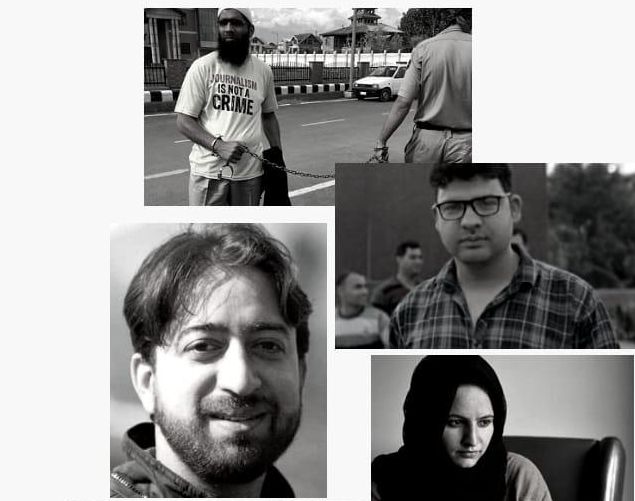
I believe that truth exists and that good journalists try to get as close to the truth as possible. They represent our best defense against disinformation, corruption and governments that want to operate behind a shroud. The regime went full-throttle, using the police, paramilitary, the courts, whatever it could, to repress journalism. There’s hate against journalists by the police in uniform”. This regime wants to destroy Kashmirian journalists, but it will be backfiring. Journalists in Kashmir will always reinvent themselves with new platforms. If anything, journalists’ voices have multiplied. They are finding one another, getting together, brainstorming on new ways to cover Kashmir. The government tries to silence them, using tools ranging from intimidation to arrest to violence. Journalists currently in jail, like Qazi shibli, Asif Sultan, and now Masrat Zahra and Gowhar Geelani were highlighted. They are journalists, not soldiers.
Efforts to undermine press freedom are sometimes more subtle. Often journalists find themselves targets of government-backed smear campaigns aimed at destroying their credibility, if not their lives.
Assaults on the media are more than just an occupational hazard. As reporters without borders point out, strategically targeting the media in an attempt “to control news and information violate[s] the guarantees enshrined in international law, in particular, article 19 of the International Covenant on Civil and Political Rights, the 1949 Geneva Conventions and the 1977 Protocols Additional 1 and 2 to the Geneva Conventions. ”Journalists are frequently threatened, physically assaulted, and jailed on trumped-up charges, including “endangering national security” or “terrorism”.
Now I want to go back into comrades like Qazi Shibli, Asif Sultan, Adil Farooq, Masrat Zahra. Qazi Shibli was detained on July 25, 2019, after he tweeted an official order regarding the deployment of additional paramilitary troops across the region. He was held without contact with his family or a lawyer until his relatives finally located him at a jail in another state two months later. On August 31, 2018, police announced in a press release the arrest of Asif Sultan, accusing him of “harboring known terrorists.” The 30-year-old journalist from Srinagar’s Batamaloo area was booked under various sections. On 20 April, Masrat Zahra, a 26-year-old photojournalist from Kashmir, woke up to learn that the cyber police had booked her under the draconian Unlawful Activities (Prevention) Act. In the press release by the Cyber Police Station, it was reported that Masrat Zahra was booked for reposting her December 2019 article on mental health crisis in Kashmir.
Journalism is not a crime. Journalism is not terrorism. Journalism is an important cornerstone of freedom. Responsible reporting about the issues that shape people’s lives is a key building block of any free society. And this freedom matters. When journalists are threatened, arrested, attacked or otherwise cowed into silence, the truth dies. It is up to all of us to keep it alive.
Journalists have the right to inform the public, for freedom of expression and to give those who go seldom unheard, a voice. But often, and especially in crime reporting, journalists come up against some serious legal problems that can impede their mission for news distribution and render their willing to speak freely, unjustified. No, there is nothing abstract about press freedom. All of us have a responsibility to fight those who try to replace truth with lies and those who try to turn journalism into a crime. We are strongest when we act in ways that respect our values. It is time to act. Those journalists who are behind bars, are languishing in jails for having committed no crime, and instead performing their obligation f informing people, and letting the truth be known far and wide.