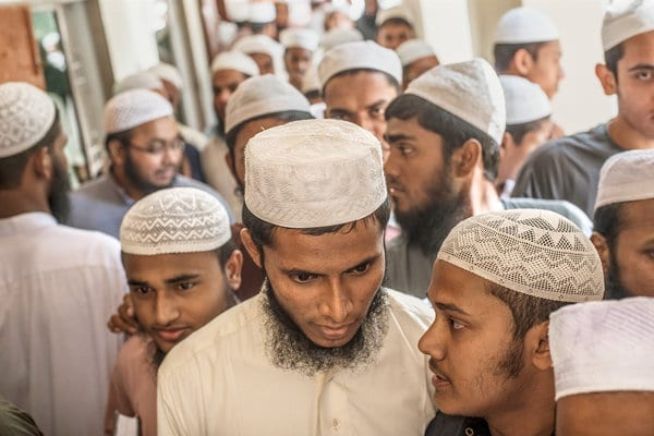
Lockdown, coupled with “Tablighi-phobia”, has proved to be a double-edged sword for the madrasa graduates, known in the society as “Hafiz Saheb” or “Qari Saheb”. The atmosphere created by over-zealous TV anchors and IT Cell-dominated social media users following Nizamuddin episode has forced them to go underground. I have interviewed nearly a dozen of them in Greater Noida city of NCR region in Delhi. They are the real sufferers with no one to shed tears for them.
A Hafiz Saheb told me that he faced a hostile crowd in a neighbourhood market where he has been frequenting for the past so many years. He was specifically told by people not to be seen in the area lest he spreads coronavirus. The Hafiz Saheb lives in the compound of a mosque situated on the main road that links Greater Noida with Bulandshahr.
Since there is no population in the immediate vicinity of this particular mosque, the management committee of the mosque has provided accommodation to him and two others for security of the mosque. After the warning, Hafiz Saheb and his companions, also madrasa graduates, have not stepped out of the compound. Now they are dependent on the night guard of the mosque, a resident of a neighbouring village, for their daily requirements.
Quran tuition is the main source of livelihood for madrasa graduates. Some lucky ones get the job of imam (prayer leader) in a mosque or mudarris (teachers) in a madrasa. Those smart enough who can manage donations venture out to launch their own madrasa. But main occupation for majority of them is Quran tuition. Muslim parents generally consider it obligatory to ensure that their children know how to read Quran. (Only read, because in majority of cases even their tutors, the madrasa graduates, don’t know the Arabic language.)
Also read | Fake News And Hate Propaganda Fuel Attacks On Muslims Across India
Another Hafiz Saheb who lives in a neighbourhood dominated by majority Hindu community was not challenged by anyone. But, according to him, just five blocks away from his building people started staring at him with suspicion. He had gone out to buy milk for his young child. But he realized it was not advisable to go further. He returned. Since then he has restricted himself to his flat. Now he calls his non-Hafiz friends to fetch him daily requirement.
Also read | Tablighi Jamat Religious Congregation: Who Is At Fault?
These two incidents were enough to send others into oblivion. Almost all of the Hafiz and Qari Sahebs I spoke to on the phone said they were avoiding public places. Majority of them said they have not gone out ever since Tablighi Jamaat was linked with COVID-19 epidemic in the last week of March.
Hafiz Sahebs are hit financially as well. Parents of their students have generally forgotten to pay them salaries. Schools, despite government warnings, are demanding and extracting tuition fees. Tutors of English and science subjects are offering their services online. Therefore, parents are obliged to pay them. Quran tutors are neither skilled enough to go online nor their services are considered that essential. Hence no work, no payment.
Story of a foot soldier
Santosh is a street vendor who used to sell bananas on his handcart in Bhangel, a small semi-urban neighborhood in Noida, U.P. But that was his story until lockdown was announced on March 24. Since then he had restricted himself to his rented room because he had no work to do and nowhere to go. Forty days later, a new chapter opened in his life. On May 2, early in the morning, his landlord asked him to vacate at once. He had not paid rent for March and April because he had no money. Apparently to compensate that, the landlord seized his mobile phone which he had bought for Rs. 10,000 just before the lockdown was declared.
Suddenly, Santosh was on the road, with an empty pocket but a stomach to fill. He had not had a full meal for the last one week or so. He has been dependent on food packets distributed by individuals or government. But their supply was not regular. In a hopeless situation like this, a man remembers only one thing: his home, which in his case was 150 km away in a village in Aligarh district of UP. But he had neither money, nor a mode of transportation. So he began his journey on foot.
When I spotted him on Surajpur-Kasna Road on May 2, Santosh had covered nearly 10 km. He was desperately signaling every vehicle passing by him. I gave him lift in my car, an inadvisable gesture in times of coronavirus scare. But sometimes situation compels you to give up precautions. Of late I have faced this compulsion a number of times.
My idea was he would get down at Pari Chowk, a usual destination for onward journey in Greater Noida. But a casual chat with him gave me the feeling that he was hungry. Since I was going to a community kitchen which some of my friends are running for free distribution of food packets, I decided to feed him before letting him go.
At the kitchen, before taking his first bite Santosh broke down. This was his first meal during the last 24 hours, he told me later. Next question was his journey. His village was more than 130 km from the place we were sitting at. Some of my friends got emotional. They started offering money. But money was not the solution. There was no transport, and no permission even if someone volunteered to drop him to his village. Despite our good intentions we could not help him further. We left him to his fate, hoping someone would come to his rescue on way to his home.
Yet another story of suffering
While announcing lockdown, Prime Minister Narendra Modi appealed to employers not to sack their employees and not to stop their salaries. Apparently, some of the employers have heeded to the appeal by half. I met four employees of a pipe factory in Begumpur neighbourhood of Greater Noida who have not been sacked, but not been paid either. The employees, belonging to Kishanganj in Bihar, told me they were paid one tenth of their March salary (Rs 1,000 each out of Rs 10,000 monthly). That’s all. No salary for April, so far. Factory owners of Noida have already said in television interviews that they would not pay April salary even if the government sends them to jail.
But employees I spoke to have been asked by the manager of the factory not to go home as their services would be required once the lockdown is over. How are they managing? “We spent whatever little money we had. Now every day we go out looking for food packets being distributed members of civil society. Sometimes we get, sometimes we don’t,” they told me.
At least one of them informed me that he had got money from home. How? Through Paytm, he said. Migrant workers at other places in Greater Noida also told me they are getting money from home. But very few have this option. Overwhelming majority of workers, especially daily wagers, are suffering beyond imagination.