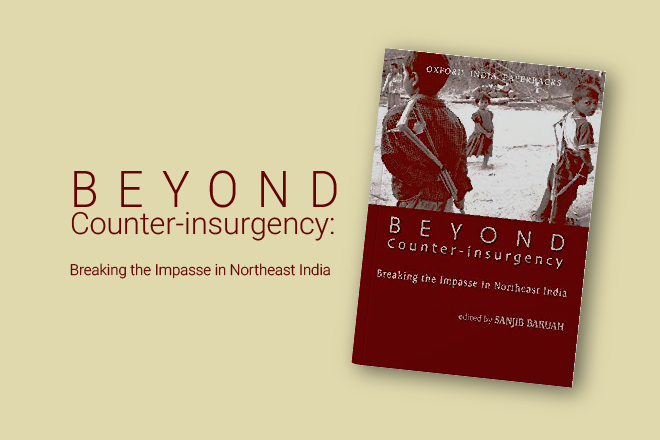
While the passing of time might have changed the Northeast’s contexts, discourses, demands, strategies, and visions, what has never changed is the stalemated nature of the region’s conflict. The region, which is known for its rich ecology and ethno-cultural diversity, has never experienced any democratic normalcy in its post-colonial existence. The state’s intransigent approach of viewing the Northeast problem as a mere security threat that could be resolved through a vehement counter insurgency plan has borne no positive results. Neither has an unrealistic perusal of a shambolic developmental policy proved to bring any positive changes in the region.
The conflict has reached a new level of impasse. It was the dissatisfaction with the existing situation that compelled the contributors of the book to take up the project of rethinking the Northeastern conflict, exploring new ways of approaching and resolving the conflict.
The book, comprising of fifteen chapters, is divided into five parts. With each part addressing an important aspect of the conflict, all the parts together provide a holistic understanding of the subject. The first part, “Stalemated Conflicts: What Cost?,” makes a riveting attempt to reconstruct the nature of the conflict and the costs involved. This smoothly transitions to the part “Nation and Its Discontents,” a part that engages with the narratives, discourses, agencies, and the imaginations constructing the nation and its discontents.
The third part, “Discourses of Inclusion and Exclusion,” engages in the proceeding to neatly map out the existing discourses and its paradoxes, calling for the need to facilitate a dialogical discourse and explore research methodologies that provide due attention to the inputs of the local actors.
The fourth part, “Making Peace, Making War: India’s Peace policy,” comprises of theoretically rich articles that offer nuanced analyses on the institutional mechanisms that operate in the Northeast. The articles in this part offer valuable and ingenious solutions to the stalemated conflict from a democratically institutional perspective.
The last part, “Breaking the Impasse,” throws light on the ingenious approaches, opportunities, and sites of discoveries that could play an important role in breaking the Northeastern impasse.
The book begins with an insightful introduction chapter written by Sanjib Baruah. Although a bit dense for an introduction, it does a fine job of incisively mapping the issues and presenting the context objectively to develop a holistic understanding of the continuing turmoil.
The article by Ananya vajpeyi used the theoretical framework developed by Amery to make sense of the heart wrenching naked protest that took place in front of the Assam riffles in Manipur. In her attempt to explain the protest movement, she also tried to capture the wretched situation the people of Northeast are subjected to. It is in this context does she believe that the only powerful form of opposition the people are left with is the act of resentment. She interprets the naked protest as a political emotion that expresses the deep-felt agonies that are deeply submerged in the hearts of people. The article’s elegant language makes it a pleasant read.
While it adopts theoretical tools that are academically in vogue, their applicability to the local Indian context is highly questionable. The article by Bodhisattva kar titled “When was the postcolonial?” makes one rethink the notion of what constitutes postcolonial in the context of the Northeast. Through an incisive historical study of the politics of inner line, Kar has been successful in bringing out the parallels that one finds in today’s politics of the inner line.
The second part consists of articles by Dolly Kikon, Rakhee Kalitha, and Nadana Dutta. Dolly kikon’s article attempts to bring out the role played by colonial ethnography and visual representation in shaping the imagination of the other, i.e., the imagination of the northeast in the postcolonial national imagination. She substantiates her argument by delineating the role played by the mainstream media, national museums, and other institutions in pushing forth a peculiar colonial imagination.
Rakhee kalitha’s article, “Writing Terror,” is a brave attempt to personalize the understanding of terrorists to engender a more empathetic outlook toward terrorism in the northeast. Her intricate attempt to personalize the conflict by reviewing the local literature not only opens the space for a dialogical discourse, but enables the unfurling of local people’s unease in naming or defining the ways of the rebels.
The next part, “Discourses of inclusivism and exclusivism,” begins with the article by Pradip Phanjobam, who neatly categorizes the prevailing discourses on the Northeast problem. By categorizing “problem” as both a subject representing the discourse of the people as well as an object representing the discourse of the Indian state, the author emphatically lists out the ways in which both these perceptions are contented in the discourses pertaining to the transforming conflicts, AFSPA, developmental politics, and the politics of legitimacy.
In his article “Preparing for a Cohesive Northeast,” Bhagat Oinam seeks to attribute a reasonable meaning to the discourse on Northeast. He takes up the intricate task of charting out the problematic discourses witnessed in the Northeast in the forms of declarative and reiterative discourses. He presents a sharp analysis to point out the distinguishing discourses that the Indian state and the protesting people represent. His analysis provides a subtle explanation on why the Northeast discourse is a deadlock.
Makiko Kimura’s article, “Agency of Rioters,” presents an extensive analysis of the Nellie massacre of 1983 to bring out the significance of agency and factors that influence decision making. Kimura arrives at an interesting position that the agency responsible for instigating the Hindu villagers and Taiwa tribals to attack the Muslim villagers was the village local authorities. Kimura is of the view that the Hindu villagers and Taiwa tribals’ perception of the other was different from that of the leaders at different levels.
In the article “The Mizo Exception,” Sajjad Hassan adopts a political historical approach to present the probable explanatory variables that help us understand Mizoram’s success in maintaining relative peace and establishing democratic institutions. Hassan attributes the Mizoram state’s success in establishing authority and control over the social forces to its colonial history. He further found the efforts put in by the state leaders during the post-independence period to reinvent an inclusive and accommodative Mizo identity to have played an important role in making Mizoram a strong state.
In his theoretically rich article “Peace sans Democracy?”, Samir kumar Das moves away from the binary discourse of viewing peace accords as democracy enabling or democracy debilitating. He makes extensive arguments to expand the definitions of accords as “complex combination of moments pointing to their inchoate and amorphous nature and it will be interesting to see how different political practices play out.” In this part’s last article, Prof. kham khan Suan attempts to understand the problem of Manipur’s conflict through the lens of the hill-valley divide, a factor that cannot be neglected when one attempts to understand the complex relationship that exists between the ethnic communities.
By mapping the existence of the state-society rupture and the hill-valley divide, he explains how each of these conditions have amplified each other. Suan’s nuanced approach to diagnose the perennial state of conflict in Manipur opened the need to consider the unique socio-political conditions of Northeast’s different states if a progressive and a fruitful strategy is to be devised to break the impasse in the Northeast.
The book’s last part has three articles. Each of them offer pragmatic solutions to the Northeast’s stalemated conflict. While presenting the case of Tripura, Subir Bhaumik focuses on the marginalization of the Tripura tribal people, which he believes to have been a result of them being alienated from their lands owing to the overbearing inflow of Bengali immigrants, which started way back in the colonial period. Basing on this analysis, he finds land settlement to be a good starting point to empower the tribals and resolve the conflict that exists between the local people and the Indian state.
While Bhamik’s candid analysis might raise a controversy in the mainland, it cannot be blindly dismissed by approaching the conflict through the lens of methodological nationalism. In the book’s last article, namely “Rethinking Delhi’s Northeast India Policy,”
Bethany Lacina puts forth a substantive case on how the counter insurgency and developmental policies have failed. Lacina calls for the need to focus on state politics to comprehensively resolve the enduring conflict. Although not an ingenious approach, Lacina’s call for establishing strong and stable institutions cannot be ignored. They might perhaps be the most important piece of the yet to be solved puzzle.
The book is indeed a fine evaluation of the health of our democratic institutions. The book’s attempt to generate new approaches and solutions to solve the impending problems is quite remarkable and refreshing. While it opened various doors to help us develop a better understanding of the problem, it also brought to focus the relationship that exists between the context and idea. As much as the articles are a complex read and lack coherency in pushing forth a central idea, they succeed in making the readers think about the conflict in various ways, fulfilling the book’s purpose of making the readers “rethink.”