Right to Education is in the news – and for slightly controversial reasons. Two separate PILs have been filed in the matter in the last two weeks by BJP leaders – one, by Javed Malik of the UP BJP Minority Morcha, and the other, by Advocate Ashwini Upadhyay (of the Jantar Mantar slogan controversy fame). Both roughly argue the same thing; that the exemptions given to minority schools in the RTE Act, 2009, deprive minority children of the fundamental right to equality, something that the NCPCR has also advocated for recently in its 2021 report, “Impact of Exemption under Article 15 (5) with regards to Article 21A of the Constitution of India on Education of Minority Communities.” In addition, the Ashwini Upadhyay petition argues for a homogenization of syllabus across the country, something minority education is seen to violate. The Javed Malik petition also argues that the alleged deprivation is ultra vires to Article 21A and Article 14. Are minority schools unfairly depriving students of the fundamental right to education, guaranteed under the constitution? We must take a deeper look into the report as well as the long-standing debates around the right of minorities to run their own institutions.
Introduction
The NCPCR (National Commission for Protection of Child Rights) Report which appeared before the public in March 2021 defines its objectives “…to ensure that the objectives are being met by the minority institutions for all the students admitted in their schools irrespective of their non-minority or minority identity, it was the view of the National Commission for Protection of Child Rights (NCPCR) that the real objective of benefiting children of minority communities by immunizing the minority institutions under Article 15(5) needed to be examined.”
But it would be myopic of us to assume that Article 15(5) has been a sacrosanct piece of law for the government. The claim of violation of Article 15 generally and Article 15(5) by the educational institutions benefitting Section 12(1)(c) of the RTE Act 2009 is flawed because, Section 12(1)(C) of RTE Act 2009 itself diluted the idea of reservation by omitting clearly specified social categories of Article 15(5) of the Constitution of India.
Isn’t RTE Act 2009 diluting the idea of reservation by changing constitutionally identified category as, “children belonging to weaker section and disadvantaged group in the neighbourhood” from “socially and educationally backward classes of citizens or for the Scheduled Castes or the Scheduled Tribes”. Even if one believe that the said social groups in the RTE Act included SC, ST, and OBC, then even after knowing the fact that the population SC, ST, OBC consists of more than 50% of the population, is it justifiable to allocate only 25% to the large population?
A long history of targeting
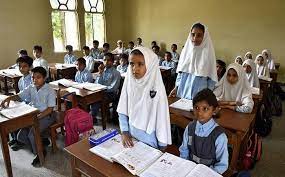
The anxiety over the lack of or denial of ‘modern education’ to students belonging to minority communities has been long brewing. This goes hand in hand with the particular focus on madrasas (seen as hubs of terror, backwardness, orthodoxy and rote learning) and more recently, Christian schools (as being hubs of conversion, even as ironically, convent schools are highly coveted and prized among all communities for their elite English language education).
The report argues that, due to the immunity provided to minority educational institutions, by citing Pramati Educational and Cultural… vs Union of India and Ors, 6 May 2014), there has been gross violation of Article 15(5). Since the focal point of the report is Muslim minorities, as well as their educational institutions and madrasas, the question becomes more relevant when one sees the current educational scenario of the community. The report itself observes that most number of ‘out of school’ children are from the Muslim community. But the report does not point fingers who are the ones responsible for this. While the minority community has been granted the right to govern and run institutions for the upliftment of their own, it does not mean that the state can evade the responsibility of its own legal and constitutional commitment to providing fundamental and basic education to all, without bias or favour.
A lack of data
The report has other, major flaws, including the lack of data. The report has observed that as a result of the exemption, “In the absence of guidelines, minority schools functioned arbitrarily, setting their own norms in terms of admission of students, recruitment of teachers, implementation of curriculum, pedagogy, etc.” Has there been extensive study to prove the claim that there is systematic deprivation? Further, if the major portion of out of school children are from Muslim community as the report rightly said, then one needs to inquire how far RTE Act has been implemented when it comes to the clauses other than reservation of 25% of reservation of disadvantaged children in private schools.
Old stereotypes in a new report
The report also reveals a hyper focus on the madrasa system, without giving adequate representation to other religions’ institutions. This is revealed further when on page 80 where the report has screenshots of fatwas. What is the significance of fatwas among Muslims, when it comes to education when there is no study to prove that choice making in terms of educational routes is heavily influenced by the scholars, who merely provide legal opinions (which are non-binding).
Instead of travelling across the country to map the madrasas the report took the easier route of conducting consultation workshops. The attendees of these workshop did not even fulfil a representational sample. Without even considering the stakeholders of madrasa education of rest of the 21 states and six union territory, how can the report come to a generalization?
Conclusion
The NCPCR report draws a link between children being ‘out of school’ to them attending madrasas (while ignoring the fact that many children attend both madrasas and other schools); it points fingers at the observation of hijab or gender segregation in some schools without establishing the extent of this or conclusively proving whether this constitutes harm to health or public morality; and it argues that minority schools do not actually teach enough minority students.
Such reports add further fuel to the fire to the pile of petitions such as the latest ones that seek to further dilute minority schooling in an atmosphere where Muslim students face various challenges, such as the recent example of Muslim girls being denied the right to observe hijab in Udupi, Karnataka, or even the targeting of many Christian schools by the Bajrang Dal as alleged hubs of conversion.