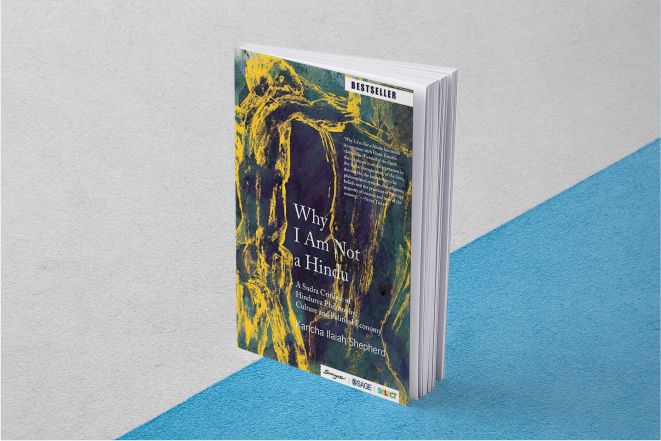
‘Why I am not a Hindu’, written by Kancha Ilahia, is a critique of the culture and economy of the Hindu upper caste from the point of view of Dalit-Bahujans’ culture and political economy. These essays are punchy, and eye-opening, and bring out the reality of upper-caste Hindus. This is an excellent book to understand the culture and differences of the Savarna community i.e. Hindus (the upper caste) and Dalit-Bahujans. Although differing in many ways, they are all considered part of a single community. Throughout the book, the author makes it clear that Dalit-Bahujans (OBC, SC, ST, and Adivasis) are not Hindus. This book is a result of the author’s personal experiences and constant interaction with the Dalits and Hindus.
As Hindutva came into the spotlight at the dawn of 1990, it was believed that anyone who is not Muslim, Christian, or Sikh is a Hindu. This notion, however, is completely false. As the book succinctly brings out, a vast majority of Dalit people are not the saviours of Hindutva, nor are they Hindus. Hinduism has no place in Dalit homes; they can’t relate to being Hindu by any means. The author narrates that during his childhood they heard about Muslims, Christians, Brahmins, and Baniyas who were different from them, and among the four categories the most different were the Brahmins and Baniyas. While they could relate with Muslims and Christians in some aspects of life, “we eat meat, we all touch each other, with Muslims we share several cultural relations” the only people that were alien from us were the Brahmins and Baniyas. But today, we are told that we share common religious and cultural relations with the latter. In contrast, the people with whom we were equal, with whom we have worked, and shared many aspects of our lives are supposedly our enemies.
Ilahia exposes some astonishing truths about Hinduism, and apart from the criticism, he puts forward an alternative ideology to Hinduization – ‘Dalitization’, which, he believes is better and more productive than Hinduism.
Throughout the six chapters, he has criticized, analyzed, and compared the ideas and philosophies of different stages of life – childhood, family life, market relations, power relations, the gods and goddess, and death that exist between Hindus (upper caste) and Dalit-Bahujans (Dalit majority), and has concluded by offering the concept of Dalitization. These chapters are the life experiences of the author and help in understanding the societal structure of India.
Kancha Ilahia says that I am not a Hindu because my parents did not know they were Hindus; the only identity we had was of our caste. Our friend circles, relatives, and playmates were all of the same caste. We were not allowed to mingle with people of other castes; we only live along with the people belonging to our caste. We were not allowed to mix with people from other castes; we could only live with people from our caste. We were not permitted to enter temples, thus we were unable to meet people from other castes, particularly the upper castes. These were the constraints imposed on us. The Bhagwat Gita, a Hindu text, was not permitted in our home; we were absolutely alien to Hinduism.
The author argues that our family system was completely different from the Hindus. The Dalit-Bahujan family is democratic; it is not patriarchal. The males and females have equal rights, women can fight back against their husbands and they have a right to re-marry after their husbands’ death. Men and women contribute equally to the production process. In contrast, the Hindu family is hierarchical, girls must obey boys, children must obey elders, a father can abuse the mother but she can’t respond, she is not supposed to retort, there is no right to remarriage, a girl is taught to prepare food according to the taste of male members, and so on.
Further, some of the Dalit castes teach their children to obey and pretend to shiver or shake before the upper caste master so that he might get his salary or wages properly. This childhood pretence later develops in one’s behaviour. On the other hand, the upper caste children are taught that they ought not to be involved in field-related work as this is for Shudras, whom they must treat as untouchables and ugly.
While discussing the cultural values, morality, and ideals of Dalit-Bahujans and Hindus, the author raises some fundamental questions, such as, “If we are to choose which culture or values we should follow, should we choose the one that is humane and democratic or the one which is undemocratic, inhuman and unequal?”
Ilahia asserts the fact that Hindu personality is made out of decadent spiritualism. In Hindus, the market, marriage, manhood, and womanhood are structured in irrational forms, and Hindu values mould individuals who cannot tolerate the spiritual equality of others. He says that ‘if Hinduism were to establish even within the spiritual domain, it would have become a universal religion much before Buddhism, Christianity, and Islam. But the family structure that was established repelled humans instead of attracting them. It established a market system that violated human beings. The Hindus were the only people who converted the spirituality and promise of redemption in the other world into their private property of only Brahmins, Vaisyas, and Kshatriyas. These aspects make religion completely vague.
Ilahia says that modern India is an extension of rural India. He explains how modern India is working according to the ‘Varna system’. How, after independence, the Brahmins and Baniyas acquired hegemony over the politics and economy of the country while Kshatriya and neo-Kshatriyas were in law-making, while the Dalits were subjected to labour. The upper caste maintained its dominance over the most powerful positions.
In his analysis, he put forward how the Brahmanical patriarchy operates. It is done by conditioning two mentalities – one that can control, manipulate, and structure, and another that can be controlled, manipulated, and structured. And this does not provide scope for questioning, debate, and discourse. This authoritarian patriarchy is maintained in their house and as well as in society. Throughout this period, they manipulated the Dalit mind and controlled them.
Even today, discrimination is evident in society because that is what the framework of Hinduism is. The author claims that no amount of scientific education and western exposure can change Hindus into rational beings; modern science does not make any impact on their reason. According to him, they have never lived amidst the productive fields; they have never experienced the life of the average working Indian. Hence, they do not understand the value of knowledge that emerges from work.
Even the gods worshipped by them are different, Hindus have different gods and Dalit-Bahujans have different ones. He points out that violence has been Hinduism’s principal mechanism of control which is the reason why many Hindu gods were weapon-wielders in direct contrast to the gods of other religions. “The relationship between their gods and us is of oppressor and oppressed, the manipulator and the manipulated.” chapter five is very unique as it provides history and distinctive information that blows one’s mind about the Hindu gods.
The author, after exposing Hinduization and how it will affect the people of India, gives the theory of Dalitization. He writes, “We reject Hinduization as Hinduization has never been a humane philosophy – it is the most brutal religious school of history of religion has witnessed. He claimed that the dalit-bahujans are a living evidence of the brutality of Hinduism and even if Hinduism expresses a desire to humanize itself in the future there is no scope for it, and its history is coming to an end. We must therefore Dalitize our society as Dalitization will establish a new egalitarian future for Indian society“.
This book is written by a person who has faced atrocities and discrimination by the upper caste. Therefore, the hostility he harbors toward Hindus is evident in his writing. It demystifies Hinduism by explicating its core beliefs and principles, illuminating the religion for what it really is.