One of the economic challenges before modern global economies, especially during post Covid-19 period, is inflation – the rising prices. The central banks around the globe are trying their level best to control the rising prices. The Reserve Bank of India (RBI) and the Government of India (GOI) have adopted an inflation-targeting mechanism to deal with this problem since 2016. According to this policy, the RBI is expected to ensure that the medium-term inflation rate should be 4 percent within a band of +/- 2 percent. According to Monetary Policy Statement issued in February 2023, the Consumer Price Index (CPI) inflation was 5.7 percent for the month of December 2022.
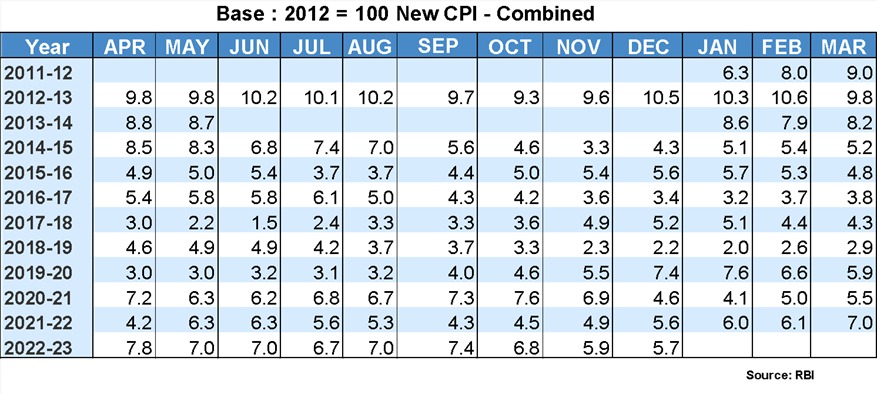
As per the CPI monthly data published by RBI for the period April 2012 to December 2022, the highest inflation rate of 10.6 percent was noted in the month of February 2013 and the lowest of 1.5 percent in June 2017. The average inflation rate for the period 2012-2022 was 5.7 percent with a standard deviation of 2.15 percent. This data indicates a high volatility in the inflation trend during 2012-2022. If the period post-inflation-targeting policy, i.e., April 2016 to December 2022, is considered then the highest inflation rate of 7.8 percent was noted in the month of April 2022 and the lowest of 1.5 percent in June 2017. The average inflation rate during the period 2016-2022 is 4.9 percent with a standard deviation of 1.6 percent. This means that during 2016-2022, the inflation was comparatively moderate and less volatile. However, during this period, for around 24 months (which is 30% of the total period in months), the inflation was not in the range of the medium-term target (of 4 percent within a band of +/- 2 percent). It means the RBI has to work more on bringing inflation into the targeted range with stability. Please refer to Table-1 below for more information.
The CPI index is usually known as Headline Inflation or General Inflation. However, the inflation is also measured in terms of Core inflation, Food & Beverage inflation, Non-food & beverage inflation, Consumer Food Price inflation, etc., depending upon the type of the commodities or services included and indicates the inflation with respect to such commodities or services. This article includes a brief comparison between CPI and Consumer Food Price Index (CFPI). Unlike CPI, which indicates the rising prices of all the general goods and services (included in the index), CFPI is a measure of change in retail prices of only food products. This comparison would give the reader an idea about the trend in rising prices of food products and how it is impacting headline inflation (CPI).
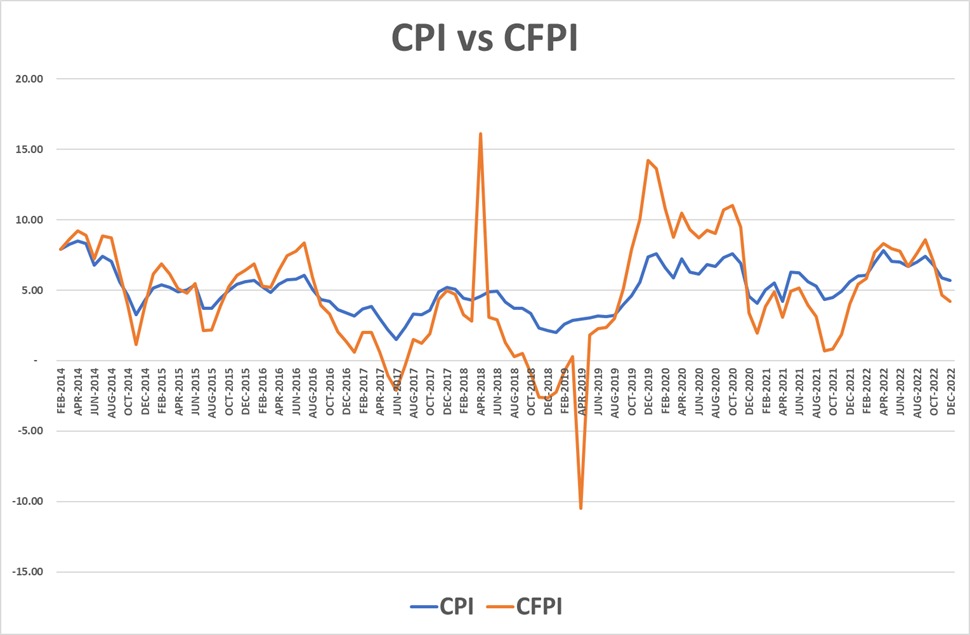
As per the data available for February 2014 to December 2022, the highest inflation rate in the case of CPI was 8.48 percent whereas in the case of CFPI, it was 16.12 percent. The lowest rate in the case of CPI was noted as 1.5 percent whereas in the case of CFPI, it was -10.50 percent. The standard deviation for the CPI index for the period is 1.60 percent whereas for CFPI it is 3.97 percent. In terms of average, however, the CFPI was lower at 4.78 percent than the CPI index having 5.08 percent. The figures reflect that the CFPI was more volatile in comparison to the CPI index. It means the prices of food products were more volatile than all the general goods and services. Please refer to Graph-1 below for more details.
Conceptually, inflation is the result of the cause-and-effect relationship between various factors. At a macro level, it is either a result of a rise in aggregate demand or a failure of aggregate supply, or both. On the demand side, the rapid growth of the population, increase in incomes, rising of non-development expenditure of the government, deficit financing, and increase of money supply are prominent factors often taken into consideration. On the supply side, inadequate production, speculative holding of stocks, and high-priced imports are considered significant factors. Due to the interdependency and connectivity of these factors and the inherent circular flow that exists in the economy, dealing with the problem of inflation in a large economy like ours is too difficult. It becomes tougher in a situation where the domestic economy is integrated with global economies in such a way that the policies of the global economies such as rising crude oil prices, disturbed supply chain, etc., have a direct or indirect impact on the domestic economy.
In the past, RBI (and GOI) has constituted a couple of high-level committees such as the Chakravarty Committee, Narasimham Committee I & II, and Urjit Patel Committee to draft strategies to deal with this issue. The policy of inflation targeting is the outcome of the Urjit Patel Committee.
Inflation, if not in the targeted range, is harmful to the economy from various aspects. For example, it will reduce the amount of disposable income in the hands of both individuals and organizations. This would further lead to low consumption and production activity. Moreover, it would adversely affect the saving behavior and investment activity in the economy. Besides, the low production activity would lead to the low export and high import affecting the balance of payment. Inflation act as two blade sword, where it is affecting the present consumption level, on the other side it is also affecting the production level in the economy. Hence, if this problem is not dealt with properly then the whole economy may go into recession.
As mentioned above, inflation is either a result of a rise in aggregate demand or a failure of aggregate supply, or both. Hence, in order to bring equilibrium, policymakers need to work on both demand-side and supply-side factors. Most important among these factors which require policy maker’s attention is the excessive supply of money, the increasing velocity of money (the frequency with which the money changes hands), the rising level of GOI deficit financing, and inadequate production (due to Covid-19), and low level of supply of goods and services (due to global geo-political issues and disruption in the global supply chain).
In view of inflation being a complex and dynamic phenomenon, finding a one-shot strategy or a single concrete model to deal with it is impossible. Nevertheless, the role of RBI and GOI in controlling the rising prices is commendable. However, it should work more on bringing the inflation in targeted bandwidth with low volatility. It is because, the stable prices in the economy would boost the confidence of the investors, producers, and consumers leading to more economic activity and more economic development.
The Author is currently an Associate Professor at Amjad Ali Khan College of Business Administration, affiliated with Osmania University.
Bibliography:
Agarwal, A. N. and Agarwal, M. K. (2023). Indian Economy: Developments, Problems and Policies (44 ed.). New Delhi: New Age International (P) Ltd. ISBN 978-93-93159-73-1.
Mahajan, M. M. (2020). Indian Economy (1 ed.). Noida: Pearson India Education (P) Ltd. ISBN 978-93-593-4063-8.
Monetary Policy Statement (February 2023). Reserve Bank of India. Mumbai. Available on: https://rbi.org.in/Scripts/BS_PressReleaseDisplay.aspx?prid=55178
Puri, V. K. and Misra, S. K. (2021). Indian Economy (39 ed.). Mumbai: Himalaya Publishing House (P) Ltd. ISBN 978-93-5495-118-3.
Website: https://rbi.org.in/
The above article was earlier published in Urdu on Raafeeq-e-Manzil: https://rafeeqemanzil.com