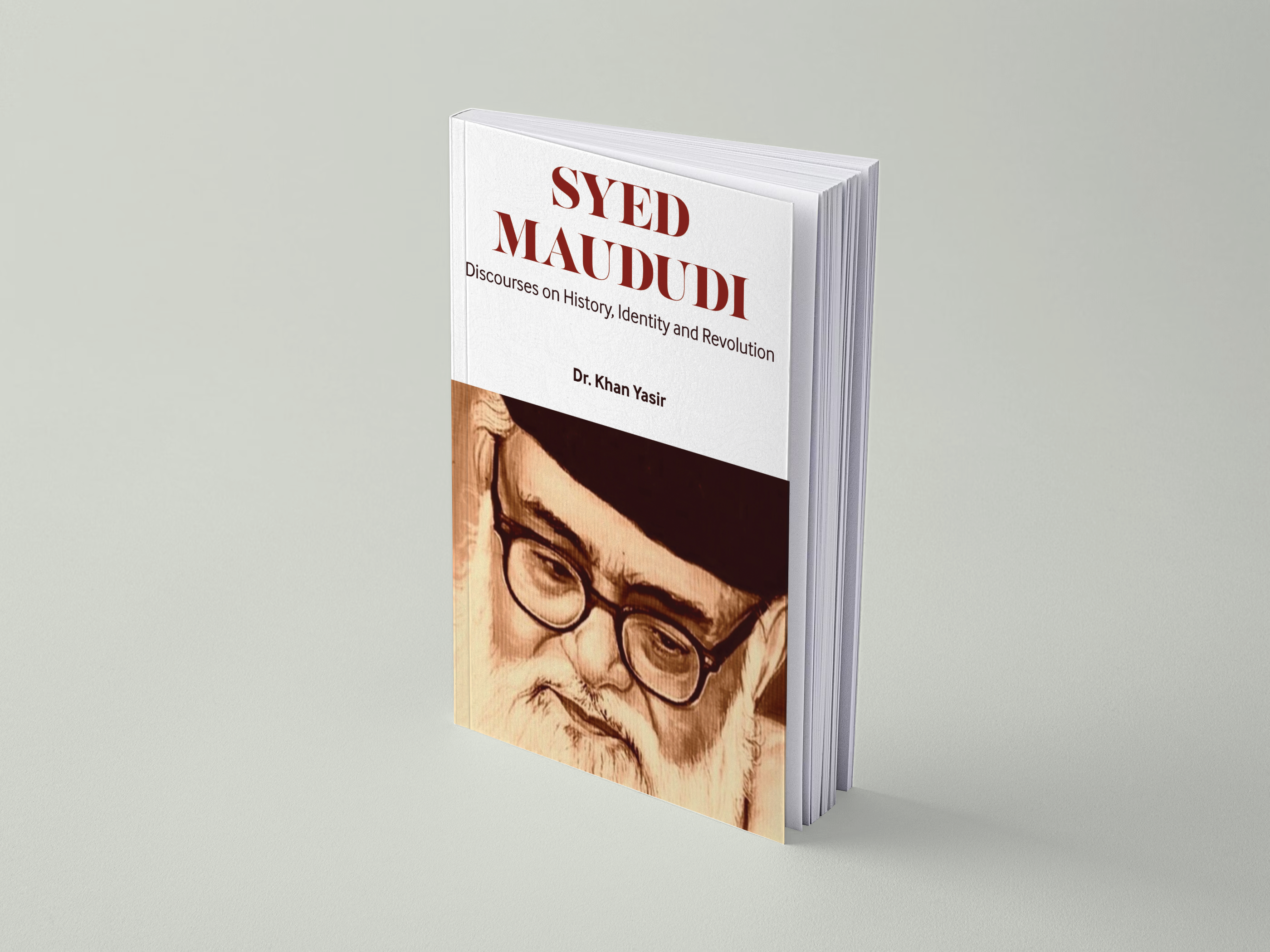
Syed Maududi: Discourses on history, identity and Revolution
Dr. Khan Yasir
White Dot Publishers
2023
This book comprises three research papers originally presented by Khan Yasir at various academic conferences. Additionally, it includes a foreword by Syed Saadatullah Hussaini, which offers an overview of the book’s themes and acknowledges the scholarly contributions of the esteemed author.
The first paper, titled ‘The Locomotive of History? Maududi’s Critique of Hegel’s Dialectics and Marx’s Historical Materialism’ delves into the concept of historical progression as elucidated by Hegel, Marx, and Maududi’s critical examination of their fundamental ideas regarding dialectics and historical materialism. This paper also elucidates Maududi’s interpretation of Islamic philosophy concerning history.
German philosopher Karl Marx undoubtedly holds a prominent place in the annals of human history. His ideas have not only exerted a profound influence on countless individuals but have also been catalysts for numerous revolutions. Among Marx’s most impactful notions is the theory of historical materialism, which appears to draw inspiration from Hegel’s dialectical process.
However, Maududi vehemently critiques Marx’s conception of history. In Maududi’s perspective, history transcends the realm of endless dialectics and historical materialism. He posits that history serves as an expression of Allah’s Sunnah—a continuum of stages encompassing forgiveness, trial, warning, leniency, and punishment. History, according to him, serves as a wellspring of lessons and admonitions for humanity. Maududi’s meticulous examination of the ideas of Hegel and Marx not only exposes their shortcomings but also presents history as a testament to the Islamic faith, particularly the belief in God and the Hereafter.
“Hegel and Marx would not have faltered in understanding true human nature and comprehending the basic laws governing the development of human civilisation had they resorted to studying the Quran instead of relying upon their own imagination and vague derivations. The anthropology and the philosophy of history presented in the Quran accurately and convincingly solve all those issues that these gentlemen have entangled themselves with.”
The second paper discusses Maududi’s views on the concept of nationalism, aptly titled ‘The Mirage of Accidental Identity: Syed Maududi’s Critique of Nationalism.’ In an age where ethnic and national pride, as well as aggression, seem to be on the rise, the author contends that Maududi’s critical analysis of modern notions such as nation, nationalism, and nation-state holds particular significance.
Drawing upon Maududi’s various writings concerning modern concepts of identity—namely, nation, nationalism, and nation-state—the author asserts that Maududi prioritizes conscious identity over accidental identity. According to the author, Maududi’s vision of socialisation of human society is grounded in two fundamental principles. The first is universal human brotherhood, rooted in the concept of universal human dignity as a human being and an assemblage of believers on the basis of beliefs, values, and principles. Another is Lines of identity in his eyes, which must not be accidental identities, transcending distinctions based on race, language, color, place of birth, and the like. Instead, the delineating criterion should invariably be the distinction between right and wrong or Islam and Kufr, representing conscious identity.
“….nationalism nurtures asbiyat e jahilliya in a person and community. Due to this asbiyat e jahilliya, asserts Maududi, a nation hates another nation only because it is another nation. Being ‘other’ is considered to be a sufficient reason to hate and destroy it. In the process values of truth, justice, and trustworthiness lose their significance, or to say the least, become subservient to prejudice.”
The distinguished author astutely observes that Muslims do not constitute a nation in the conventional sense of the term. Rather, they form a group, party, or movement (Hizb) united by distinctive goals founded upon faith, beliefs, principles, and values.
The third paper is titled ‘Violence and Revolution: The Historical-Conceptual Romance and Maududi’s Unyielding Antagonism.’ In this insightful work, the distinguished author endeavors to illustrate, through Maududi’s various writings and speeches, how Maududi held sustainable and organized aspirations for legal, disciplined, and constructive change—a process involving the molding of public opinion in favor of ushering in change and revolution.
The author underscores Maududi’s careful distinction between reform and revolution, quoting him as follows:
“Reform and revolution, both aim at averting deterioration. But the motivation and modus operandi are fundamentally different in both cases…. As against this, the revolution starts with reaction and revenge and with rage and fury. Evil and excess are countered with a bigger evil and excess destroying not only the evils and excesses but also the good and the fair.”
Maududi’s vision for the Islamization of collective institutions was rooted in a process of societal transformation. The distinguished author convincingly demonstrates that Maududi’s pursuit of change and revolution was entirely devoid of aggressive, violent, or terrorist inclinations that were often erroneously attributed to him.
Maududi formulated strategies for achieving the Islamic revolution as follows:
“My last advice to the workers of the Islamic movements is that they should refrain from running underground movements or bringing Islamic revolution through arms. This is in fact a kind of impatience and hastiness and in terms of results more detrimental than the rest. A true revolution always comes through popular movement. Spread your Dawah openly, reform the minds and thoughts of the people. Change their views. Conquer the hearts through moral weapons. And in this endeavour whatever dangers and tribulations befell, face them manly. The revolution that comes in this gradual way will be so strong and enduring that storms of hostile forces would not be able to obliterate it.”
In summary, Khan Yasir’s book represents an academic endeavor to comprehend and elucidate Maududi’s perspectives on profoundly significant and sensitive subjects. This book promises to be an invaluable resource for exploring Maududi’s viewpoints on these issues.