India, which was said to be the world’s largest democracy retaining the outward architecture of democratic governance, regular elections, a free judiciary, a vibrant media ecosystem, and constitutional guarantees of civil liberties, no longer stands on its pillars. The functionality of these institutions has been increasingly undermined ever since the BJP government came into power, not through outright dismantling, but through calculated legal, political, and institutional manipulation. What has emerged is not the abolition of democracy, but its hollowing from within, a managed democracy where elections occur without meaningful contestation, dissent is criminalized through legislative instruments, institutions are weakened by executive overreach, and the media and civil society are brought under pressure through intimidation and regulation.
In essence, India stands today not as an authoritarian regime in the traditional sense, but is a hybrid democracy, where democratic processes exist in form, but are increasingly subordinated to the political and ideological imperatives of the ruling regime. During Modi’s tenure, key democratic institutions have remained formally in place while the norms and practices underpinning democracy have substantially deteriorated, says Maya Tudor in her essay, Why India’s Democracy is Dying.
Since 2014, India’s global democratic standing has deteriorated sharply, as reflected in major international indices. Freedom House downgraded India from “Free” to “Partly Free” in 2021, citing attacks on civil liberties, harassment of journalists, and growing discrimination against minorities (Freedom House Report – India 2024). The V-Dem Institute went further, classifying India as an “Electoral Autocracy”, highlighting the use of defamation, sedition, and anti-terror laws to suppress dissent and the decline in judicial and media independence (V-Dem Democracy Report 2024). Reporters Without Borders (RSF) ranked India 159th out of 180 countries in its 2024 World Press Freedom Index, pointing to increased censorship, violence against journalists, and government pressure on news outlets (RSF – India Press Freedom Index 2024). These rankings underscore a systemic weakening of democratic norms and institutions, even as formal electoral processes continue.
Several critical laws have been selectively amended or used to repress dissent and curtail civil society. Amendments to the Unlawful Activities (Prevention) Act (UAPA) in 2019 enabled the government to designate individuals and not only organizations as “terrorists” without trial or conviction, significantly increasing the state’s ability to detain dissenters. In 2020, The Foreign Contribution (Regulation) Act (FCRA) was made stringent, leading to the closure of many rights- and humanitarian-based organisations due to severe constriction of foreign funds to the NGOs. Together, these laws provide a legal scaffold for delegitimizing dissent, chilling free expression, and enabling prolonged pretrial incarceration under the guise of national security and public order.
The scale of democratic suppression in India is starkly evident in arrest statistics and internet shutdowns. Between 2014 and 2021, a total of 10,552 individuals in India were arrested under the Unlawful Activities (Prevention) Act (UAPA), but only 253 were ultimately convicted, according to a 2021 report by Scroll.in. This data highlights the law’s low conviction rate and has raised concerns about its use as a tool for prolonged detention rather than securing justice. indicating the law’s use as a tool for prolonged incarceration rather than justice. India topped the world in internet shutdowns during the same period. From 2016 to 2023, India ordered more than 680 internet shutdowns, more than any other country, and with Kashmir making up a significant majority. These were spontaneous shutdowns often timed during protests (CAA, civil society shutdown, centre vs states shutdown, etc.), or elections, and resulted in effective hampering of mobilisation and flow of information. The data paints an ugly picture: legal and technical tools are being used at an industrial scale not to keep people safe but to stifle dissent.
India has also experienced an unprecedented centralization of authority since 2014, in the Prime Minister’s Office (PMO), accompanied by the erosion of institutional checks. The office has overpowered traditional ministerial roles time and again governing through ad hoc task forces and bureaucratic networks directly accountable to it while bypassing parliamentary oversight and cabinet consultation, one notable example is the demonetization decision which was taken in 2016, without consulting the Finance Ministry or the Reserve Bank of India board in any substantive or potential way. The Election Commission of India has come under fire for inconsistent enforcement of the Model Code of Conduct, for instance, delaying action on multiple speeches by Prime Minister Modi that were allegedly communal or polarizing during the 2019 and 2024 elections, swiftly penalizing opposition leaders for lesser infractions. The CAG, once vocal during the UAPA era, has been failing to investigate or publicly comment on major post-2014 controversies such as the electoral bonds scheme, whose opacity has been criticized by the Supreme Court as well, as a violation of voters’ right to know. Manish Tewari mentioned that the Modi Government has made ‘Government corruption Official’ by bringing electoral bonds. In the media landscape, government-friendly business groups like Reliance and Adani have acquired large stakes in influential outlets such as Network18 and NDTV, respectively, blurring the line between corporate interest and editorial independence. Regulatory bodies like the Broadcasting Content Complaints Council have remained largely passive amid rising cases of hate speech and disinformation on prime-time TV. These developments firmly signal a deliberate weakening of the institutional architecture designed to constrain executive power and protect democratic norms.
Not only governmental institutions have been targeted, civil society actors, particularly RTI activists and journalists, have faced escalating threats. Over 100 RTI activists have been assaulted or killed since the Act’s inception, with little institutional protection or investigation. A 2019 report by Counterview highlighted that 80 RTI activists had been killed since 2014, while the Modi government has consistently declined to enforce the Whistleblowers Protection Act, leaving those exposing corruption and wrongdoing without legal safeguards. Moreover, the RTI Amendment Act of 2019 weakened the autonomy of Information Commissions by giving the Centre control over their tenure and salaries, diluting a key tool for public accountability (PRS Legislative Research). Cases of harassment and murder of RTI applicants are increasing across the country, and the biggest challenge in the upcoming years is to ensure their protection, according to a new report on the status of the implementation of the RTI Act.
In a March 17, 2024, investigation, correspondents Sophie Landrin and Carole Dieterich reported that under Prime Minister Modi’s leadership, the Indian government has launched an aggressive crackdown on civil society. This state-driven campaign has been specifically targeting NGOs and human rights organizations, while also expanding to include the media and academic institutions, which have been a part of a broader effort to silence dissent and consolidate nationalist control. Combined with the use of sedition laws, UAPA, and digital surveillance tools like Pegasus, these measures have been fostering a chilling effect, discouraging dissent, and enabling a slide towards authoritarian governance. A recent in-depth report by The Guardian has highlighted how a combination of escalating attacks on journalists, widespread self-censorship, the use of harsh anti-terror laws, and growing corporate control, especially by politically aligned tycoons, over major media outlets, is significantly undermining India’s democratic framework. These developments underscore how democratic backsliding in India is not incidental but appears to be a part of the calculated centralization of executive authority.
In recent years, the Indian government has increasingly used investigative agencies to intimidate independent media outlets, reflecting a broader decline in press freedom. In February 2023, the BBC’s offices in India were raided by the Income Tax Department shortly after it aired a documentary critical of Prime Minister Modi’s role in the 2002 Gujarat riots (CNN). Similar tactics have been used against The Wire in 2022 following its reporting on the Meta controversy, and Newsclick in 2023, where the portal was accused of receiving foreign funding to spread “Chinese propaganda”, allegations widely seen as politically motivated (Al Jazeera). These raids, often without conclusive legal outcomes, have a chilling effect on journalism and reflect a pattern of instrumentalizing state machinery to suppress investigative reporting, as analyzed in the Journal of Democracy‘s coverage of India’s “electoral authoritarian” trajectory (Journal of Democracy).
Simultaneously, civil society organizations and academic institutions have come under increasing pressure through the selective enforcement of the Foreign Contribution (Regulation) Act (FCRA). Over 20,000 NGOs have lost their licenses since 2014, including internationally respected organizations like Amnesty International India, whose offices were forced to shut down in 2020 after their accounts were frozen (Wikipedia – FCRA). Human rights groups, Christian charities, and even research centers have been disproportionately targeted, especially those critical of government policy. This crackdown has extended to academic institutions and independent think tanks, such as the Centre for Policy Research (CPR), whose FCRA license was suspended in 2023, jeopardizing intellectual freedom and global collaboration (Democracy Journal). These developments form a coordinated strategy to suppress dissent, intellectual independence, and international engagement, pushing India closer to the edge of democratic decline.
India’s Muslim population, which makes up around 14% of the country, has seen a significant erosion of civil liberties in recent years. Incidents of anti-Muslim violence, especially mob lynchings linked to accusations of cow slaughter or beef consumption, have been surging. Data from IndiaSpend reveals that 97% of such cow-related mob attacks between 2010 and 2017 took place after Narendra Modi became Prime Minister in 2014, with Muslims being the primary victims.
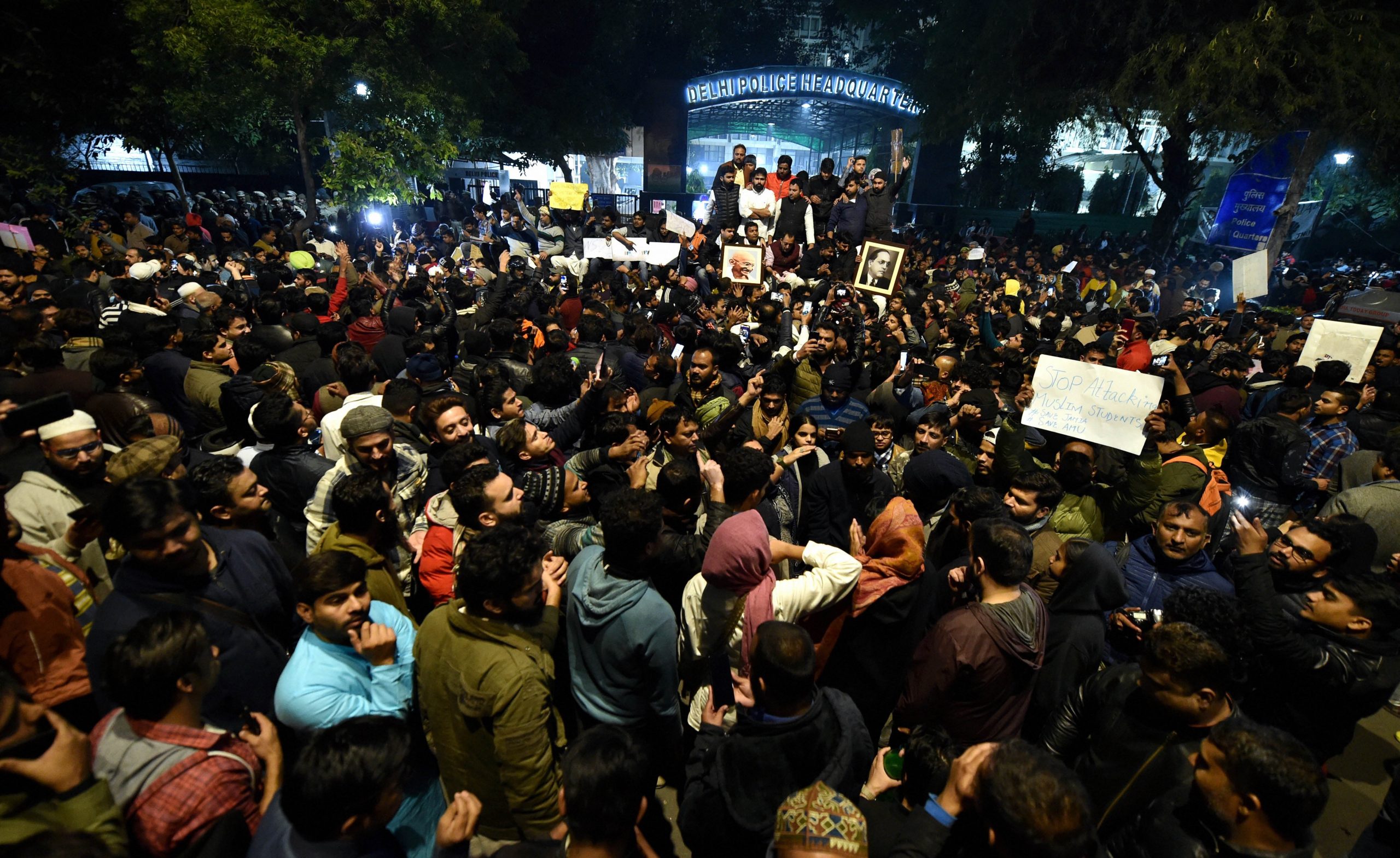
According to independent groups like Human Rights Watch and the U.S. Commission on International Religious Freedom, India’s largest minority now lives under a pervasive atmosphere of fear. The Citizenship Amendment Act (CAA), passed in 2019, deepened concerns, as it explicitly excludes Muslims from fast-tracked citizenship eligibility for refugees, marking a shift from bias in practice to discrimination in law. Many fear that when combined with a proposed nationwide citizenship registry, the law could lead to Muslim citizens being disenfranchised if they cannot produce the required documents.
Meanwhile, Jammu and Kashmir, the country’s only Muslim-majority region, has been subjected to sweeping restrictions on rights and freedoms since its special status was revoked in 2019. Freedom House now classifies the region as “Not Free,” noting that the scale and intensity of the crackdown resemble conditions last seen during India’s Emergency period in the 1970s.
In the BJP Government, India has been seeing a disturbing rise in the use of repressive national security laws and surveillance technologies, often disproportionately targeting dissenters and marginalized communities. Chief among these tools is the Unlawful Activities (Prevention) Act (UAPA), which allows extended detentions without formal charges or trial. While the conviction rate under UAPA remains below 3%, the law has been used extensively against students, academics, activists, and journalists. Notable examples include the Bhima Koregaon case, where 16 human rights defenders, such as Sudha Bharadwaj and the late Father Stan Swamy, were imprisoned on tenuous evidence, much of which was later shown to be digitally planted. (Wired) Similarly, student activists Sharjeel Imam, Umar Khalid, Safoora Zargar, and Meeran Haider were charged under UAPA for allegedly inciting the 2020 Delhi riots, despite evidence suggesting they had only called for peaceful protests. Disha Ravi, a 22-year-old climate activist, was similarly booked for sedition and UAPA over a “toolkit” shared online during the farmers’ protests.
Parallel to these legal crackdowns is the rapid deployment of digital surveillance infrastructure, especially CCTV networks and Facial Recognition Technology (FRT). Projects like NATGRID and the Central Monitoring System (CMS) give government agencies unchecked access to citizens’ communications without judicial oversight. Studies show these surveillance technologies are disproportionately concentrated in Muslim and working-class neighborhoods, further entrenching inequality and over-policing.. In Kashmir, journalists like Aasif Sultan and Fahad Shah have been repeatedly jailed under UAPA and PSA for reporting critically on the state (CPJ). The use of “punishment by process,” where arrest itself becomes the penalty, has become a hallmark of policing under the current regime. With little transparency, high-profile arrests but few convictions, and systemic targeting of minorities and dissenters, the current model of surveillance and policing reflects a securitized state drifting toward authoritarianism, at odds with India’s constitutional commitments to liberty and justice.
India’s political and legal frameworks have increasingly reflected a Hindu majoritarian ideology, reshaping the concept of citizenship and national identity in ways that marginalize religious minorities, especially Muslims. The Citizenship Amendment Act (CAA), 2019, explicitly excludes Muslims from a fast-track citizenship provision offered to undocumented non-Muslim immigrants from Pakistan, Afghanistan, and Bangladesh (Wikipedia – CAA). This law, when combined with the National Register of Citizens (NRC), first implemented in Assam, has led to widespread fear of statelessness among Indian Muslims, with over 1.9 million people excluded from the NRC in Assam alone (Wikipedia – NRC). In March 2024, the Ministry of Home Affairs officially notified the rules to implement the CAA nationwide, reviving public protests and raising fresh concerns about religious discrimination in citizenship policy (BBC). Scholars and rights groups argue that the CAA-NRC framework institutionalizes a two-tiered model of citizenship, violating the secular ethos of the Indian Constitution (Democracy Journal).
The political environment has also seen an alarming rise in cow-related vigilantism, bulldozer justice, and communal hate speech, fueling further polarization. In February 2023, a horrific case in Haryana shocked the nation when two Muslim men, Junaid and Nasir, were allegedly abducted and burned to death by cow vigilantes linked to Bajrang Dal (Muslim Mirror). Laws banning cow slaughter have been tightened in multiple BJP-ruled states, often used to target meat sellers and minority-run businesses. In Uttar Pradesh and Madhya Pradesh, “bulldozer justice” has become a state-sanctioned tool to demolish homes and shops of alleged rioters, disproportionately Muslims, without due process, as seen after the Prayagraj protests in 2022 (Hindustan Times). Hate speech by elected leaders has also escalated, including calls for violence at Hindu nationalist gatherings like the Dharam Sansads, with little legal consequence (Quint). These actions and narratives not only erode constitutional secularism and equal protection, but also feed a communalized socio-political climate that encourages exclusion, fear, and division, all of them being key elements of what political scientists call a “managed democracy” drifting toward majoritarian authoritarianism.
Since 2014, social media platforms such as WhatsApp, Facebook, YouTube, and Twitter (now X) have become central to political communication in India. These platforms have been offering new spaces for civic participation, but they have also been systematically weaponized by the state and affiliated groups to amplify and provoke propaganda, silence dissent, and spread misinformation, fundamentally undermining democratic discourse. A report by the Oxford Internet Institute (OII Report, 2019) classified India as one of the top countries where political parties and state actors conduct organized disinformation campaigns. The ruling Bharatiya Janata Party has been shown to operate extensive networks of online supporters and troll armies that dominate digital platforms with nationalist content while targeting opponents with abuse and misinformation.
Facebook’s internal research, revealed by whistleblower Frances Haugen and reported in The Wall Street Journal (WSJ, 2021), showed that the company was aware of the surge in hate speeches, especially anti-Muslim posts in India, but avoided taking strong action against extremist accounts due to fears of political backlash. These internal warnings noted that “fear-mongering and dehumanizing posts” had spread widely across Facebook and WhatsApp in India, inciting offline violence. WhatsApp, which has over 500 million users in India, is a major vector for viral misinformation. Investigations by Reuters (Reuters, 2018) uncovered how BJP-linked networks operated thousands of WhatsApp groups during elections, to flood users with curated propaganda. Studies by Alt News and Boom Live have repeatedly debunked false claims, often communal in nature, widely circulated in pro-government WhatsApp chains, some of which have led directly to mob violence, such as lynchings tied to rumors of cow slaughter or child abduction.
Platforms have become a site of targeted digital repression. Independent journalists like Rana Ayyub have faced relentless online harassment, including doctored images and coordinated abuse, traced back to pro-BJP networks. The UN Human Rights Council condemned this campaign in a 2022 statement (UN OHCHR) as an example of state-enabled gendered disinformation and intimidation. In addition, under the Information Technology (Intermediary Guidelines and Digital Media Ethics Code) Rules, 2023, the government has granted itself the authority to compel social media platforms to remove content it deems “false or misleading”, a move widely criticized by civil society as unconstitutional censorship. The Internet Freedom Foundation argues that these rules have created a chilling effect, pressuring platforms to take down content too quickly or unnecessarily, just to stay on the government’s good side.
In totality, these trends signal a transformation in the digital public sphere from a space of pluralistic debate to a digitally controlled arena where state-aligned narratives are being dominated, dissenters are discredited and silenced, and misinformation functions as a medium of ideological consolidation. In this “managed democracy,” control over information has become as important as control over institutions.
In spite of the democratic backsliding evidenced in institutions, legislation, media, and civil liberties, the Bharatiya Janata Party has continued to win elections at the national and state levels. Popular support for Prime Minister Modi is high, and the party’s ideological rhetoric has resonated deeply with vast segments of the citizenry. This paradox poses a question that should trouble all of us is that how does a regime undermine democracy yet win elections on its behalf? One of the reasons is the production of consent via persistent narrative control, media takeover, religious polarization, and digital disinformation. When the opposition is delegitimized, facts are drowned beneath viral propaganda, and opposition voices are branded anti-national, public opinion is no longer an autonomous mirror of democratic will; it becomes an output of managed inputs.
Another aspect is “performative legitimacy,” which has been projecting strength, nationalism, and cultural pride, usually communicated through spectacle politics such as abrogating Article 370 or temple openings that have been fostering emotive loyalty that goes over institutional responsibility. Such situations turn elections into identity plebiscites rather than about governance. But there is also proof of democratic exhaustion, in which citizens, wearily burned out by financial adversity or disheartened by ineffective opposition, turn away from critical vigilance. Hollowing out the institutions might no longer be a priority in a culture desensitized by perpetual crisis and distraction. But democracy does not perish with tanks in the streets; it perishes quietly, through widespread apathy and misplaced confidence.
India is at the edge today, not because democracy has failed in an instant, but because it has been gradually leached of substance while maintaining its ceremonial trappings. Courts continue to operate, elections continue to be conducted, newspapers continue to publish headlines, but the essence of democracy is dissent, accountability, equality before the law, and that soul is under attack.