Democracy is not tested only on the day of voting. The real test happens quietly, in the months before an election, in the revisions of voter rolls, in the unseen decisions of bureaucrats, and in the paperwork that decides who counts as a citizen and who does not. What once looked like dull administration has become a political weapon. And that is the danger we face today.
In recent weeks, the issue of manipulated electoral rolls has moved from quiet murmurs to the center of political debate. Rahul Gandhi put it bluntly, calling the practice “vote chori”, the theft of votes. He released data and videos that he claims show massive irregularities in constituencies like Mahadevapura, including duplicate entries, invalid addresses, and bulk registrations. What might once have been dismissed as clerical error has now been exposed as systematic exclusion.
The Election Commission, instead of opening its records, responded with bureaucratic thunder, demanding proof or an apology, and calling such allegations “misleading.” But Gandhi did not retreat. Joined by Tejashwi Yadav and others, he launched the Voter Adhikar Yatra across Bihar. Farmers, students, migrant workers, and daily wage earners came forward to testify. Their stories echoed one another: they reached polling stations only to find their names missing. This was not a glitch. This was a pattern.
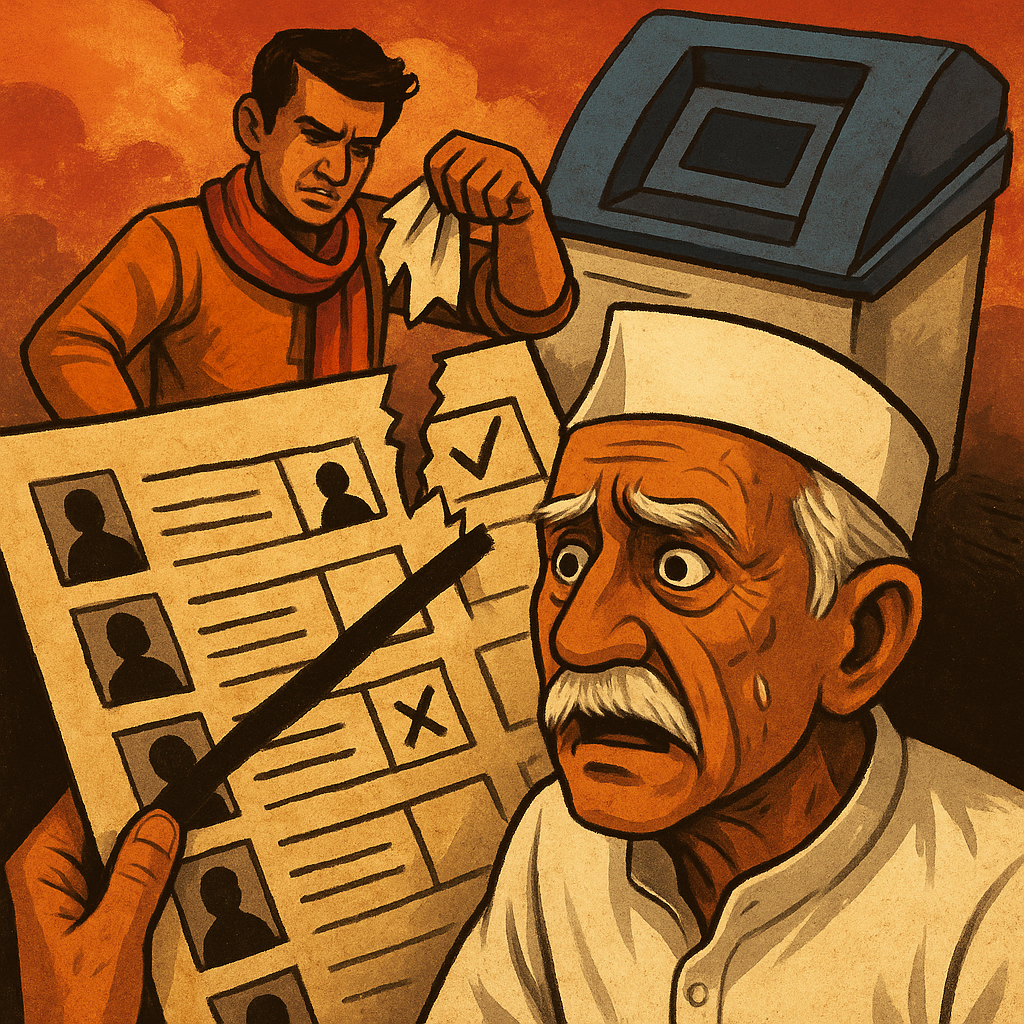
This kind of disenfranchisement is uniquely dangerous because it is invisible. Burned buses make headlines. Police batons get caught on camera. But when a poor worker arrives to vote and finds his name erased, the violence is silent. It leaves no scars that newspapers can photograph. It hides in paperwork, procedure, and denial.
Hannah Arendt once warned that institutions built to defend freedom can, over time, turn into tools of domination. That is precisely what we see today. The Election Commission, once a proud guardian of fairness, risks becoming an accomplice in manipulation. The violence here is not loud, but it is devastating: the quiet removal of a citizen’s political existence.
Civic groups and petitioners, including Yogendra Yadav, have taken this battle to the Supreme Court. Their case is stark: the Election Commission’s Special Intensive Revision (SIR) exercises allow arbitrary deletions and demand impossible documents from the poor. This, they argue, violates Articles 14, 21, 325, and 326 of the Constitution, the very articles that protect equality, the right to life, and universal franchise.
The Court itself has voiced doubts about whether the current process meets even minimal standards of fairness. The timeline is too rushed, safeguards are too weak, and transparency is almost absent. Yadav has gone further in public: the most dangerous violence today is not physical, but bureaucratic, the quiet violence of exclusion. A regime can manufacture its electorate simply by deciding who exists on paper.
Why does this matter? Because politics explains motive. Those who benefit most from shrinking the electorate are the very groups now accused of manipulating rolls. The poor, migrants, Muslims, Dalits, and informal workers are disproportionately targeted, precisely because they are the least able to defend their documentary status on demand.
This is not random error. It fits a political strategy. By controlling the voter list, the ruling regime can reshape the electorate so that the result is preordained. It does not need to stuff ballot boxes or stop elections from happening. It only needs to ensure that millions of potential opponents never make it to the rolls in the first place.
At the heart of this lies the RSS-BJP project: the relentless pursuit of power by hook or crook, even at the cost of destroying democratic institutions. From the Election Commission to the courts, from investigative agencies to universities, institutions that once defended the idea of India are being bent to serve the ruling machine.
The vision is not hidden. It is the dream of a Hindu Rashtra, a nation defined not by constitutional equality but by religious majoritarianism. To reach that goal, every obstacle must be cleared. An independent media must be tamed, a dissenting judiciary must be pressured. And above all, the universal franchise, the equal vote of every citizen, must be hollowed out.
The RSS knows that the vote of a migrant Muslim worker in Delhi is worth the same as that of a corporate executive in Mumbai, that equality is the heart of the Republic. To destroy it, they do not need to ban elections. They only need to redraw the map, name by name, booth by booth, until the “largest democracy” in the world is reduced to a stage-managed ritual.
Consider the cruelty of this tactic. In Assam, the NRC exercise left millions in limbo, branded strangers in their own land. Across states, migrants, Dalits, and the urban poor arrive at polling booths only to be told they do not exist. Names vanish without notice, and restoring them requires navigating an impossible maze of bureaucracy.
This is not just about numbers, it is about dignity. To erase a citizen from the roll is to declare them irrelevant to the Republic. It is to silence their community before it can speak. John Stuart Mill warned that silencing an opinion robs humanity of truth. What then of silencing entire populations?
The solution is not complicated, but it requires political will. First, name the problem for what it is: not technical error, but systematic disenfranchisement. Second, demand transparency: machine-readable voter rolls, public audit trails for every addition and deletion, and justifications that independent experts can review. Third, shift corrections into the hands of citizens: local verification desks, legal aid, and independent observers.
These are technical fixes, but precisely because they work, they are resisted. Transparency is not neutral, It cuts into the advantage of those who thrive on opacity.
The ruling alliance insists that critics are spreading misinformation. But in a democracy, appearances matter as much as facts. Once institutions refuse to open their books, once they label every challenge as “misleading,” trust collapses. Even lawful acts begin to look suspicious when the umpire is seen as biased. And when trust in the election process is lost, the Republic itself is at risk.
This is not only a Muslim issue, or an Assam issue, or a migrant issue. Once bureaucratic exclusion becomes normal, no one is safe. Today it is the poor and the marginalized. Tomorrow it could be students, pensioners, or entire neighborhoods that oppose the ruling regime.
Frantz Fanon observed that physical violence sometimes exposes injustice because it cannot be ignored. Administrative erasure does the opposite: it hides the injustice so that it cannot be seen. That is why it is so effective and so cruel.
India still calls itself the world’s largest democracy. But numbers mean nothing if millions are missing. What pride is there in headcounts if the heads that are counted are chosen by the ruling party’s software?
John Rawls reminded us that justice is the first virtue of institutions. What remains of justice when the first act of injustice — erasing the citizen himself — becomes routine? What remains of democracy when the ballot is staged, the guardians are compromised, and the Republic itself is hollowed out?
Rahul Gandhi was right to call it what it is: vote chori. Yogendra Yadav was right to warn that administrative disenfranchisement is the most dangerous form of violence today. And we are right to ask:
If they can erase your neighbour today, what stops them from erasing you tomorrow?
If they can steal the vote silently, what remains of democracy at all?
India must confront these questions now or else risk waking up one day to discover that the world’s largest democracy has quietly been reduced to a hollow ritual, performed for an audience already chosen.
(Ismail Salahuddin is a writer and researcher based in Delhi, focusing on Muslim identity, Communal Politics, Caste, and the politics of knowledge. Social Exclusion & Inclusive Policy at Jamia Millia Islamia, [email protected] )
References
- Indian Express. (2024, July 10). Rahul Gandhi launches Voter Adhikar Yatra in Bihar, alleges vote chori in voter rolls. The Indian Express. https://indianexpress.com
- The Hindu. (2023, November 18). Mahadevapura voter list controversy: Allegations of fake and duplicate entries spark political row. The Hindu. https://www.thehindu.com
- Press Trust of India. (2024, July 12). Election Commission rejects Rahul Gandhi’s allegations on voter rolls, calls them misleading. The Hindu. https://www.thehindu.com
- The Print. (2024, November 15). Yadav, Y. The quiet violence of exclusion is the most dangerous form of disenfranchisement today. The Print. https://theprint.in
- Supreme Court of India. (2024). Swaraj Abhiyan & Ors. v. Election Commission of India [Writ Petition challenging Special Intensive Revision of electoral rolls].
- The Wire Staff. (2024, December 2). Supreme Court questions Election Commission on transparency of voter roll revisions. The Wire. https://thewire.in
- Government of India. (1950). The Constitution of India. Articles 14, 21, 325, 326.
- Human Rights Watch. (2019). “They Have Erased Our Names”: Discrimination Against Women and Girls in Assam’s National Register of Citizens. https://www.hrw.org
- Arendt, H. (1951). The Origins of Totalitarianism. Harcourt, Brace & Company.
- Mill, J. S. (1859). On Liberty. J. W. Parker and Son.
- Rawls, J. (1971). A Theory of Justice. Harvard University Press.
- Fanon, F. (1961). The Wretched of the Earth. Grove Press.