

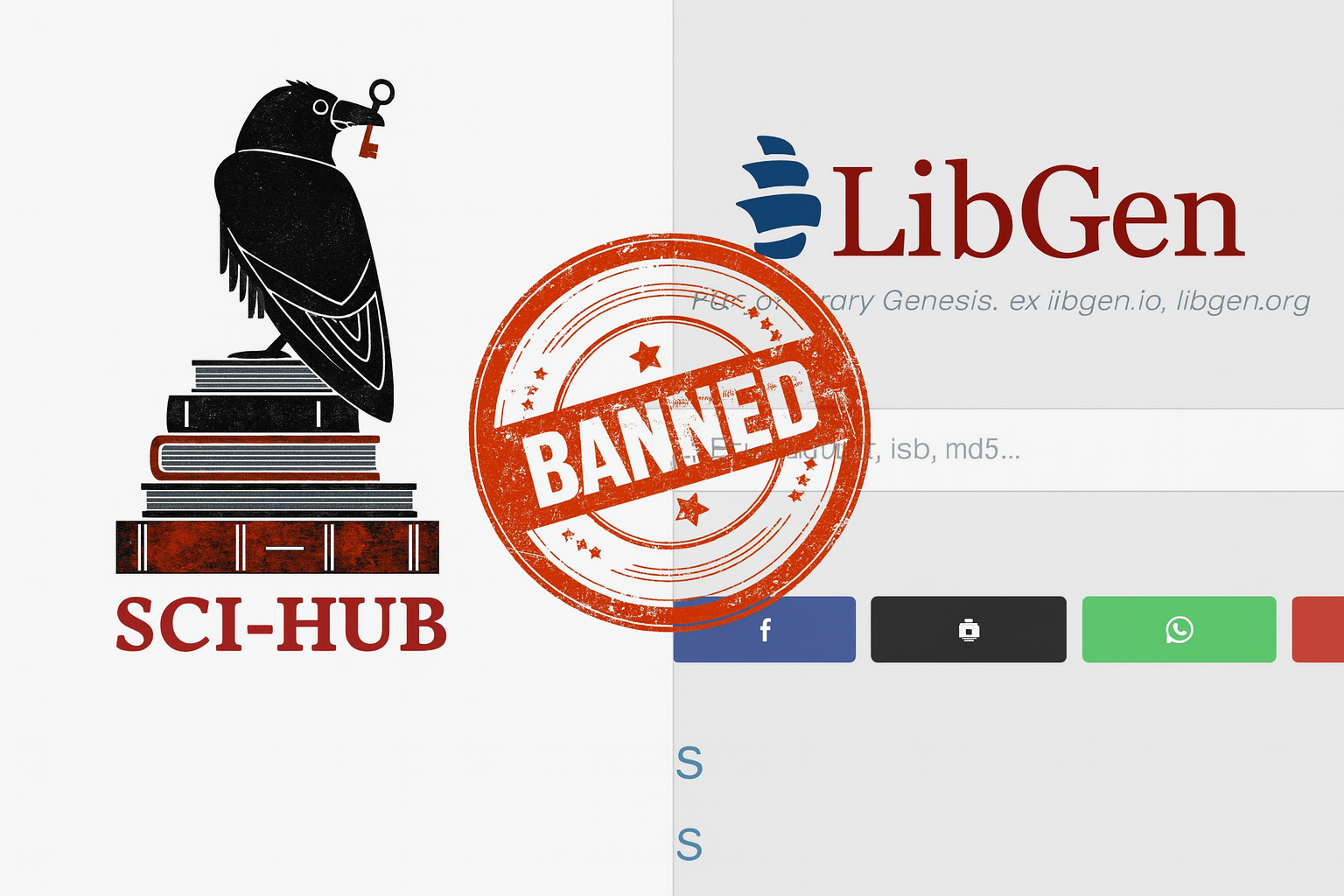
On 23rd August 2025, the Delhi High Court ordered a ban on digital shadow libraries across the country in response to piracy complaints filed by the publishers. The ban largely affects websites such as Sci-hub and Libgen, used for academic papers and e-books respectively. A shadow library is a digital space that provides access to a plethora of books, articles, and journals free of cost, which are usually held behind an expensive paywall. The decision comes in a line of long-standing conflict over open access between academics and publishers, where one side demands free access to all knowledge for all people, but the other side emphasises its copyright policies.
While the publishers’ concern for copyright is justifiable to an extent, the fact remains that such paywalls limit the reach of their publications as well, which is not in anyone’s well interests. The goal of any work of research, therefore, should be knowledge production and not monetary gains. This capitalism of academia not only gatekeeps older research materials from reaching valuable minds, but also severely hampers the avenues of future research projects. Even the copyright clause allows some flexibility for fair use of the publication—a fact that is conveniently overlooked by many to serve their own agendas.
Platforms such as Sci-Hub and LibGen prove to be especially helpful to students and researchers, who need free and affordable access to previous research in order to build upon it and produce new quality research. While researchers from reputable universities are often provided limited access to some resources through their institution, in light of such bans, it is the independent researcher who suffers the most. With no proper access to the latest academic resources, their research either stalls indefinitely or lacks a contemporary paradigm.
Over the years, there have been many individuals and organisations fighting to make academic literature open to all. Perhaps one of the most well-known cases in this fight for free access is that of Aaron Schwartz. A computer programmer, writer, political organiser, and internet activist, Aaron was primarily interested in the cause for free access and digital rights movements. “Information is power. But like all power, some want to keep it for themselves,” he had stated. Using his MIT network access, Aaron downloaded about 4.8 million articles from JSTOR between late 2010 and early 2011, intending to make them freely available for researchers. While JSTOR did not press any charges on him, the US federal government prosecuted him under the Computer Fraud and Abuse Act, threatening him with decades in prison and heavy fines. While on trial, Aaron ended up committing suicide. He is now hailed as a martyr in the cause of open access knowledge, and a document authored by him, known as the Guerilla Open Access Manifesto, is now seen as a manifesto for the cause. It particularly highlights the unequal structures of knowledge access across the world:
“Providing scientific articles to those at elite universities in the First World, but not to children in the Global South? It’s outrageous and unacceptable. … We need to take information, wherever it is stored, make our copies and share them with the world. … We need to download scientific journals and upload them to file sharing networks. We need to fight for Guerilla Open Access.“
In a third world country such as ours, intellectual piracy—which is predominantly considered a first world issue—forms the least of our concerns. It is confounding that such a ban should be legislated in the Global South, which already has an immense shortage of academic knowledge production and viable research opportunities. It underlines a trend of global discrimination, wherein a researcher in the West may be able to access any book or article freely, whether through their own well-off means or through their university’s access provision; but a researcher in the East is deprived of the most basic academic access. Is it not unfair, then, to demand the same quality of research from both? Where one has all the digital and physical literature at their disposal, the other has to contend with dilapidated libraries, worn-out books, and outdated journals. A shadow library, in such a case, puts both researchers on an equal footing, providing them knowledge by virtue of their being researchers, and not by their privilege of birth or financial suitability.
While local governments may create their own digital libraries as alternatives, they remain largely limited and often quite useless. Thus, a decision such as this appears less an effort to protect publishers’ copyrights and more an attack on academia itself. In a country that prides itself on its use of the Right to Information (however selectively applied), a ban on the free flow of information not only raises considerable challenges for academic life but also questions the very functioning of the country as a whole. The gatekeeping of knowledge has never proven to be a prudent endeavour for humankind, and especially in today’s age, it begs the question: Who benefits the most from the ignorance of a people?
The following author is Kahkashan Aafreen, PhD Scholar, AMU. Instagram: @bookishqalb


Knowledge should not be limited only to the rich and affluent.
There are always ways.