

Rainbow is completed only when the seven different colours constitute together. India is also like that, where difference in language, culture, religion and caste come together to form a nation. This diversity can be seen in politics as well.
The term politics is used for involving in political activities. However, after the formation of the concept of nation-state the concept shrank into mere involvement with the nation and elections limiting it to party-politics. Civil politics is another terminology. But the limitation of these types of politics such as power politics and civil politics is its ‘structure oriented’ nature a stark drawback of modernity.
Every structure oriented things will produce a bundle of waste. For example, the making of a chair trashes a lot of waste from the original wood. Likewise the violence is essential when a well-structured modern nation is formed. We had witnessed bloodshed in the formation of every nation in modern times. At the same time the nation formation marginalize backward and oppressed communities in the society. Thus an invisible (sometimes visible) encounter between the dichotomy of ‘national politics’ and ‘waste politics’ is also becoming the politics.
Another issue is political space. The major space in modern times is nation only. The different social groups and engagement with them is another space. This requires an equal consideration to all groups. Unlike the communists, who asserted only for/of the proletariats that sidelined them from the history.
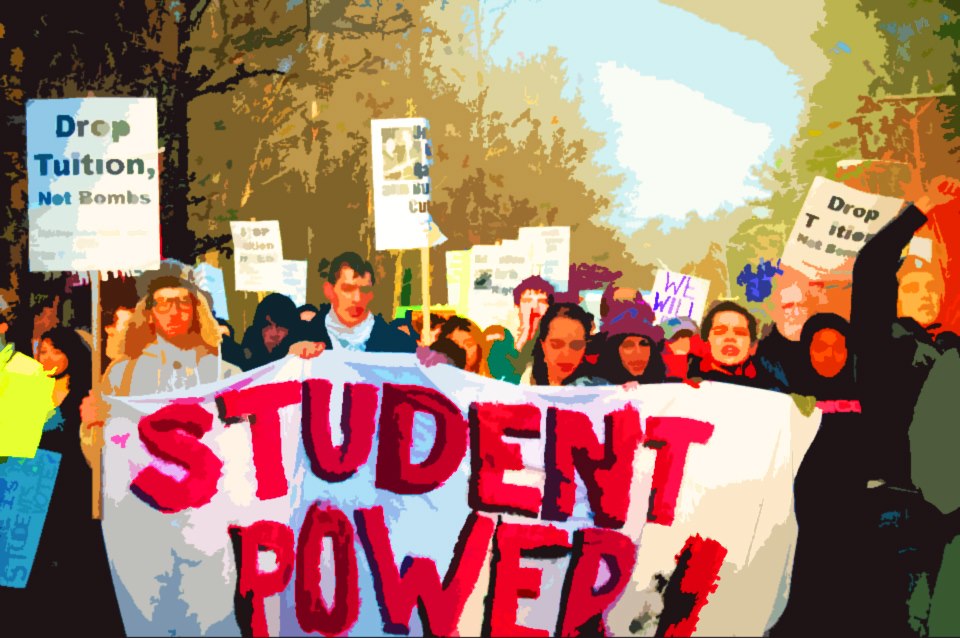
Philip G. Altbach in his book Students Politics in the Third World explains students’ politics as civil politics and students’ community as civil society. Such civil societies and groups perform historical proactive engagement with the governments.
Like all other systems, students’ movements are also having several drawbacks. The educational institutions, curriculum, syllabus and students communities are different in different regions of India. So the conditions to politically assemble, work and independently engage in union activities are limited in this country. The majority of these kinds of institutions are designed hardly to accommodate or represent the economically weaker sections, backward castes and various cultural identities.
The products of our educational system are for market as decided by the imperialists. Although we have 569 universities, 36,000 colleges, 30 National Institution of Technology (NIT) and 11 Indian Institution of Technology (IIT), we do not rank among the top 200 educational institutions of the world as per the list of one UN agency. Ironically there are many Indians teaching in these top 200 educational institutions.
The upliftment of historically oppressed communities such as Dalit, Muslim and Adivasi are being suppressed by the administrations in central universities like EFL University and other higher educational institutions. The circular of UGC warns universities to be cautious about ‘religious fundamentalists’ and the Dalit and Adivasi groups. This indeed is a deliberate attempt to intensify marginalisation of socially backward sections and minorities. The students’ movements should consider all these realities before manifesting their space. We should also be conscious about the continuing British colonial education system in India ie., ‘Macaulian’ stream.
The civil society serves to route the engagement of political society into more fruitful ways. The involvement of political society is mostly violent and sentimental due to their coarse experience of issues. The civil society attempts to solve those issues by inviting government attention. NGOs, trade unions, students’ movements, journalists, social activists etc. are included in civil society, which are just an annex of government. Nevertheless, the self-acclaimed civil societies mostly consist of a particular castes and class. So they cannot holistically represent the diverse political society.
The actualisation of political system will come into reality only when the political society become civil society. But unfortunately the ruling blocs never allow to actualisation of this, because they have apprehended the collapse of ruling composition.
Students Movement in Post Secular Period
However the students’ movements have succeeded in manifesting a new space in social structure. It is well known that the students’ movements were behind in the discourse of gender debate in France during 1960s. Today Indian students are effectively engaging in various fields such as virtual spaces. Students’ organisations are involved in utilising cultural space as well. During 1930s the students in Osmania University struggled for Telugu language by singing ‘Vande Mataram’ whereas in 2009 the same Osmania University witnessed ‘beef festival’ and in 2011 ‘Asura Festival’. These are some examples of cultural mobilisation of students.
The amoebic structure is suitable for any students’ organisation, who long to impact the whole nation. This structure is much flexible to diverse region and culture. This is necessary to reach into the roots of all types of students communities. Sangh Parivar is the only organisation who could effectively implement the amoebic structure in India.
The policies of a political students’ organisation should be in accordance to acknowledgement with the diversity of nation and new situations. Therefore India requires a new students’ political organisation which works in diversity and emphasises on academic politics. The future of our nation will be safe only when both ideological liberation and social liberation get equal importance in students’ activism. So let us re-orient our activism accordingly.

Great words and presentation