

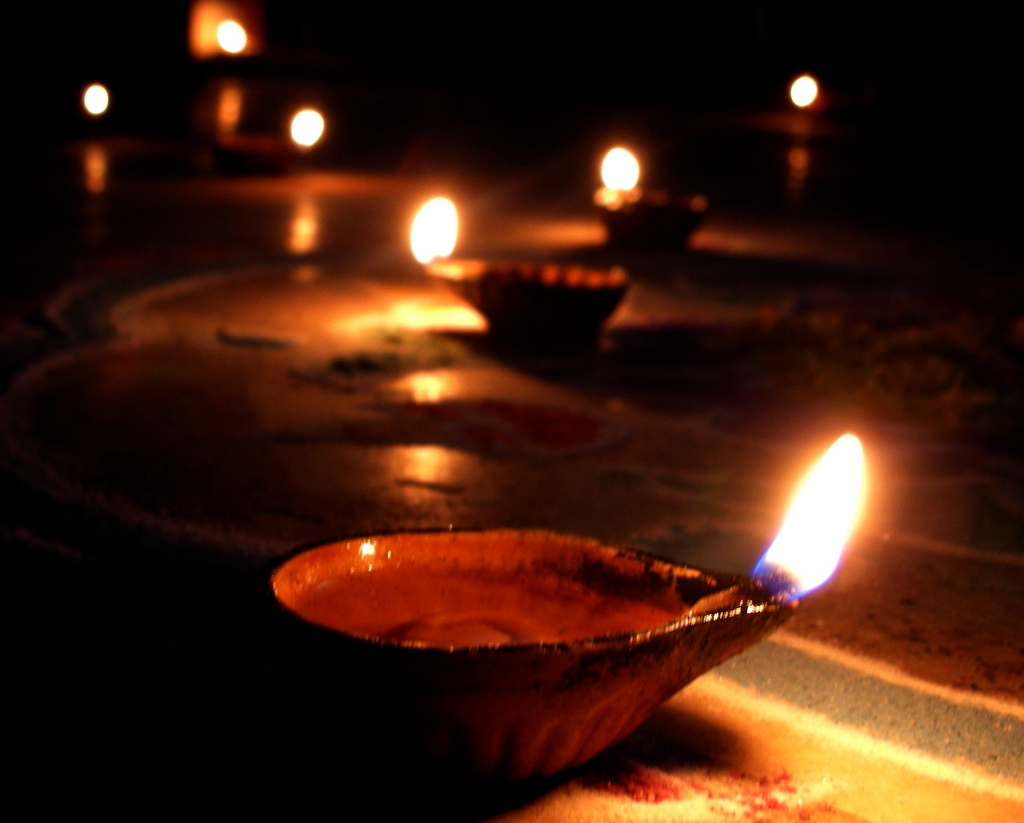
Once more it’s that time of the year when rows of neatly lined earthen lamps impart a regal look to even the shabbiest of looking huts, when just to have a bite of that yummy desi ghee ke laddoo you would grab one even from the puja altar without much guilt, when you would compete with your neighbors to have the best rangoli at your doorstep, when you would burst crackers till the wee hours of the night and try to gather as many memories as you can to last you for a lifetime or standing alone in the balcony of your hostel miss your family or long for ghar wali diwali.
Celebrated in the months of autumn, when nature’s beauty is at its peak, Diwali marks the beginning of the Hindu New Year. Diwali celebrations start with people buying gold or gold and silver coins on Dhanteras, the first day of the festival of lights. The second day known as Naraka Chaturdasi or more popularly as Choti Diwali, starts with taking the customary oil bath before the beginning of the main celebrations on the third day. The most awaited festival of the year i.e. Diwali is celebrated on the third day amidst the brilliance of hundreds of diyas, deafening firecrackers, innumerable variety of sweets, love and togetherness. On the next day i.e. the fourth day of Diwali, Govardhan Puja is performed in the northern parts of the country while in the south of India the day is celebrated as Bali Padyami. On the fifth and the final day of the celebrations, it is time for the siblings to get together for Bhai Dooj, Bhai Pota or Yama Dvitiya.
It would not be wrong to say that it is the festival of togetherness and perhaps this is the reason why Diwali is a favorite festival of majority of Indians, especially the younger generations.
With so many festivities lined one after the other, it’s difficult to remain untouched by the magical beauty of it all. More than the pujas it is the joy of being together with your family. It would not be wrong to say that it is the festival of togetherness and perhaps this is the reason why Diwali is a favorite festival of majority of Indians, especially the younger generations. The endless gossip sessions, small fights between the siblings, secret jokes shared between sisters, the hyper activeness all around the house, the rich aroma of traditional mouth watering delicacies wafting from the kitchen, the sight of rich yellow colored marigolds strewn along the verandas, diyas lighting every corner of the house, paper lanterns going high up in the sky dispelling the darkness, the fairy lights wound carefully around the trees, the colorful fireworks, the mind numbing crackers are more than enough to lift the spirits of any wretched soul.
But, unfortunately the whole magical feeling of this beautiful festival is marred by the pollution created by the bursting of the firecrackers. The pollution caused during this time spells trouble for people who have asthma. It aggravates their condition and the harmful gases coming out of the crackers are powerful enough to cause new cases of asthma in children.
Apart from the crackers, gambling is another evil that creeps in on this very night that signifies the victory of good over evil. According to the legends it is said that Goddess Parvati played dice with her husband Lord Shiva and upon her victory announced that whoever gambled on this night would earn more wealth throughout the year. Although it is a light hearted game supposed to be played amongst the family members some people take it quite seriously and visit the local clubs and casinos taking out all the fun from it. Some even spend the whole night away from their family engrossed in the vices of gambling and liquor.
That magical time of the year is here again – every corner of the house is spick and span, furniture washed and polished, gardens perfectly mowed, fairy lights already in place, diyas in different shapes and colors washed and dried and now all we wait for is the night of the new moon. Let’s ensure that we have a much greener Diwali this year, so the asthma patients don’t have to lock themselves away in a room alone with their inhaler and everyone – from the young to the old get a chance to enjoy to their fullest. And let the lights dispel the darkness of ignorance.
splendid piece of writing. But I do have couple of comments to make.
1. Pollution was the recent phenomena introduced linking to the festivals in India, be it Green Diwali/Green Ganesh Chaturti or Green Holi.
some way or the other many communities are welcoming the idea of conservation of nature and natural resources.
2. Often we overlook the condition of fire-factory workers which employs majority of child-labors and women whose safety and basic rights are compromised.
3. The festivals in India end-up with over-spending on food and these days ONLINE-OFFERS that misses those section of people to whom every morsel of food counts.
I wish that we Indians understand the condition of our people and make the little changes on our life that MAKES A DIFFERENCE. Let us draw inspiration from the festivals we celebrate.
More articles on Indian festival should be promoted for better understanding of Pluralism of India.
Happy Diwali to all and The Companion staff.
u dont seem to be considering the God angle. all the pujas are for different gods, which is actually not true. there is only one god. lord of the worlds. to Him is all praise. he alone we ought to worship, and he alone we ought to call for help. he is the master of the day of judgement