
Statement 1: If you appear in the examination without head-scarf (Hijab), your faith will not vanish.
Statement 2: Plea is nothing but a matter of ego.
This is what our Hon’ble Chief Justice of India had to say on the controversies brewing about an AIPMT exam being cancelled due to cheating and CBSE coming out with new stringent dress codes to avoid unfair practices during examination.
Two propositions can be made in response to these remarks, which were extremely demeaning and derogatory. A person sitting in the highest judicial position is not expected to behave with such an insouciant attitude and talk in such a vile parlance.
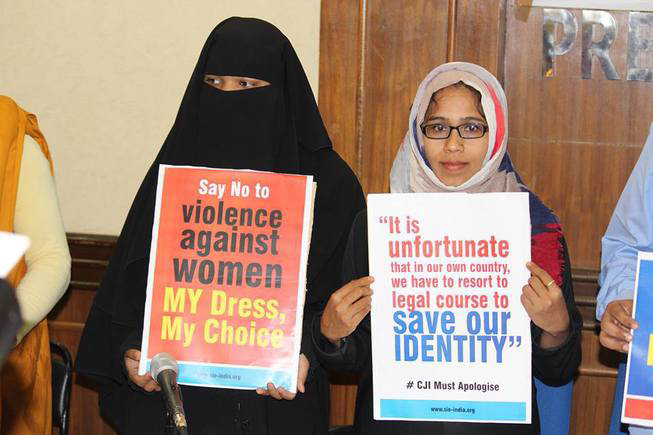
Proposition 1: My body, my right. My hijab, my choice. Faith comes with practices.
Proposition 2: Were it ego, let it be. Modesty ought to come with ego. Nonetheless, it is our fight for fundamental rights.
Religious identities are a manifestation of faith into the belief system people choose to follow. These identities can’t be tampered with by any institution. Not allowing a Christian girl in Kerala and a Muslim girl in Lucknow to write medical entrance examination are blatant aspersions on minorities. The ‘covered’ have been victimised with the CBSE moves on dress code. The fact that CBSE comes with prescribed attire norms to preclude students from resorting to unfair means in the examination shows an illogical coherency. Detailing what to wear and what not to, unmasks the failure of the CBSE to conduct the exam fairly. This indicates the institutional debacle of the poor surveillance system and invigilation at an all-India level examination.
Such a highly nonsensical anti-cheat dress code should be decoded as the colonisation of the wardrobe in general and deprivation of the religious minorities of their constitutional rights to practice what they have reason to value, in particular.
If you have full sleeve button-studded shirts in your wardrobe, replace them with t-shirts or half-sleeve shirts. You are highly unwelcome at the exam hall if you go like a gentleman with formal shoes. Make sure that a hanging clock is there in the examination hall because your wrist watch can be a calculator. Now, the CBSE will dictate you on how to dress up for the entrance exams. Thanks to the CBSE that it has not asked the Sikh minority to remove turbans and the curly-haired dudes to go bald before applying for AIPMT. Such a highly nonsensical anti-cheat dress code should be decoded as the colonisation of the wardrobe in general and deprivation of the religious minorities of their constitutional rights to practice what they have reason to value, in particular.
Harassments, molestations and rapes count as instances of gender violence in academic public discourses and spur civil society agitations and public resentments in the form of rallies and slogans-raising, demanding the culprits to be hanged or arrested, and politically-heated discussions. Is not the ban on head-scarfs a case of gender violence, though on a lesser level, or more appropriately, womanhood defamation? Is it not a selective reading of gender atrocities? My argument should not be deciphered as my acceptability of physical assaults on women.
When Deepika and the likes choose to uncover (refer to ‘Vogue empower’https://thecompanion.in/test/the-dogma-of-selective-and-racist-feminism/), it comes under “my choice”. When others choose to cover, it is painted as anachronism and gibed at, with the snide comment that ‘your faith will not vanish in 3 hours’. “My choice” applies as much to Hijab as to other sartorial fashion. It is not the stint of 3 hours which is objectionable but rather the dress code mandate which is curtailing the independent decision-making rights of the minorities in a democracy. This curtailment has negatively affected the pluralistic ethos of the nation.
When the government recently asked Internet service providers to block around 857 pornographic sites, it was heavily criticised and thought to be moral policing, where the government was attempting to imperialise people’s privacy. Ill-liberals called it as an encroachment on their freedom of expression. Media, celebrities and free-speech propagandists all expressed serious dissent over the ban. However, the order was soon withdrawn with the dictum that only child porn be banned, on the ground that “we can’t be present in everyone’s bedroom”. The argument to be made here is: why can banning the head-scarf not be articulated as an attack on freedom of expression? Why is this kind of womanhood defamation not seen as objectification of women? Why does the government want to peep into minorities’ covered faces?
Democracy should offer its citizens the freedom of decisions and widen the domain of opportunities. Banning head-covering, which will have a direct bearing on the people’s participation in education, will indeed reduce opportunities and strengthen gender inequality. This will further aggravate discrimination against minorities and badly affect their social and economic participation in the mainstream.