

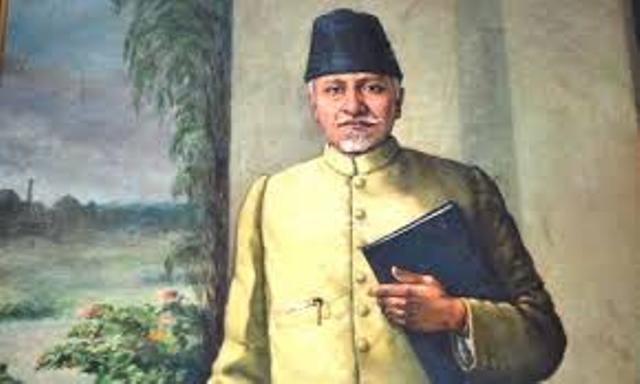
“A truly liberal and humanitarian education may transform the outlook of the people and set it on the path of progress and prosperity, while an ill-conceived or unscientific system might destroy all the hopes which have been cherished by generations of pioneers in the cause of national struggle.”
(Abul Kalam Azad , Press Conference, February 18, 1947.)
Its fascinating how history remains mum about some of the most crucial moments of a country. On that fateful day of Independence in 1947, Abul Kalam Azad took over the reins of the Ministry of Education.
Given the conditions prevailing then, this was a moment more potent than any other. The country had just emerged from the bondage of slavery, and was now in the midst of some very uncertain times. People were as dispersed and disunited as ever. The illiteracy rates were abominable, and the public unruly. The country was in dire need of a man with a broad vision, a sound character, one that was humane, unbiased, transparent, and democratic in a true sense, one who would dispense his responsibility of educating the masses ably with great commitment and perseverance. Azad easily fits the bill.
It was the incomprehensible profundity of his intelligence, wisdom and erudition, that he was held in such high regard by his fellows, including Nehru and Gandhi. Both had known him closely since the time he set foot into public life and were aware of his concerns and services he had extended for their betterment. He was simply the right man for the herculean task. The path he was to tread upon was not a flowery one. It is always so for a person with a gnawing conscience, the feeling of accountability for the needs of every single man in the newly formed state. In his own words, it was a noble responsibility he was endowed with.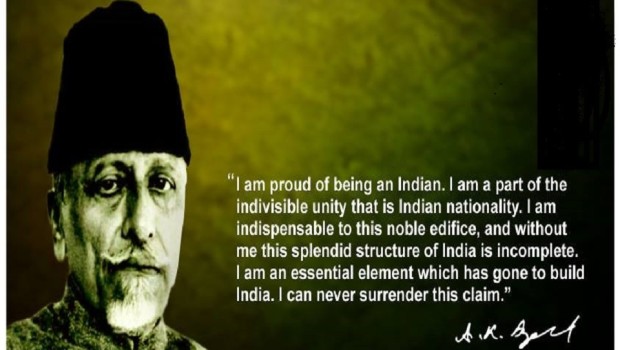
Azad’s philosophy of knowledge and education was as unique as himself. Education to him was not some learning and muttering of words and letters to achieve a material goal. He saw in it a far-reaching purpose- reform of not just human behavior, but of minds and hearts; inculcating the right values and ideals of truth, justice and tolerance, instilling in them a sense of understanding, co-operation and togetherness, to ultimately serve for the welfare of the society and in turn, the whole nation. This for him was the sole basis for any kind of education, without which it had no meaning whatsoever.
He saw education as a tool to promote unity, democracy and communal harmony. He abhorred communalism and sought to eradicate feelings of hatred and dissension through general education, which was quite resonant in his speeches.
He saw education as a tool to promote unity, democracy and communal harmony. He abhorred communalism and sought to eradicate feelings of hatred and dissension through general education, which was quite resonant in his speeches. At the convocation address at AMU in 1949, he said, “…the educational set-up for a secular and democratic state must be secular…It should have its own intellectual flavor and its own national character. It should have as its aim the ideal of human progress and prosperity…a scheme of common education for all without distinction in favor of any community or group.”
These words are as applicable today as they were in 1949. He was aware of the horrendous impact a ‘communal’ and ‘colored’ education would have had on students. Being a part of a diverse and pluralistic society, Azad knew there had to be a way to imbue its people with tolerance, acceptability and civility, without which the security of the country would reach a crisis. He stressed on use of books and material that taught values of unity and brotherhood, and very openly shunned divisive notions and ideas, as well as opposed sectarian and separatist nationalism. He endeavored to liberate his people from the manacles of caste and creed, irrationality and superstition.
He is known to have said, “In the advancement of nations there is no greater hindrance than narrow-mindedness. It is our duty to keep ourselves free from this disease in the new era of Independence.” His writings and thoughts echoed his belief that for a nation to prosper, it had to be united ‘politically, economically and socially.’
Another important aspect of education that he came up with was that of ‘social’ education. In other terms it was the education of the adult population. He was aware of the positive outcome of such an endeavor, if it were to be promoted seriously. He wanted the public to be acquainted with the meaning of democracy, secularism, their rights and duties as citizens, about public health, the prevailing social conditions, and about freedom and the obligations that came with it, to evolve them into a society free from the encumbrances of years of colonization. In his words, it would help in the “production of an educated mind in the masses in the absence of literary education”. He knew educated individuals were not created through reading and writing alone but through enlightenment of minds. That, however, is not surprising. History is witness to some of the most eminent ideologues who arose from amongst self-taught philosophers and thinkers, he himself being a class apart among his contemporaries despite the fact that he was never exposed to any kind of formal education.
In spite of his dislike for the traditional form of education that he had received, Azad did not in any manner advocate against religious education. He believed in an integrated approach, where religion and science would complement with each other. In his presidential address of the 14th session of CABE 1948, he said, ” the solution lies not in rejecting religious instruction in elementary stages, but in imparting sound and healthy religious education under our direct supervision so that misguided credence may not affect the children in their plastic stage.” He would often publicly accept that his thoughts found origin and evolved from the religion he was an ardent follower of, and made no secret of his equal pride in being a Muslim and an Indian at the same time.
For Azad, man was not just a social animal, but a being perfect in creation. He further explained in his address, “If we think of man as only a progressive animal, there is nothing to prevent his using science to further interests based on the passions he shares in common with animals. If, however, we think of him as an emanation of God, he can use science only for the furtherance of God’s purpose that is the achievement of peace on earth and goodwill to all men.”
Besides his incisive thoughts on primary education and its importance, Azad was equally concerned with teachers and their method of instruction. He urged them to “develop a spirit of real service and dedication in the cause of the nation.” This is perhaps where most of our educationists and teachers falter. There rarely comes a teacher who wholeheartedly takes up the job of transfusing knowledge to nurture and mold young minds. Azad was aware of how most saw no other objective in it other than fiscal gains in service to the government. The standard of a student is directly proportional to the quality of instruction given, and instruction is not whole unless it is purged of all hypocrisy.
There are many other takeaways from his thought on education- that education is a birth right of every citizen and no state can claim to have done its job until every citizen receives what is due to him, that children should be taught in their mother tongues to allow them to think ‘naturally’ and not ‘artificially’ via a totally foreign language, that women must be educated so they are on par with men in the society, that education should be rational and ‘add’ to one’s intellect, that if the problem of education was solved, many others would cease to exist.
Abul Kalam Azad laid the foundation of education in India with clear objectives in mind. He wished to see a country with “men and women of vision, courage and honesty of purpose,” to steer the country towards further development through improvement in education, science and culture. His achievements in his tenure of eleven years as the Education Minister are uncountable. He is credited for the National System of education, the foundation of National Policy of Education (1986) and for the reorganization of the All India Council for Technical Education. He established a number of institutions with educational and cultural significance. Some out of all the worthy mentions would be- the University Grants Commission, Council for Scientific and Industrial research, the Indian Council for Cultural Relations, the Hindi Shiksha Samiti, and Sahitya Academy. In 1958, the year he breathed his last, the Central budget for education was more than 30 crores, which was raised from just a mere 2 crore during his tenure.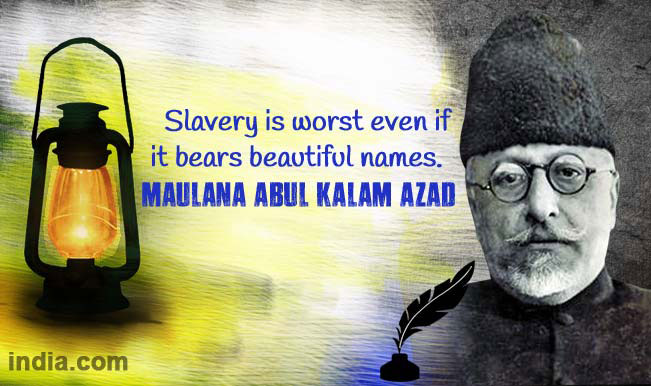
There is something more fascinating about history. When told truthfully, it doesn’t part without revealing to us how much we measure up. More than 60 years later, we still house a large percentage of illiteracy. We have some of the most abysmal government schools and educational institutes where the infrastructure stagnates just as the low quality of education imparted. Government employees are attracted only by the lure of lucre. Absenteeism is abundant not just in students in government run institutes but equally in teachers, who are also deprived of any sense of accountability. There are frequent claims and rhetoric about our educationists formulating new policies to transmit ‘quality’ education to all and attempts to end illiteracy, but what is overlooked is that such claims are too pedantic and the impact is barely visible. There is still a tremendous need of improvement at all levels of education.
When Abul Kalam Azad first took over as the Minister of Education, there was something about his conviction. He dreamt of a country imbued with ideals of unity, brotherhood and non violence. What we see today in our society, is the direct consequence of our sanctimonious commitment to the cause of education. It is the utter failure of our educational system that even in this day and age of ‘freedom’, we still see corrupt, biased and communal minds flourishing in our society, and kakistocracy itself being backed and supported by a major portion of the public including the top brass in the country and the very proof of it lies in the deliberate silence of our history books on our First Education Minister’s untiring efforts.
Its high time we ‘truly’ celebrate Azad and his ideals.


Marvellous tribute to Maulana Azad.
The present education system is under the threats of saffronisation, manipulation and unscientific tendancies. At this juncture we need to remember Maulana Abul Kalam Azad and his ideas. Hope those who have got the noble chance to be educated in this country of majority of illiterates, must strive for the spreading of knowledge and education to bring the sunlight of the wisdom in all…
A nicely written piece.