
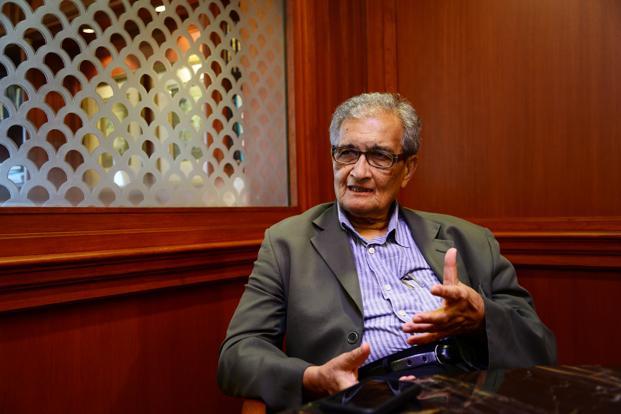
“Those who dream about India becoming an economic superpower, even with its huge proportion of undernourished children, lack of systematic health care, extremely deficient school education and half of the homes without toilets, have to reconsider not only the reach of their understanding of the mutual relationship between growth and development, but also their appreciation of the demands of social justice, which is integrally linked with the expansion of human freedoms.” This is how India’s two leading development economists Amartya Sen and John Dreze define and argue on the prospect of Indian growth. India booming- but for whom? This is the question put forward by the duos in their noble book, An Uncertain Glory: India and its Contradictions.
No doubt, since independence the nourishment of Indian democracy is incredible. And in seven decades, it has set its foundation so strong that it is in a position to challenge the superpowers especially in terms of economic growth. In the last two decades the pace of growth rate has been remarkable and has reached its maximum height of 9 per cent during the period of 2003-2007. After the reform brought by P. V Narsimha Rao in 1991-92, India has never looked back. The growth is rapid in post reform era and is moving towards the free- market economy. The Goldman Sachs, an American multinational banking firm predicted that India will take over France and Italy by 2020 in terms GDP at current price later Germany, UK and Russia by 2025. However, for the first time after reform India has beaten China and and it is playing an influential role in shaping the global economy. International Monetary Fund ranks India as seventh largest economy of the world in terms of nominal GDP.
This is would be the partial truth if we ignore the social conditions and living standards of Indian within its boundary of the same booming nation. United Nation in its Millennium Development Goals report 2014 writes that “Still, nearly 300 million people live in extreme poverty in India and face deprivation in terms of access to basic services, including education, health, water, sanitation and electricity”. In another MGD study UN argues that India is a residence of one-third of total extremely poor people of the world.
“Over the past few decades, for a stark reminder of the global gulf between the rich and the poor a visit to any country in the third world has sufficed. India is one of the most striking examples. Here we have our least fortunate living with resources less than those available to dwellers in sub-Saharan Africa, and our wealthiest in the list of the world’s top 100 billionaires,” is what ‘Oxfam India,’ an independent organisation working on global inequality, concluded about the income inequality in India. Increasing income-inequality is another matter of concern which is already affecting the aim of sustainable development. In pre liberalisation era there were hardly any billionaires on boat. But in another three decades, India ranks third among all countries in producing highest number of billionaires and is expected to grow incredibly with the time. The story itself reveals the pace of growing income inequality in the country. And if it continues to grow like this then the outcome will be very odd as Peter Singer moral philosopher from Australia warns that growing “economic inequality can give wealthier people an unacceptable degree of control over the lives of others and it can undermine the fairness of political institutions and economic system itself.”
Now after the distribution of wealth let’s analyse the amount of pie general population is getting from the cake of development. In 2014 Indian Economic Summit, Mint published top seven challenges Indian economy is facing and key agenda to discuss under the theme ‘Redefining Public-Private Cooperation for a New Beginning’ that included issues like Education, Urbanization, Health, Sanitation, Gender, transparency and Water scarcity.
The status of education system in India can be judged by recent ‘Bihar and Gujarat topper scam. Infact these scams are not unique, there are many such reports on various education scams from all the states, once you Google you can find many results. Vyapam Scam also falls in same category.
According to Akshay Saxena, co-founder of Avanti Learning center, millions of children are unable to go to the high school and 50 million students having terrible high school among all those fortunate children who finally make their high school. In his words “education is a problem of teachers, students and curriculum, public schools facing tremendous shortage of teachers at millions”.
India once holds the pride for being the ‘center of learning’ while having institutions like Nalanda University and Taxila, but in 21st century none of institutions from India are able to occupy space in top 200 colleges of the world. This doesn’t mean India does not produce extraordinary minds but the fact is after graduating from IITs and IIMs Indian minds look towards Europe and United States for the research programs.
In 1964-66 Kothari commission recommended that India should spend 6 per cent of the GDP on education while according to 2010 data India spends merely 3.3 per cent of the GDP when the global average is 4-9. While comparing from country like China and Sri Lanka we find that they have much better education facilities and literacy rate, even education sector primarily manage by the public sector. It is either because of corruption or lack of funds or may be because of the prevailing education policies. From primary to higher, the crisis is going deeper and deeper in Indian education system.
Other public sector including healthcare is facing same kind of ignorance by the government. Expenditure on health is continuously shrinking even in current budget proposed by Jaitly, it is reduced by 15 per cent. The data says one million people die every year because of inadequate healthcare facilities and around 700 million people have no access to specialist care. So in such circumstances the question will be obviously asked from the government that ‘who is getting all pies of cake’?
“Since the practice of democracy depends greatly on which issues are publicly discussed, the comparative silence of the media on health care makes it much more difficult to remedy the problems from which Indian healthcare suffers. The issue is not only that India is doing very badly in child immunization, but also that this terrible record has remained unchallenged and virtually unaddressed.” This is what Sen and Dreze concluded about health crisis in India in the same book .
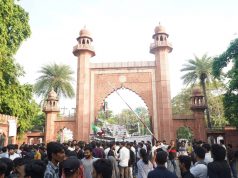
Population is often used as an excuse for the poor social indicators India has. On being asked a question regarding the population growth and the development, Zulfi Sheth, an eminent scholar of economics at Aligarh Muslim University, replies, “Well when baby comes in the world, comes with not only mouth but with a pair of hands too. Like china focused on hands and massively invested in training people and building infrastructure we can follow Chinese model of human development. But for that we need a big push and very stable government with one point clear vision. If we won’t invest in infrastructures specially training institutes, our potential demographic dividend will become demographic disaster.”
Migration, urbanization pollution and the depletion of natural resources also demand equal attention as these issues widely affect the economy in long term and the population, mostly the poor.
Currently India finds itself at 130th position in Human Development Index among 188 countries while in 1991 the rank was 131. So what is changing? What else need to describe the uncertain glory of the India? Yes, India is emerging, growing and shining but for whom. It seems like there is itself an India within the India and ignoring it cannot give any picture than worse in short as well as in long term growth.