
He was an uncommon student for his classmates who used to name and shame him by calling “Thoti” or “Bhangi”, a historically discriminated untouchable caste primarily involved in manual scavenging since ages, the profession of removal of untreated human excreta from toilets or pit latrines.
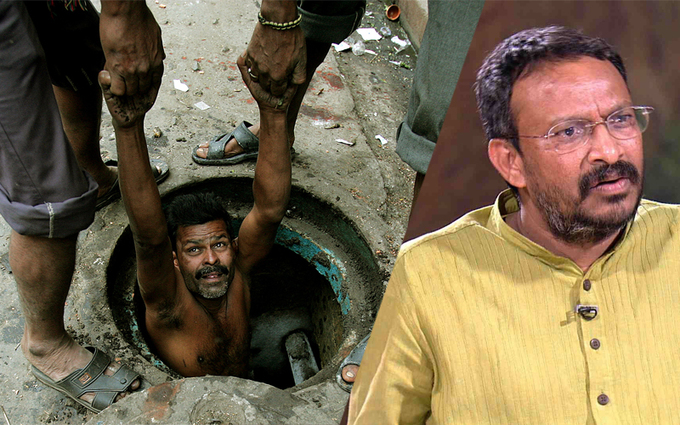
One can witness the other forms of manual scavenging in the municipality workers who are often seen cleaning the jammed potholes in the cities. [1]
He contemplated suicide upon coming to know of his family’s profession and having been brought up in a society that never treated him as an equal human being.
At 20, while applying for a job at employment exchange the officer himself filled Wilson’s desired profession as “scavenging” without even asking for his consent, thanks to the caste he is ascribed to! This incident sparked the vigil within him to fight against the caste oppression and ,in particular, manual scavenging .
Winner of 2016 Ramon Magsaysay award, Bezwada Wilson’s struggle all through the past 4 decades is nothing less than a fight against the insanity and inhumanity prevalent in our deeply discriminatory society. While we eulogize the multifold development in the country post independence there still continues this practice of manual scavenging. An estimate by Bezwada Wilson’s NGO Safai Karmachari Andolan(SKA) counts over 1200 worker deaths on the sewer line go unnoticed each year.[2]
Although the “The Employment of Manual Scavengers & Construction of Dry Latrines (Prohibition) Act, 1993”[3] dictates the prohibition of engagement or employment of persons for manually carrying human excreta and further prohibits the construction or maintenance of dry latrines, ironically the practice of manual scavenging is rampant in various parts of the country especially in the northern states in both private and government establishments. Bezwada Wilson estimates there are around 2 lakhs people still involved in manual scavenging till date.[4]
It is a disgrace for us that the practice of manual scavenging was prevalent up until the late 20th century and still continues. During early 1980s when Wilson started his struggle there were about 2 million people across India involved in this practice. As such the problem as Wilson feels is within the society. He feels the crux of the problem is caste and patriarchy. 80% of the scavengers are feared to be women.
Winner of 2016 Ramon Magsaysay award, Bezwada Wilson’s struggle all through the past 4 decades is nothing less than the fight against the insanity and inhumanity prevalent in our deeply discriminatory society.
Wilson’s struggle started from 1986 when he started sensitizing the community about the problem with manual scavenging and that it won’t help them live with dignity and self respect. It took him around 10 years to take his family, relatives and the community into the confidence about the fight against the manual scavenging. He was successful to bring the whole community on one platform to abolish this profession and work for rehabilitation.
He has been putting pressure on the Government of India from 1986 to till date but the government has barely taken any substantial measure to abolish this practice. A Public Interest Litigation (PIL) in 2003 named all the state and central government departments as violators of Manual Scavenging Prohibition Act (1993). The sad state of affairs has not yet changed for good which clearly affirms the lack of political will in abolishing this menace.[5]
As Wilson rightly promulgates, the crux of the problem is the caste system and the collective apathy toward the fellow human being that every one of us live with day in day out.
It is evident that no one is serious in abolishing this practice. Government, civil society, and the people who employ the scavengers, in fact can be accused of committing this crime.
More importantly, the fact that it took a person from the scavenging community to stand up and fight against the system that doesn’t help a historically discriminated and underprivileged section of the society come out of the menace of manual scavenging, itself proves that there is dearth of conscience in the society.
On the contrary our already bloated education system strengthens this lack of conscience and continues to provide the senseless, roboticized and apathetic individuals many of whom become statesman, educationist, officers, and technologists but fail to recognize the plight of fellow human!!!
It also rekindles the caste question. Whether India is free of caste oppression or it is an uncomfortable fact that no one wants to live with.