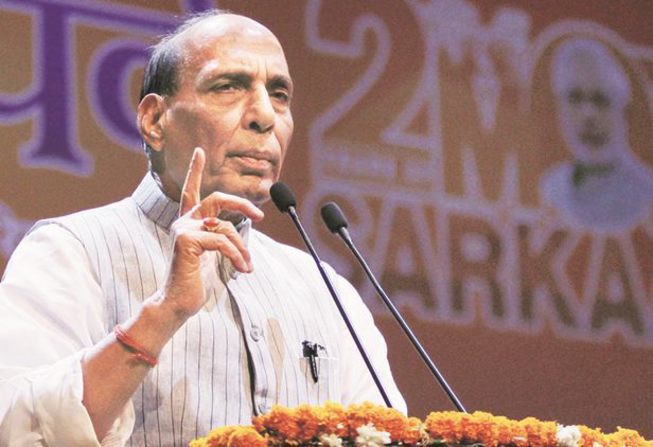
Given rhetoric, seeking to amend the 1955 Citizenship Act, Union Home Minister Rajnath Singh introduced the Citizenship Amendment Act, 2016 in the Lok Sabha on July 19, 2016.
Bringing in the issue of ‘illegal’ immigrants from Bangladesh, Pakistan and Afghanistan, recently, the concern of original Citizenship Act of 1955 that proposed to be amended, has eventually caught a cold hold due to the ‘violation’ of Article 14 of the Indian constitution, as the sources claim the Act might do!
Citizenship Act, 2016
Under the existing provisions of the Act, persons belonging to the minority communities, such as Hindus, Sikhs, Buddhists, Jains, Parsis and Christians from Afghanistan, Bangladesh and Pakistan, who have either entered into India without valid travel documents or the validity of their documents have expired are regarded as illegal migrants and hence ineligible to apply for Indian citizenship. It is proposed to make them eligible for applying for Indian citizenship, Rajnath singh describe the act in paper.
Under the very act, all the religious minority community from the defined neighbor country, will not be considered and indulged as illegal immigrants. Muslims, on the other hand, are not being exempted from being regarded as a threat to the security of the nations.
For the minorities mentioned above – the residence period in India will be six years. Also, illegal immigrants would be permitted to apply for citizenship without having shown valid documents.
The issue
Immigration issue of India and Bangladesh other than Pakistan and Afghanistan has been doing heavy rounds for years in the north east of India. From time and beyond, migrants from Bangladesh considered to be illegal on the ground of unavailability of legal documents or staying beyond the time permitted to them, have been making up-burning security and socio-political grievances.
By seeking to grant citizenship on the basis of religious denomination, it is blatantly in violation of the constitution, said Shalim Hussein of the Delhi Action Committee for Assam. The Act permits all the minorities from the trio Muslim dominant country but barred Muslims specially from accessing the Indian citizenship, which ultimately violates the Indian secular ethos, as per claimed by several activists.
Is the bill communal? What Politicians/Activists have to say-
BJD’s Bhartuhari Mahtab, in Lok sabha, raised his objection against the introduction of the bill, saying, “This bill needs proper scrutiny. Specific amendments have been listed in it. It needs a proper discussion. I would request the government to form joint committee and refer the matter to it and should discuss the matter in a time bound manner.”
Other than parliament Act also faced harsh response from the streets, September protest in Delhi brought bunch of unpleasant to the government. Banojit Hussein, an active protester at the rally, keeping the issue in mind, said, “This would mean, for instance, that the sizable population of Hindu migrants from Bangladesh living in Assam would become citizens while Muslims who migrated to Assam from East Bengal a century ago would continue to be harassed as ‘illegal migrants from Bangladesh’. This amendment makes plain the BJP’s agenda in Assam. It aims to consolidate the Hindu vote through this amendment.”
The major queued-up agitating liners therefore are–first, whether the seclusion made to the Muslims through the bill was actually for vote purpose, and second, will not the secular idea of Indian state be thwarted by anti-secular notions?
Having formed a basic structure of what illegal immigrants are and what citizenship act of 2016 is, even mass across, has been putting up the bill in a question of being communal, and rightly so!
Consequently, the law manages to shelter minorities, claimed of religious persecution, except Muslims. In the talk of ‘religious persecution’, the mass may raise question on them being intimately discriminated in India. Who is to answer this question? And, in order to ordeal one stance, are we to let go the other, important ‘secular’ nature of Indian fraternity?
Even when the matter is of religious persecution then why Muslims of Rohingya or certain sub section of Muslims like Ahmadia in Pakistan were denied? The questions are many and without any second thought – the bill does stand uprooted to certain ideological tribulations, which in turn, are resulting to behead the nature of article 14 of the Indian law and the communal harmony of the India.