
The ‘Kashmir conflict’ has crossed decades of unrest and has, profoundly, become the Asia’s longest political conflict. When in 1947, joint India got divided on ‘politico-religious’ lines, unfortunately, final ‘settlement’ of Kashmir, then princely state, remained an ‘unaddressed’ political question. Subsequently, socio-political impact of ‘Kashmir conflict’ made its way to grow further and, unpredictably, it sneaked into every single social formation of Kashmir society; from individual to family; from group perception to popular perception; from masjid to market; from proletariat’ to intellectuals and from political to academics. It affected overall behavioural pattern of society, not leaving any individual or collective social, political, and psychological aspiration and communication unchanged. Being, essentially, a destructive phenomenon, conflict fetched unprecedented challenges and shaped wretched conditions of living, practically, under undemocratic mechanization, for general masses, particularly the youth deprived of opportunities and expression.
Since, conflict, by meaning and application, is other name of violence between two conflicting parties, therefore, damage to life, property and honour are inescapable, however, not justifiable. Situation turns worse, when conflicting parties aren’t equal on power equation, because, in that case, relation between the conflicting parties is described in terms of ‘oppressor’ and ‘oppressed’. And Kashmir, exactly being a victim of such situation, has been witnessing stories of ‘oppression’ at the hands of ‘oppressor’.
When I say ‘oppressor’ and ‘oppressed’ in Kashmir context, it doesn’t necessarily reflect any “anti-national” attitude, as many would generalize, because the scope of ‘oppressor’ and ‘oppressed’ debate is possible even within the ‘nationalistic’ institutions if the very basic ‘constitutional values’ such as democracy, equality and justice aren’t applied in principle. Referring to justice, at institutional level, reminds me of John Rawls, who said in his famous book A Theory of Justice, “justice is the first virtue of social institution and laws and institutions, no matter how efficient and well-arranged, must be reformed or abolished if they are unjust.”
All the way through history of Kashmir conflict, present times are believed to be the worst because of the adversities, humiliations and tortures it caused to the ‘oppressed’ side of equation. In its recent manifestation, already fragile relation between the ‘oppressor’ and ‘oppressed’ deteriorated further and the whole story of ‘oppression’ went viral on internet. It was actually ‘oppression’ of total uncivilized nature, when for the first time, both “oppressor’ and “oppressed’ were in uniform and loaded with arms; ‘oppressor’ wearing usual khaki and carrying bullets, pellets, and pepper gas shells; and ‘oppressed’ dressed in ‘college’ uniform carrying pens, notebooks, textbooks and upto the most ‘lunch boxes’. The action of ‘oppression’ happened at the time, when things were already on boil due to fresh spree of killings, mostly young students, during the ‘undemocratic’ election process.
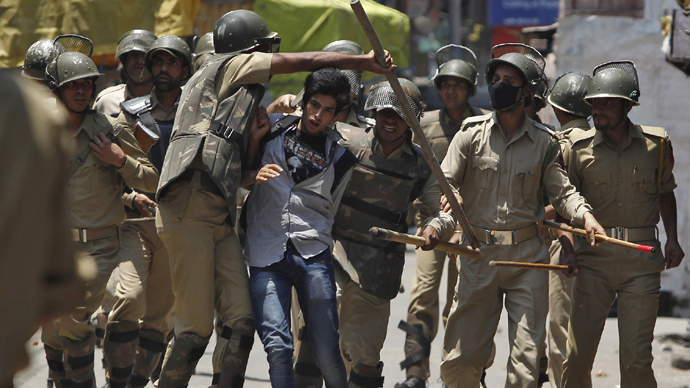
There was apparent wave of collective anger against the oppressor. The oppressor drunk by the sense of unchecked ‘power’ over ‘oppressed’, not realized sensitivity of the matter. However, there was every possibility to avoid ‘violence’, but, ‘oppressor’, being too eager to jump over, couldn’t resist his ugly will to demonstrate his power and impress upon the oppressed that he is too powerful to ‘crush’ you anywhere and, for that matter, he doesn’t need to bother about the ‘place’; be it a busy market; a place of worship; or an educational institution.
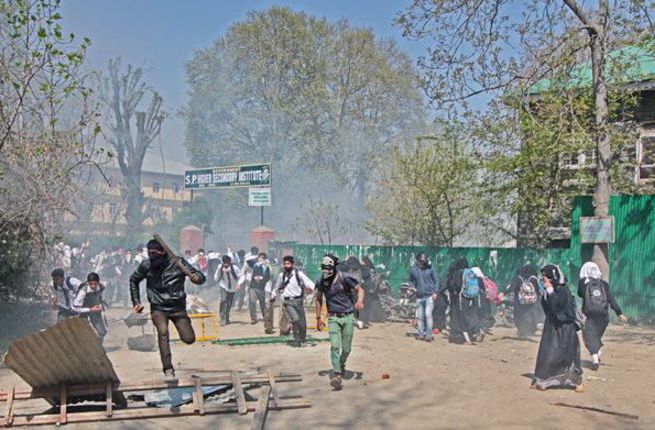
The particular story of ‘oppression’, invoking extensive condemnation from politicians (both mainstreams as well as separatists), academicians, human right groups, and other civil society organizations, actually came from Pulwama, a Southern district of Kashmir. The story begins, when in a ‘normal’ college day, on 15 of April, students were engaged with their regular classwork and all, suddenly ‘Rakshaks, name of a white colored forces vehicle that actually, for an ordinary Kashmiri, transports sense of fear and threat, appeared in front of the main college gate. It is said that, they had come to investigate about those students who had hurled stones on Army just two days back who had visited principals office for organizing some sort of competition under Sadbavna. The news, ‘Rakshaks are making way into college premises, spread across the college and students, including girl students, started marching out of their classrooms- totally trapped inside a disturbed psychology and not being able to reconcile between emotions of ‘violent past’ and seemingly ‘stable’ present.
Students, giving outlet to their ‘boiling’ emotions, raised slogans against “oppressor’ in general and for making ‘unnecessary’ movement inside the college premises, which they believe is sacred, in particular. On seeing reaction of the students, the ‘oppressor’ could have vacated college jurisdiction in a civilized manner, hence, preventing all damage that happened later. But, no, they were ready to let it happen so easily because leaving the college premises, as they thought, would have declared their ‘physical’ defeat. With this thinking, they moved on, committed to register their win over ‘oppressed’ right inside their home- this time college. Without giving second look to idea of ‘let’s fight with muscles’, they did everything what they otherwise do on encounter sites or while grappling road violence.
According to news reports, more than hundred smoke shells (including deadly pepper smoke shells) and some pellet shells were shot inside the college campus, of course, targeting none other than students. Eyewitnesses narrate that how, in seconds, a sanctified place of learning and acquiring knowledge presented itself horribly not less than a practical encounter site. Slogans, stone pelting, frequent movement of Rakshaks, sound of smoke shells, hues and cries of injured students, mostly girls, and beeping ambulances, all together, changed the atmosphere of college campus. Unquestionably, conversely, it was again a ‘moral’ loss of ‘oppressor’ against ‘oppressed’.
This incident of ‘violence’ against students, which could have been successfully avoided, reminds me of “NIT issue” of 2016, when some out-station students were beaten by local police. Within minutes, it became flash news of national media. Immediately, HRD ministry condemned the said incident and accused local police for being brutal and showing inhuman conduct. Even, the upper house of Parliament couldn’t keep silence and ordered direct intervention into the said matter. However, when it was local police beating local students, similar kind of ‘pain’ was not felt in New Delhi, which actually reflects clear signs of ‘otherness’. Such attitude of Delhi brought a clear-cut message for Kashmiri students that even if ‘we’ say ‘you’ are our integral part but that doesn’t mean ‘you’ are equal, rather, we treat ‘you’ as ‘lesser’ humans.
Next day, student community organized protests against ‘forces violence’ at Pulwama College, all across the valley. Most of the protesting students were holding placards reading “We aren’t safe inside “colleges”, “Keep Educational Institutions Free from Politics, “Violence Inside “Colleges” is Undemocratic” and “Law and Order is breaking the “LAW”. Subsequently, fresh clashes erupted and again, it happened between uniformed ‘oppressor’ and ‘oppressed’. Reports of more injuries came from Boys College Sopore, S.P. College Srinagar and Women’s College, Srinagar. The live videos of clash between Students and forces went viral on social networking sites such as Facebook, Twitter, Instagram and WhatsApp invoking further chances of ‘violence’. After all damage was done, injuring more than hundred students, authorities realized that ‘oppression’ is getting counter-productive and ‘violence’ may turn ‘cyclic’ like 2016 public uprising. It was, shockingly, announced that universities, colleges and higher secondaries would remain off for next two days. Moreover, internet facilities, excluding Broadband internet, were barred in order to prevent boundary-less circulation of older and uploading’of new videos.
Some may call it a timely decision to stop escalation of violence, but, I won’t agree because, all these ‘undemocratic’ implications on the pretext of establishing law and order were not needed, if, forces would have understood the sensitivity of the matter before entering into college premises. That time, just one simple order ‘move back’ would have surely made a remarkable difference, of course, amoral victory. Unfortunately, it didn’t happen and oppressor added one more chapter to his book of oppression. I conclude, hoping that this chapter would be the first and last of its kind.