

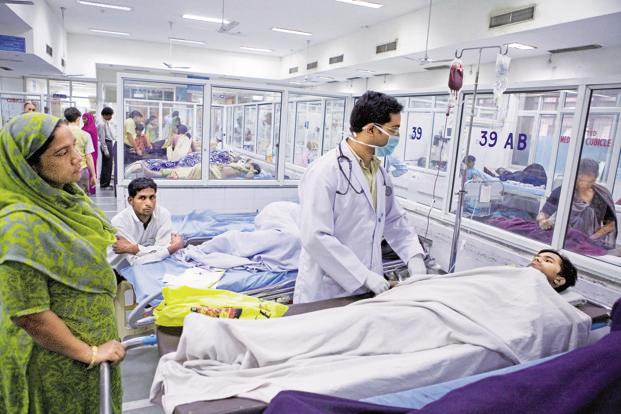
Every year approx 24 lakh Indian dies under treatable condition. Alone in the year 2016, 16 lakh Indian died due to poor health care quality system. The report published in The Lancet suggests the situation of India is worst among 136 nations selected for the study.
Estimated population of India is approx 134 crore which requires serious commitment from the government and vast infrastructure to ensure the quality health of the nation. However, in which India continuously failing.
According to the reports of the Ministry of Health and Family Welfare, India has a total 10, 41, 395 doctors to look after 134 crores people, which leaves one doctor for every 1,287 people.
In Lok Sabha during question hour Anupriya Patel, Minister of State of Health said, “Assuming 80 per cent availability, it is estimated that around 8.18 lakh doctors may actually be available for active service. It gives a doctor-population ratio of 0.62:1000 as per current population which is estimated to be of around 1.33 billion.”
The standard doctor population ratio set by the World Health organization is 1:1000 and India has poor ratio than countries like Brazil (1.852:1000), China (1.49:1000) and Pakistan (0.806:1000).
Healthcare system in rural India
Rural India, however, is suffering most from the ignorance of the poor governing system. In the year 2005, the government of India launched the National Rural Health Mission to provide accessible, affordable and quality healthcare system in rural India. Among other core commitments of the program, strengthening the three-tier healthcare system was the priority.
However, the recent report of NRHM suggests otherwise. According to the yearly report, there are total 25, 650 Primary Healthcare functional with 27, 124 employed doctors in the rural region of the country. Among them, only 958 PHC’s are functioning with four or more doctors. 15, 700 PHC’s are running with the support of only one doctor. Sadly, 9, 183 PHC doesn’t have any lab tech.
The data in the report suggests that 19, 039 PHC’s are functioning without any lady doctor while NRHM claims to focus on Reproductive, Maternal, Child and health of adolescent.
Pradhan Mantri Jan Arogya Yojana (Modicare)
Prime Minister Narendra Modi in September 2018 announced his ambitious healthcare scheme Ayshman Bharat. The scheme claims to provide a cover of 5 lakh to marginalized population of the country.
In the budget speech of 2018, the Ayushman Bharat for a new India 2022 was announced which included two major initiatives, namely creation of health and wellness centres (HWCs) and an ambitious National Health Protection Scheme. (see for details Ayushman Bharat Initiative (2018): What we Stand to Gain or Lose! )
The HWCs are to include point of care, wellness room for yoga and physiotherapy, a private consultation space, free diagnostics and pharmacy, facilities for telemedicine, and waiting area for 30 plus persons.
“Pradhan Mantri Jan Arogya Yojana (PM-JAY) will provide financial protection (Swasthya Suraksha) to 10.74 crores poor, deprived rural families and identified occupational categories of urban workers’ families as per the latest Socio-Economic Caste Census (SECC) data (approx. 50 crore beneficiaries). It will have offer a benefit cover of Rs. 500,000 per family per year (on a family floater basis).
The scheme promises free treatment at all public and empanelled private hospitals with 1,350 medical packages covering surgery, medical and daycare treatments, cost of medicines and diagnostics.
Additionally, the coverage extends to facilities such as emergency medical services, management of communicable and noncommunicable diseases and general outpatient care, as well as reproductive, maternal, neonatal, paediatric and adolescent health services.
The scheme undoubtedly has a positive impact. It reduces the financial burden and gives fair opportunity to reach to healthcare facilities. But despite this, the scheme fails in addressing the very fundamental issue of infrastructure. The scheme heavily depends on public care system but there is no allocation of budget on improving the facilities. The scheme also excludes remaining 60 percent of the Indians. This scheme, however, reduces the role of government from being provider to financier in the healthcare sector.
What’s Ahead?
the K Srinath Reddy, president of the Public Health Foundation of India suggested to increase the healthcare spending up to 2.5 percent of the GDP. Currently, India spends 1.1 percent of the GDP which is surely not enough for the huge requirements of the sector. The country requires several measures which include employing more doctors to meet at least WHO standards of doctor population ratio. Upgradation of PHC’s to prevent the lives of treatable patients.
The World Bank Data suggests that the average global healthcare expenditure is 9.89 percentage of the GDP while India spends only 3.89.
India’s recent allocation to health budget is 63, 538 crore, which is 5 times less than the budget allocated to defence. It’s indeed saddening to see government ignorance towards the health sector when lakhs of Indians are dying every year when these deaths could have been prevented.