

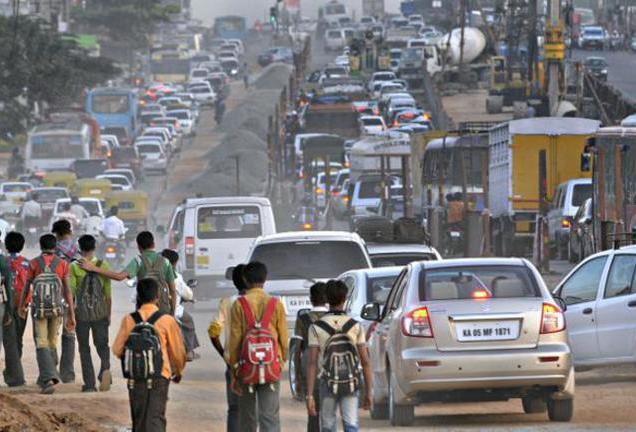
Rapid urbanization, growing infrastructure and millions of vehicles distinguish a city and develop one. Parameters to observe development of a city largely depend on the infrastructural and material growth.
Obsession with Gross Domestic Product(GDP) and industrialization in residential area always dominates over the debates of environmental, health and civic problems. The casualties of what we call ‘development’ are something that are never calculated.
Bangalore, the Indian Silicon Valley; the capital city of Karnataka, drives crowd from all over the world for having expertise in software development. The city is home to 10.1 million people and is the third most populous city in India followed by Delhi and Mumbai. Establishment of Bangalore is not very old and it became the capital of one of the southern states of India only after independence. But the climate of the city is getting worse day by day. Once a cold city is now turning into a hot balloon, but global climate change alone is not to be blamed.
In the name of development, environment suffers the most. Deforestation has become a norm. It takes years to grow a plant into a full trunk tree that helps prevent soil erosion, conserve energy, and purify air to maintain weather. But it takes only minutes to axe trees for widening the roads or streets without caring about the civic and environmental consequences.
According to a research published by T. V. Ramchandra in the year 2015, “Spatial Patterns of Urban Growth with Globalization”, from 1999-2014, urban land use in cities has increased by 184 percent and vegetation has decreased from 45 to 8.4 percent. In the same period, urbanisation in Bangalore has increased to 125 percent. Another haunting data states that more than 50,000 trees have been axed down between the period of 2010-2015 alone. The government planned to cut down some 800 trees for steel flyover project but halted after facing massive wrath from the citizens.
Climate change in Bangalore is now the worst nightmare – once cool, condensed city is now witnessing heat strokes in its early summer. Weather in the capital changes like crazy. From the month of February, temperature rises to 30 degree Celsius and the average temperature in summer reaches to 35-36 Celsius. As a result, winter months are getting shorter and there is no feel of shivering in the morning as experienced 10 years back (several people confessed this on Quora). Rainfall in the last decade is also affected, hunting down of greeneries being one of the reasons. However,Vardah storm in December 2016 brought plenty of rain to Bangalore.
Lakes were the important spot which added an extra show to the charm of the city, but unfortunately, in the process of ‘claimed development’, this has been totally ignored. The number of lakes has reduced to 17 which was 51 back in 1985. Many of them have vanished because of encroachment and construction nearby. Within 30 years, several beautiful spots have turned into markets, playgrounds and also converted into residential areas. And of course, lack of will and poor urban planning has a lot to do with the ruin of eye-catching natural destinations.
With the ever increasing burden on groundwater and poor rainfall, the water table is bound to deplete and go down. If one has to believe on reports of Firstpost, “Bangalore gets an annual rainfall of 900 mm, but the use of over 3 lakh borewells in the city to draw groundwater amounts to three and a half times water drawn than the amount received to recharge it. Hence, it comes as no surprise then that most of the borewells have gone deeper, even up to 1,000 feet and the ones which aren’t as deep have run dry.” The groundwater table is continuously falling and many predictions of vacating the city in the very near future are in the queue, because of a possible dry future.
Moving ahead, on the note of ‘garbage city’, waste generation and its management is another result of poor city management which is damaging the capital with smells and diseases. In the year 2015, two landfills were closed after turning into a garbage Himalaya and leaving behind more than 1 lakh tons of waste which couldn’t be processed. Imagine the level of contamination and environmental degradation of nearby places! Bengaluru alone produces 4,000 tons of municipal waste each day and unsegregated waste can be found everywhere, by the side of the roads or in the nooks and corners of residential areas. All of the waste is neither collected nor segregated even at the point of dumping that ultimately adds mountains to landfills. And this is perhaps the reason why the city of garden turned into the capital of garbage.
Besides these, the number of vehicles can narrate rest of the story of the pollution in the city. Currently, more than 60 lakh vehicles are on the streets with an addition of 5 lakh new ones in each financial year. Vehicular pollution attributes as a main cause of pollution in the capital by emitting 42 percent of particulate and 67 percent of nitrogen oxides in the air. And with further urbanization, health risk is likely to increase at a higher rate.
From the past decade, Bangalore is facing huge environmental and civic crisis. And, of course, the government and the bureaucrats are accountable for this degradation. But turning eye after shifting blames to the government is definitely not going to resolve the issue.
Awareness is one step but ‘solving the problems’ is the real challenge. By making little efforts with a problem-solving attitude, citizens themselves can fix many dents. From segregation to water conservation, it all lies in individuals’ hands. Refusing plastics and polythene bags at very small scale can divert sufficient of solid waste from landfills. Promoting the culture of carpooling and preferring public transport can potentially reduce traffics and air pollution as well. Planting trees and protection of environment largely depends upon individuals. Citizens themselves need to take small but necessary steps to solve their local problems to protect their own piece of beloved land.