

“I aspire to do graduation but there are no colleges in our area, to join college we need to go to Darjeeling where room rents are expensive and financially I can’t commute every day to Darjeeling.”—Adolescent studying in class XII
“I want to do nursing to become a nurse but my mummy and papa will not be able to arrange money for my education.”—Adolescent studying in class XI
“I wish to do masters in arts but then financially I feel it will not be possible....”—-Adolescent studying in class X
The above statements refer to the crux of the article. Higher education is found to be a major tool for social and economic development of an individual. Achievement of higher education increases opportunities in life especially employment opportunities which help the individuals to have economic stability in life. Higher education acts as a status stabilizer. Education has been the only tool which brought a social change and allowed people from lower strata to move out of their traditional position in the society and earn a better living and respect in society. (Uplaonkar, 1988)
However higher education is still a scare resource in India. Low economic background restrains students from going for higher education as higher education is more expensive than schooling. There is greater number of applications for admission but only few gets admission in higher education. The enrollment in primary schools has increased but at higher level it is still very less. In the institution level admission of students does not take place solely on the basis of student’s performance in school or merit. Caste, religion and family background of the students play a role in admission of the students in India. (Jayaram, 1977). Several studies conducted point to the fact that caste in India is a still a significant barrier to enrollment, entry into some occupations and driver of wage-differentials within occupations.
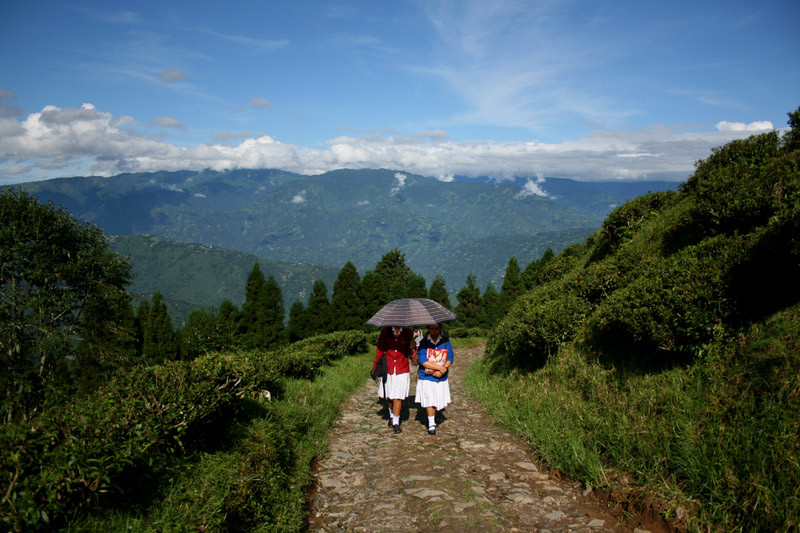
The article is written on the basis of a field study conducted in Rishihat of Darjeeling district in West Bengal. The first objective of the study was to understand the socio-economic background of the adolescents who are children of Tea Garden Labourers. Secondly,it is to understand aspirations of the adolescents studying in classes X, XI and XII, for higher education. The area has faced years of colonialism, even after the British left the country, Darjeeling is still under colonial rule under West Bengal. The area is under continuous agitation for a separate state. In such a situation, it is important to know the aspirations for higher education of the adolescents who have been oppressed for generations. Lastly, the study was conducted to understand the factors that influence the aspiration for higher education of the adolescents. The data was collected from the students studying in standard tenth, eleventh and twelfth who were children of tea garden labourers in Rishihat. Response was collected from sixty-eight students.
The study revealed that fourteen percent students found higher education important to get a job, fifty percent students found higher education important to achieve their dreams, thirty-six per cent students found higher education important for overall development, to get a job, to achieve their passion, higher social status, to meet family pressure, also societal pressure.
The responses from the interviews showed that through education the objective of equalizing opportunities and enabling under-privileged classes to improve their condition has been met because the students desired to get higher education to get a good job and secure future. It is clear from Kelsang’s response, “To settle properly. The amount of suffering, hard work my parents have done that much I wish to give it back to them. To give back the fruit of the amount of money that they have spent on my education, education is the only tool through which I can do that.”
Higher education also helps in achieving higher status in the society as Pravash said, “there are many people who have dropped out of school and are jobless, they are less respected in the society in comparison to people who have graduated or completed higher education.”
The families of these adolescents have been involved in tea garden as labourers for generations and most of the participants were the first generation to pass class X in their entire family. Therefore, they were bringing a social change through education and breaking the chain of poverty, where parents were labourers so they had less salary and lived in poverty. They were in poverty and did not get their children educated. Children were uneducated and worked as a labourer again. Therefore, now through education this cycle is breaking. Parental support and peer support were found to be conducive factor to the adolescents in pursuing higher education.
Parental aspiration for children’s education rather than parents educational level had a positive impact on the adolescent’s aspiration for higher education in their lives. Saurav said that his mother was uneducated but encouraged him to study well. He said that, “There are many works at home, to collect grass, many works regarding goat as well, no matter what work it is, my mother says don’t do that work son I will do it on my own. And sends me to study.” It shows how supportive their mothers are regarding their education in spite of her being uneducated.
When asked about father’s aspiration for their children’ education, Bikas said, “my father wakes me up in the morning serves me tea and biscuits and asks me to study” Therefore, both mothers and fathers have high aspirations for their children and it encourages the adolescents to aspire for higher education.
The study also revealed that majority of the girls said that their friends had positive influence on their education for instance Priyanka said, “I want my friends to study well, one of my friends is very poor and she has to do household work as well so I write notes for her so that she can easily understand”
When Renu was asked about the influence of friends on her education, she said, “Yes, I have only one, she forces me to study. Encourages, if there is any difficulty in class then she tells me to complete one at a time, brings notes and does home-work, says you will not get time.”
In the study, it was found that majority of the male participants had friends who encouraged them to take tobacco, etc. and did not encourage to study. When asked about the influence of friends on education Neeraj laughed and said, “friends only encourage to take tobacco, and other substance, but they never encourage to study”. Boys had negative influence on their peer’s education, it may be because it is a male dominated society where boys have more freedom than girls. Taking tobacco, alcohol etc. are accepted when a boy does it but is not accepted when a girl does the same.
In the study, it was also found that out of eighteen participants eleven participants (61%) said that their parents would not be able to financially support them for higher education. Remaining seven participants (39%) said that their parents will be able to financially support them for higher education, most of them said that it would be difficult for their parents but somehow, they would manage it.
Reena, an adolescent girl who was asked about her constraints against getting into higher education she replied,“Money, money only. Only my mommy works so that’s it, I feel my mommy will not be able to financially support my higher education” she started crying when asked if her mother will be able to support her. She took almost five minutes to settle down.
Similarly, an adolescent boy, Ramesh, a student of class twelve said “dukha garera parauchu”, “I will work hard and educate you, says my parents, but still when we need money it is not available and we need to take help from my cousins.” The boy said that his father tells him he will work hard to educate him but due to financial constrain in spite of his father’s willingness to help, his father is not able to do so. Even the students who had expectations of financial support from their parents for their higher education, informed that their parents will have to sacrifice a lot to educate them.
Jayaram has said that there is greater number of application for admission but only few gets admission in higher education. Education is still a scarce resource in India. The enrollment in primary schools has increased but at higher level it is still very less. (Jayaram, 1977). Although he said it in 1977, it is still relevant in 2017. Even after forty years we can still see that in India Higher Education is still a scare resource. In the interviews, adolescents have said that for higher education after class twelve they need to go to Darjeeling to study and rent is expensive in Darjeeling, cost of living is expensive for them as the wages of their parents are very low due to which higher education becomes difficult to achieve for these adolescents.
There are only three government hostels in Darjeeling namely Roop Narayan Singh (RNS) Hostel for boys, Snow View Hostel for Girls and Youth Hostel. Admissions in these hostels are not easy. Specially in the Youth hostel where the entire process is online. The youth hostel has been open for all population beyond youth. It acts more like a tourist lodge than a hostel which leaves the students with only two options: Snow View for Girls which is functioning till date with few students and RNS for boys which is dysfunctional.
Lack of money, government hostels, awareness about hostels, cheap room rent, public transportation facilities from rural to urban areas along with costly private tuition, contributes in making education a scare resource in rural Darjeeling for the children of Tea Garden Labourers.
The situation of adolescents in tea garden areas are in a greater loss because they do not have any educational support other than school, they do not have any coaching centres, they also lack better internet facilities, information and opportunities. All this contributes to backwardness of the youth, and impairs their studying in rural schools. After overcoming all these obstacles, they go to urban areas and compete with the students of urban areas, who are in a better position by the virtue of living in urban area, where there are better educational facilities, better internet facilities, where extra coaching centres are also available with better opportunities. The students of urban area do not need to spend extra money on rent or hostels so they have less expenditure in comparison to students migrating from rural area while joining higher education. Therefore, adolescents of Tea Garden areas are in disadvantage when it comes to achieving higher educating.
Very less amount of fund has been allocated to education in India in the 2017-18 budget. It has been many years that many students organisations have been raising demands for increasing the fund allocations on education, and especially higher education. The government wants to enhance quality education but there is no funding at all for the Teaching Support Unit which can come up with new pedagogy to bring a whole new teaching models. Critiques have been asking where is the plan to fill the vacancies in higher education? Where is the plan to set up Research facilities? (Garg, 2017)
55% slash on the government’s fund in the UGC in the budget 2016 meant that there was a cut down on the infrastructure and capacity in the public funding system, as a result the quality of education in the public funded university would decrease and the students would be forced to go to private universities, which in turn would lead to promoting privatisation. The UGC Gazette notification pertains to the latest set of amendments, the amendment excludes tutorials and undervalues practical. Two practicals are equivalent to one lecture, the number of lectures that a teacher has to take increases. With the increase in the number of lectures the teacher is left with no space to provide tutorials to the students. (Ghosh, 2016). Massive seat-cuts have happened in universities across the country with the latest UGC notification.
Removal of teachers would lead to increase in the work load of the current teachers. It would lead to less number of tutorials with more students, where the whole purpose of tutorials is lost as it will be more of classroom than tutorials.(Narayan, 2016)
In such a situation will the marginalised students be able to study and compete with the students of the urban context. Will the government institutes be able to provide quality education to the marginalized group when there is continuous cut down on funds for education by the Indian Government. This is a big question mark.
The education of adolescents in rural areas is severely affected. The transportation facilities make a lot of difference in the lives of the students when it comes to higher education. There are very few colleges available in rural areas which makes access to higher education difficult for the students of rural areas. Higher education is available in the urban cities or towns only. Education in India thus is a scarce resource. Although there are many colleges coming up in towns but higher education has still not reached the rural areas of India. This further leads to drop out of students after passing class twelve. It is not by choice but by compulsion because these students do not have money to survive in the urban areas to pay for their course fees, house rent, they don’t have money to meet their personal expenses as well. It becomes even more difficult when there are very few hostels provided by the government. Even the existing government hostels are malfunctioning. It is not properly maintained.
For a country to educate their youth, students should be given proper career guidance and tutorials in schools, colleges, the government should increase number of government institutes for higher education in rural areas. The Government of India should make more hostels for youth and college students with special concession in fees for marginalized communities of rural areas. Public transportation to rural areas should be introduced in Darjeeling so that students can commute to Darjeeling every day to achieve higher education. To achieve all these proper funding is required from the government, only then hostels can be built in urban areas, money is also required for career fairs. Therefore funding is the major part of solution for the crisis in higher education.
Note: All names of respondents here have been changed
References
Uplaonkar, A. T. (1988). Social Background And Occupational Aspirations Of College Students. Delhi: Ajanta Publications.
Jayaram, N. (1977). Jayaram N higher education as status stabiliser: students in Bangalore. Contribution to Indian Sociology.
Garg, D. (2017, February 1st). Perceptions and Reflections on the Union Budget 2017-18 for Higher Education Sector.
Ghosh, S. (2016, June 2nd). UGC Notification: Modi Government’s Another Attack on Education. Retrieved from https://www.youtube.com/watch?v=MQ_T_aBso4Q
Narayan, N. (2016, June 6th). Prime Time: DUTA protests against UGC circular on working hours. (R. Kumar, Interviewer)