

India is often celebrated as the world’s largest living democracy. Yet what is less recognised is how fragile this democracy becomes when its majoritarian character asserts itself in public life. The majority begins to decide the binaries of right and wrong, and defines the nation’s conscience in line with the ideology of the ruling party. In today’s context, this means the BJP and its guiding philosophy of Hindutva. It is no longer the secular conscience of the Constitution that sets the terms of belonging, but the conscience of Hindutva—a conscience that dictates who belongs, who must adjust, and who must fall silent.
Arjun Appadurai’s Fear of Small Numbers: An Essay on the Geography of Anger (2006) offers a useful lens here. He argues that minorities provoke disproportionate anxieties within majorities precisely because their smallness unsettles the illusion of a pure and homogeneous nation. Their mere presence destabilises the majority’s imagined wholeness. In India today, Hindutva politics thrives on this anxiety. The presence of Muslims is framed not as part of the nation’s plural reality but as a perpetual threat to the dream of a Hindu Rashtra. Their belonging is relentlessly questioned, and their citizenship subtly but systematically undermined.
This dynamic brings to mind George Orwell’s Animal Farm, which marks its centenary this year. Orwell’s dictum, “All animals are equal, but some animals are more equal than others” was written to describe how egalitarian ideals were betrayed once power consolidated itself. Yet India’s present condition calls for an inversion: “All animals are equal, but some animals are less equal than others.” Unlike Orwell’s pigs, who privileged themselves by becoming “more equal,” Hindutva terrorists have recast Muslims into the condition of being “less equal.” The radical egalitarian promise of democracy, equality as its most foundational principle has been rewritten to justify second-class citizenship for Muslims.
Festivals, Tolerance, and the Majoritarian Will
In his Treatise on Toleration (1763), Voltaire insisted that “it is not tolerance that is needed, but acceptance of our shared humanity.” Yet this principle of shared humanity seems to vanish whenever Hindu festivals occupy public space in contemporary India. What we see instead is not acceptance but a one-sided practice of toleration, in which the burden falls squarely on Muslims. Festivals such as Ram Navami, Ganesh Chaturti, or the Kanwar Yatra are no longer confined to devotional acts, they have become public spectacles of identity, where the boundaries of belonging are dictated by the majority.
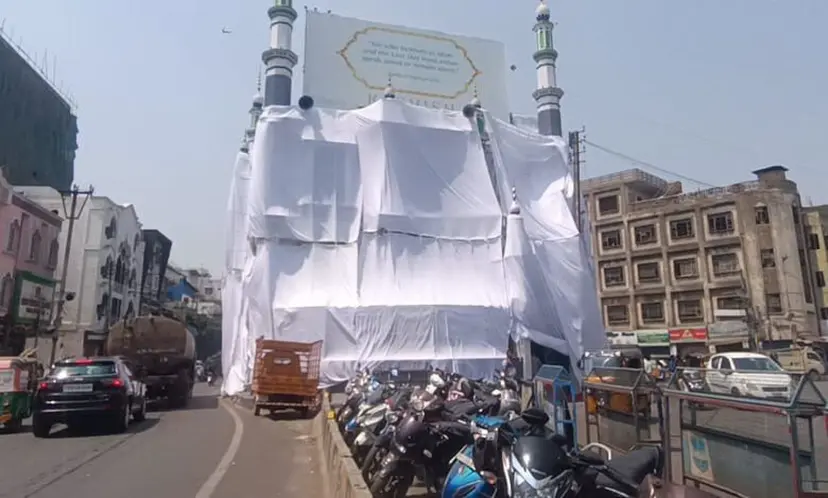
Consider Ganesh Visarjan happened few days ago. As processions move through the streets of Hyderabad, mosques along the route are pre-emptively covered with white clothes and tarpaulins to prevent colours from staining them and to avoid potential conflict. Similar arrangements recur during Ram Navami and Kanwar Yatra, where armed processions march past mosques, often brandishing swords or guns. The message is clear: it is Muslims who must tolerate the majoritarian spectacle. The state, instead of disciplining such aggressive displays, effectively normalises them by placing the burden of accommodation on the minority.
This imbalance extends beyond festivals. The Eid-e-Milad-un-Nabi procession this year, scheduled for 5 September, was postponed to 8 September in order to avoid clashing with Ganesh festivities. Once again, the minority was compelled to adjust its practices. Or take the case of a Delhi police officer kicking Muslim worshippers performing Friday namaz outside of the Mosque because their mosque lacked sufficient space. Here too, the logic is unmistakable: the burden of tolerance lies not with the majority, but with the minority forced into silence or invisibility.
India’s claim to tolerance thus reveals itself as hollow. It is not reciprocal tolerance, let alone genuine acceptance, but what I call “hegemonic tolerance”, a framework where the very meaning of toleration is set by the Hindus in majority, and the Muslims are expected to comply.
Tilak, and the Transformation of Festivals
This dynamic has a longer history. Shabnum Tejani, in her book Indian Secularism: A Social and Intellectual History, argues that the Ganapati festival’s transformation from a domestic ritual into a public spectacle was not an organic cultural development. It was the outcome of deliberate political intervention. At the centre of this reinvention stood Bal Gangadhar Tilak, who, in the early 1890s, urged Hindus to move Ganapati worship from the household into the streets. Writing in Kesari on 18th September 1894, Tilak declared: “If Hindus are to gain strength, they must come together in common celebration, for in unity lies the capacity to resist.”
This was more than rhetoric. By linking Ganapati, the remover of obstacles with the struggle against colonial rule, Tilak transformed religious devotion into political language. He capitalised on a loophole in colonial law, which prohibited large political gatherings but permitted religious assemblies, turning the festival into a space where Hindu unity could be performed. Once installed in public streets, Ganapati processions became more than rituals; they were assertions of Hindu presence in public space.
Tejani identifies this moment as decisive: the festival, by moving from private homes to public squares, recast the city itself as an imagined Hindu space. Local tensions were reframed as Hindu–Muslim conflicts, first through colonial police reports that reduced disputes to “communal disturbances,” and then through the circulation of pamphlets and newspapers that carried these stories across towns. What began as a sectarian clash in one locality became a trans-local marker of Hindu identity. The festival thus became a politicised theatre of belonging, where the act of celebration was also an act of exclusion.
From Hinduism to Hindutva
It is here that V. D. Savarkar’s Hindutva: Who is a Hindu? (1923) becomes significant. Savarkar codified into ideology what was already latent in Tilak’s politics and in the colonial redefinition of religious communities. For Savarkar, being Hindu was not primarily a matter of faith or worship. It was about shared culture, geography, and history. To be Hindu was to regard India as both pitribhumi (fatherland) and punyabhumi (holy land). By collapsing religion, culture, and territory into a single category, Savarkar turned Hinduism from a spiritual practice into a political identity.
Tilak still invoked Ganapati as a deity, even if for political ends. Savarkar stripped away the devotional element altogether. The pantheon of gods and myths was reimagined as cultural resources, historical markers, and symbols of collective belonging. In this move, the slippage from Hinduism to Hindutva described by Tejani, reached its most crystallised form. Hinduism, once reframed as a public identity in the nationalist struggle, became the fertile ground for Hindutva’s ideological project: to make Hindu identity synonymous with Indian nationhood.
The Price of Belonging
The burden of tolerance imposed on Muslims during Hindu festivals today cannot be understood in isolation. It is the product of a long history in which Hindu symbols were politicised, urban spaces were recast as Hindu spaces, and Hindu identity itself was reconstituted as a marker of national belonging. Tilak’s politicisation of Ganapati festivals created a public theatre of Hindu unity; Savarkar’s Hindutva codified that unity into a civilizational ideology. Together, they set in motion the logic that continues to operate today, where tolerance is demanded of minorities and majoritarian spectacle is normalised as national culture.
India’s democratic promise was meant to secure equality for all. Yet, under the conscience of Hindutva, equality is redefined in Orwellian terms, i.e. some citizens (Muslims) are “less equal than others.” Until tolerance gives way to genuine acceptance of shared humanity, festivals will remain less a celebration of culture and more a reminder of the silence demanded from those relegated to the margins.
References
Appadurai, Arjun. Fear of Small Numbers: An Essay on the Geography of Anger. Durham: Duke University Press, 2006.
Orwell, George. Animal Farm. London: Secker & Warburg, 1945.
Voltaire. Treatise on Toleration. Translated by Joseph McCabe. London: Watts & Co., 1912 (original work published 1763).
Tejani, Shabnum. Indian Secularism: A Social and Intellectual History, 1890–1950. Bloomington: Indiana University Press, 2008.
Tilak, Bal Gangadhar. “Ganapati Festival and Hindu Unity.” Kesari, 18 September 1894.
Savarkar, Vinayak Damodar. Hindutva: Who is a Hindu? Nagpur: Veer Savarkar Prakashan, 1923.
Mohd Alfaz Ali is a Doctoral fellow at Jamia Millia Islamia, New Delhi. His research interest lies in Hindutva politics and question of secularism. He can be contacted at [email protected]