

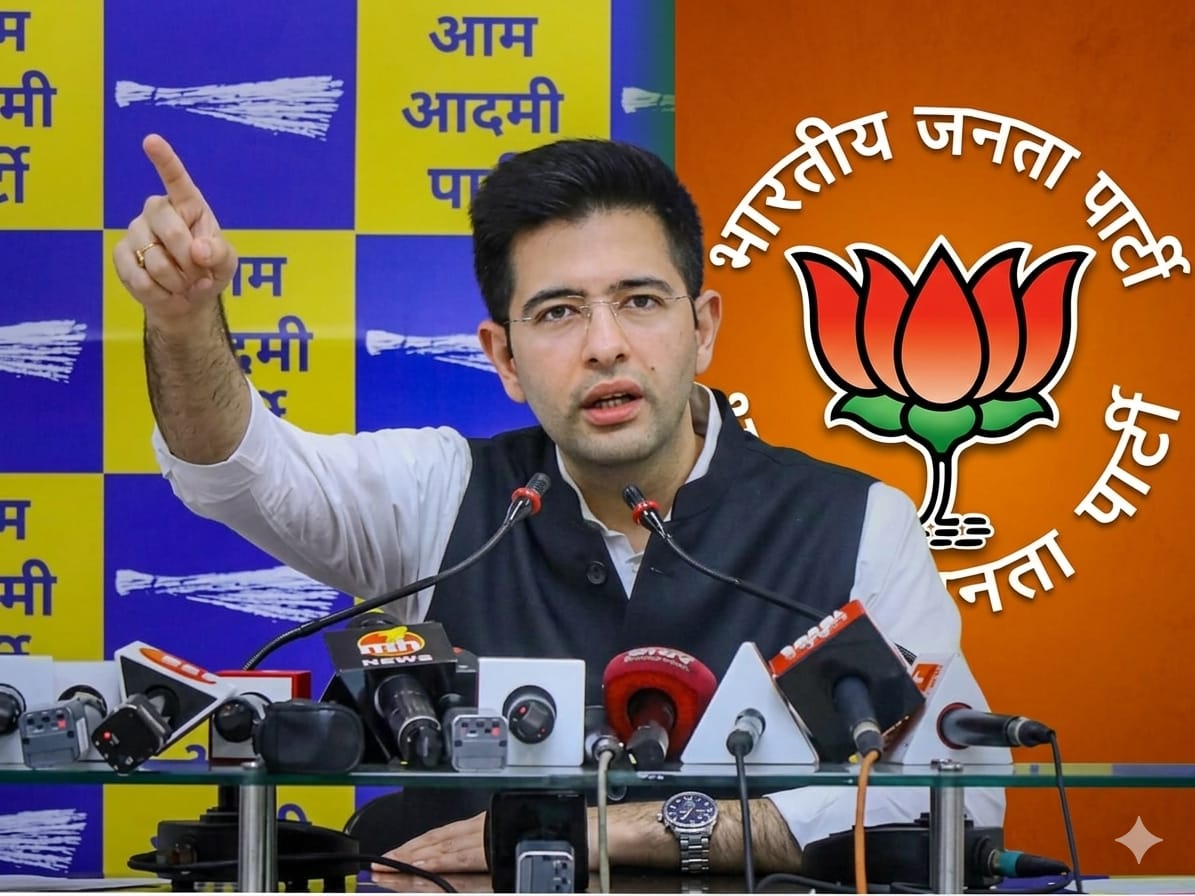
The recent defection of several Rajya Sabha MPs, including a prominent young face from the Aam Aadmi Party (AAP), to the Bharatiya Janata Party (BJP) on 24 April 2026 is neither surprising nor unprecedented. Political defections have long been part of India’s democratic theatre. Yet, what makes this moment noteworthy is not the act itself, but what it reveals about the deeper condition of opposition politics in India today.
Over time, the BJP has come to be seen, by its critics at least, as a kind of political “washing machine,” capable of absorbing even its fiercest detractors.
Raghav Chadha himself, who joined the BJP along with his colleagues, had earlier stated in the media that “there exists no amount of money that could buy Raghav Chadha.” In another widely circulated remark, he had described the BJP as a “party of hooligans.’
Statements made in the past resurface, not as reminders of conviction, but as markers of how fluid political loyalties have become.
The Aam Aadmi Party and Its Discontents
Political defections are hardly new to India’s democratic landscape. Leaders routinely move from one party to another, almost always justifying their decisions in the language of public service and collective good. Such explanations, however, rarely conceal the underlying reality: these shifts are often driven less by principle and more by political survival, relevance, and ambition. In the name of the people, leaders frequently end up serving little beyond their own political continuity.
This raises an uncomfortable but necessary question. If ideological commitment is genuine, how easily can it be abandoned? And if it can be set aside so readily, was it ever truly held? These questions become especially pertinent in the case of the Aam Aadmi Party and the Bharatiya Janata Party, both of which have, in recent years, positioned themselves as sharp adversaries, each claiming a monopoly over honesty and moral clarity.
Yet the story of the Aam Aadmi Party is more complicated than its self-image suggests. Emerging from the anti-corruption movement associated with Anna Hazare, AAP was seen as a disruptive force that challenged the dominance of the Congress, particularly in Delhi. But a more critical reading suggests that this disruption may also have had the effect, intended or otherwise, of clearing political space for the BJP’s rise. Once that shift materialised in 2014, the question naturally follows: why would the Sangh continue to need the Aam Aadmi Party?
Developments in Delhi over the past few years have only sharpened this ambiguity. It has long been suggested that the BJP possesses the institutional and political capacity to marginalise Arvind Kejriwal when necessary, and recent events seem to reinforce that perception. Electoral setbacks, combined with controversies such as the alleged liquor policy case, have contributed to a sense of gradual erosion rather than abrupt decline.
Within the party, too, questions of leadership and coherence have surfaced. Some observers argue that beyond figures like Sanjay Singh, AAP lacks a stable core of leaders who command consistent trust. Whether or not one fully agrees with this assessment, it points to a deeper concern: that the party’s political culture often mirrors the very tendencies it set out to oppose, of the Sangh and the BJP, marked by a blend of assertive religiosity and claims of moral uprightness.
Kejriwal himself embodies this tension. In seeking to project an image of uncompromising integrity, he often appears to draw upon the political grammar perfected by Narendra Modi, particularly the emphasis on personal resilience, public victimhood, and rhetorical performance. His repeated references to the abuses he receives, sometimes even counting them in public speeches, illustrate how this performative dimension has become central to his political persona.
What emerges, then, is not simply a story of one party’s rise or decline, but a broader reflection on the fragility of ideological politics itself, where claims of difference often dissolve into patterns of resemblance.
Prashant Bhushan’s Statement and the Sangh’s Agenda
Recently, a statement issued by Prashant Bhushan has brought renewed attention to the legacy of the anti-corruption movement that reshaped India’s political landscape in the early 2010s. Speaking with unusual candour, Bhushan expressed regret over his association with the movement led by Anna Hazare and figures like Arvind Kejriwal. His contention was stark: what was projected as a moral uprising against corruption ended up facilitating a transfer of power, dislodging the Congress and creating the conditions for the BJP’s ascent.
One may debate the fairness or completeness of this assessment, but it resonates because it touches a visible shift in political momentum. The anti-corruption movement had mobilised extraordinary public energy around the demand for a Lokpal, yet once the BJP came to power, that momentum seemed to dissipate. Hazare himself, who had become the moral face of the agitation, receded from the streets. For many observers, this withdrawal raised difficult questions about the continuity between the movement’s stated goals and its political consequences.
Seen in this light, the movement appears less as an isolated moment of civic awakening and more as a turning point that altered the balance of power. Its legacy is now being read not only in terms of what it opposed, but also in terms of what it enabled. At times, BJP leaders speak of changing the Constitution; at other times, efforts such as the push for a Uniform Civil Code and anti-Muslim rhetoric reinforce this trajectory.
Equally troubling is the broader climate in which these shifts are unfolding. Openly anti-Muslim statements and even calls for violence are made from public platforms. During festivals, provocative acts such as dancing and processions in front of mosques create tensions. Thus, public discourse has, at times, been marked by openly hostile rhetoric against minorities, with inflammatory speeches and cultural provocations deepening social tensions. Such developments do not exist in isolation; they feed into a larger ecosystem where political messaging, cultural assertion, and institutional power begin to reinforce one another.
All of this, it can be argued, finds its roots in the Anna movement itself, which paved the way for the BJP’s rise to power and enabled it to assert influence over constitutional structures.
The Sangh and the Question of Institutional Power
It is worth recalling a remark Rahul Gandhi made during the 2019 general election campaign in an interview with Ravish Kumar. He stated clearly that even if his party were to come to power, the scope for meaningful change would remain limited, as key institutions had already been staffed by individuals aligned with the Sangh and its ideological worldview.
At the time, the statement was dismissed by many as political rhetoric. Today, however, it resonates more strongly with a growing perception about the nature of institutional power in India. Across sectors, from administrative bodies to universities, the BJP and the Sangh seem to be present everywhere, and this ideological proximity plays a decisive role in shaping appointments and influence. Even the judiciary, traditionally viewed as a space of relative autonomy, has not remained untouched by such concerns, with occasional public statements by members of the bench drawing attention to this perceived overlap between law and ideology.
In universities, this shift is perhaps most visible. The selection of vice-chancellors and key administrators is often read not merely as an academic decision but as an ideological one, raising questions about the direction in which intellectual life itself is being steered.
For younger observers, particularly those often grouped under the label of “Gen Z,” the situation can appear both disorienting and disheartening. Yet neither uncritical enthusiasm nor complete despair offers a meaningful response. Political systems are rarely as static or monolithic as they appear. The recurring spectacle of leaders shifting positions, often at critical moments, reinforces the impression that ideological commitments are fragile and contingent.
In this sense, the challenge is not only institutional but also ethical. When political actors treat ideology as negotiable, institutions inevitably begin to reflect that instability. What follows is not merely a concentration of power, but a gradual erosion of the distinction between conviction and convenience, one that leaves both politics and public trust diminished.
Where Does the Real Battle of Ideology Lie?
When I say certain leaders are “ideologically crippled,” I am pointing to a deeper contradiction in contemporary politics. Many appear ideological in moments of comfort, who speak the language of conviction and principle. Yet when confronted with crisis or uncertainty, they adjust their positions with remarkable ease, aligning themselves with the dominant current of power. One may still choose to call such figures ideological, but what they exhibit is not conviction; it is convenience dressed up as belief.
Genuine ideological conviction reveals itself in adversity. It steadies individuals in moments of uncertainty and strengthens them when challenged. India’s political history offers many such examples. During the freedom struggle, some chose to compromise with power, while others stood firm in their principles, even at the cost of their lives.
In this context, institutions are often mistaken for the primary battleground. In reality, they are only instruments. The deeper issue lies in the weakening of ideological conviction itself. When that weakens, institutions become sites of adjustment and opportunism. When it is strong, they can become instruments of meaningful change.
Where Is the Opposition Today?
There are a few questions that must be asked of today’s opposition, straightforwardly and without hesitation. What is the ideological foundation of your party? What sustained efforts are being made to nurture and strengthen that ideology within your ranks? How are you preparing your younger members to think politically, not just act electorally? On the ground, there is little evidence of such engagement.
Rallies and press conferences can mobilise crowds and create the appearance of momentum, but they cannot substitute for ideological depth. A political party cannot be carried forward on spectacle alone. Without sustained investment in ideas, training, and internal dialogue, it risks becoming an electoral machine rather than a transformative force.
India’s political history offers a useful contrast. The 1970s marked a turning point, as the dominance of the Congress began to decline and regional parties emerged from intense struggles and mass mobilisations. The leaders shaped in that period carried the imprint of those movements, and their influence endured for decades. Today, however, there is a visible absence of such grounded political energy. India appears to be waiting for a new movement, one that is not only electorally viable but ideologically rooted and socially embedded. This becomes all the more important given that challenging the Sangh and the BJP is no simple task, particularly when many institutions are perceived to be aligned with their ideological framework.
What is needed, therefore, is not merely political revival but the regeneration of social consciousness. Politics must reconnect with society at the grassroots, where the sense of collective belonging and civic engagement appears to have weakened.
A glance at India’s political traditions reinforces this point. The movement led by Periyar E. V. Ramasamy in the South was sustained not merely by electoral ambition but by a deep engagement with social questions. Periyar himself grew uneasy when he saw sections of his movement drifting toward narrow political goals at the expense of ideological clarity. Similarly, B. R. Ambedkar’s transformative work was rooted in rigorous intellectual and political struggle. His critique of caste was inseparable from his critique of the broader ideological failures of mainstream politics.
The same trajectory can be observed in the socialist tradition, where the rise of political ambition often coincided with a decline in ideological depth and social commitment. Over time, movements that began as vehicles of social change became confined to the logic of elections. It is precisely this shift that has enabled the Sangh and its ideology to consolidate a space that opposition parties now find increasingly difficult to challenge.
The consequences are visible at the grassroots. The near absence of opposition parties in everyday struggles has strengthened those in power. On most issues, the response of the opposition is limited to press conferences and social media statements. There was a time when rising prices of essential goods would trigger widespread protests, bringing governments under pressure. Today, even as inflation rises and burdens on ordinary citizens deepen, political leadership often remains confined to controlled spaces, while supporters wait for cues in the form of posts and statements.
It would be naïve to ignore the risks involved in organising mass movements in the current climate. Mobilisation today carries consequences that cannot be dismissed lightly. Yet the path to political relevance has never been easy. It cannot be reduced to visibility alone, nor can it be achieved through carefully managed appearances. Without presence on the ground, without engagement with real struggles, the opposition risks fading not because it is defeated, but because it is absent.
Student Politics in the Role of the Opposition
It is increasingly difficult to ignore a striking reality: what voices like Umar Khalid have been insisting for years now demands repetition, the formal opposition has, to a large extent, retreated from the people, and in that vacuum, sections of the student community have begun to carry the burden of dissent. Across a handful of universities, students have stepped in where political parties have hesitated, raising questions that others have chosen to avoid.
Yet even these spaces are under sustained pressure. Campuses are no longer insulated arenas of debate; they are increasingly shaped by the same ideological contestations that define national politics. The expanding influence of the Sangh and the BJP within academic institutions has, in many cases, sought to narrow the space for dissent. And still, students at universities such as Jawaharlal Nehru University, University of Delhi, Jamia Millia Islamia, Maulana Azad National Urdu University, English and Foreign Languages University, and University of Hyderabad continue to resist, often at considerable personal cost. Their persistence is not incidental; it reflects a deeper need for democratic expression that has found fewer outlets elsewhere. Their struggle deserves recognition, solidarity, and encouragement.
To understand this moment, it is important to trace the gradual thinning of opposition space. Over time, institutional positions have increasingly come to be occupied by those aligned with the Sangh. Political shifts following the Anna movement altered the balance of power at the national level. Smaller opposition formations have either weakened, fragmented, or been absorbed. Alongside this, popular movements were forcefully suppressed, whether during the Citizenship Amendment Act protests, particularly targeting the Muslim community and its allies, or during the Indian farmers’ protest, involving the Sikh community and their supporters.
What follows is a broader contraction of dissent. Social media and television, once seen as platforms of expression, increasingly reflect managed narratives. Institutions that might have served as sites of resistance appear constrained. In this landscape, universities remain among the few spaces where disagreement can still take shape, but even here, restrictions on student union elections and administrative actions against student leaders signal a tightening grip.
If these spaces are allowed to weaken further, the implications will extend beyond campuses. Democratic life depends not only on formal institutions but on the presence of active, questioning publics. When those publics fall silent, the consequences are not immediate, but they are profound.
The responsibility, therefore, cannot rest on students alone. Political parties that claim to represent opposition must re-engage with society in a meaningful way—strengthening ideological clarity, rebuilding grassroots connections, and sustaining social movements that go beyond electoral cycles. At the same time, there is a need to critically examine institutions, to identify where democratic norms are being eroded, and to bring such processes into public view. So that no leader, out of fear of power or institutions, feels compelled to take the path of someone like Raghav Chadha.
Equally urgent is the restoration of student politics itself. The demand for student union elections across universities is not a procedural issue; it is central to the cultivation of democratic practice. Without such spaces, political participation becomes distant and abstract, rather than lived and contested.
It is here that the warning of Ram Manohar Lohia acquires renewed relevance: “When silence descends upon the streets, Parliament turns wayward.”
References:
- https://maktoobmedia.com/public/post?id=112364&slug=after-18-months-without-representation-manuu-students-intensify-protest-for-union-elections
- https://www.thehindu.com/news/cities/Delhi/jamia-millia-students-demand-reinstatement-of-union/article19804145.ece
- https://frontline.thehindu.com/social-issues/social-justice/jnu-protest-ugc-equity-guidelines-2026-education/article70687663.ece
- https://scroll.in/latest/973178/prashant-bhushan-says-india-against-corruption-movement-propped-up-by-bjp-rss
- https://www.thehindu.com/news/national/raghav-chadha-aap-mps-join-bjp/article70901275.ece
- https://www.facebook.com/watch/?v=674531186331012
- https://www.aljazeera.com/news/2020/4/22/indian-police-accused-of-targeting-muslims-over-anti-caa-protests
- https://amnesty.ca/human-rights-news/india-right-to-peaceful-protest-under-threat-due-to-mounting-restrictions-and-escalating-crackdown-on-farmers-march/