

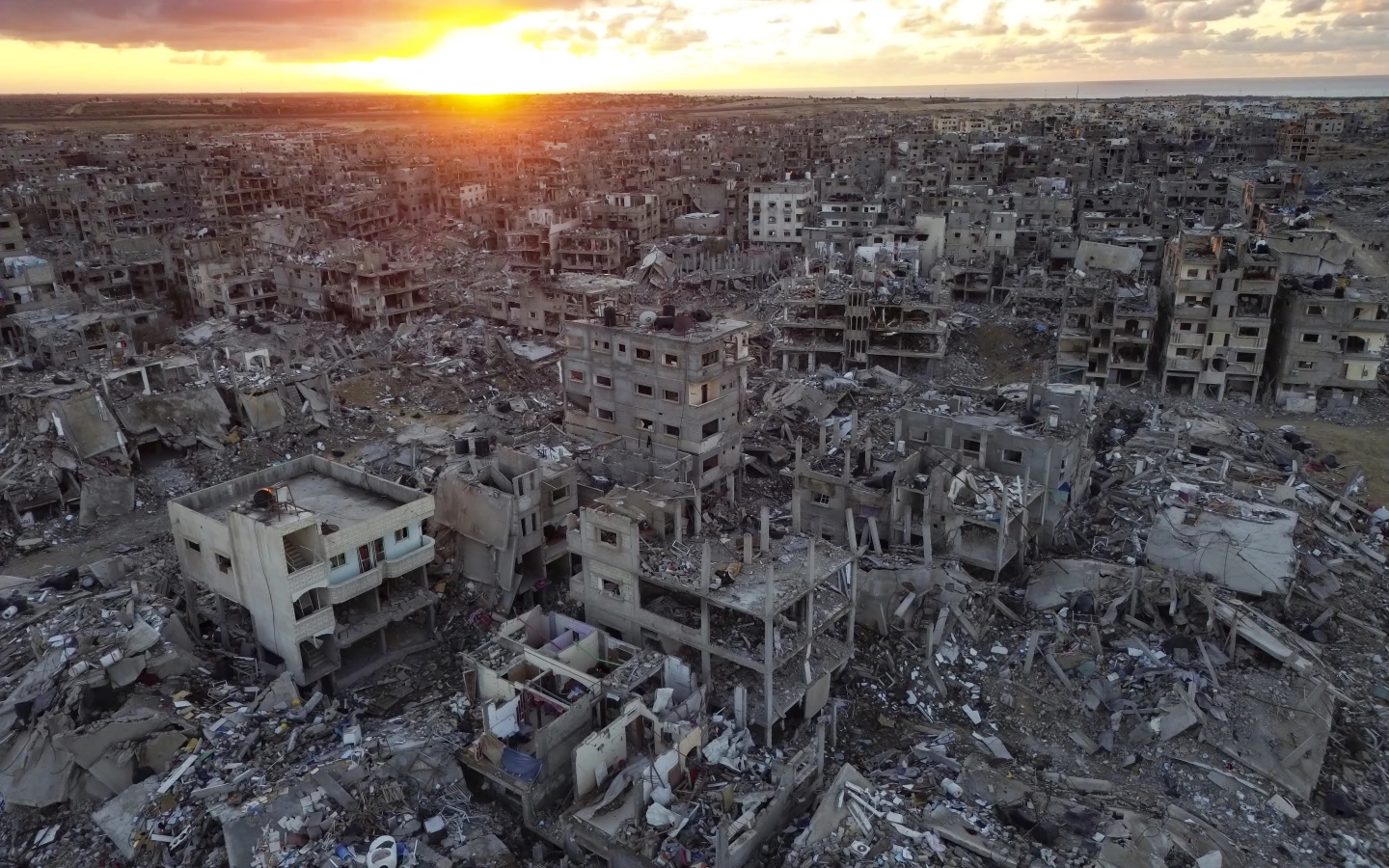
After 15 months of relentless conflict, Israel finally approved a deal early Saturday for a ceasefire in Gaza, ending the deadliest and most destructive fighting that began in October 2023. This war claimed the lives of over 46,000 Palestinians, the majority of whom were women and children, with more than 100,000 injured, according to official reports. The ceasefire is to take effect (not) coincidentally a day before Donald Trump’s inauguration as President of the United States. While the ceasefire marks a critical moment in the ongoing conflict, with the ‘guns poised to go silent’, it also presents an opportunity to reflect on the past 15 months. What about the wounds of “the bullets”? Will they be acknowledged, or will they vanish into the waves of the past, overshadowed by the fleeting calm of this agreement?
This moment compels us to ask ourselves not only why it took so long to secure this agreement but also to confront the questions it raises about the balance of power and the effectiveness of international institutions, especially the United Nations, in preventing such devastating consequences. Could the world have saved many lives if the United Nations had exerted more pressure on Israel when the ceasefire was first proposed in the last year? These are not merely academic inquiries; they go to the heart of global moral and legal responsibilities.
While not entirely ruling out the possibility of renewed tensions, the three-phase ceasefire agreement offers a chance to ask: Will justice follow beyond this agreement? Will the United Nations fulfill its foundational responsibility to ensure world peace and hold Israel accountable for its alleged genocidal acts in Gaza and its long-standing violations of international law?
Israel’s violations of international law are well-documented, particularly its settlement policies in the Occupied Palestinian Territories (OPT). Article 49 of the Fourth Geneva Convention states: “The Occupying Power shall not deport or transfer parts of its own civilian population into the territory it occupies.” Yet, since 1948, Israel has pursued policies that have done precisely this, displacing Palestinian civilians and establishing illegal settlements. These actions violate not only the Geneva Conventions but also the Hague Regulations of 1907 and are classified as war crimes under the Rome Statute of the International Criminal Court.
The International Court of Justice (ICJ) has repeatedly ruled against these settlements, declaring them illegal. Despite these judgments, Israel continues expanding its settlements, exploiting Palestinian land and natural resources with no regard for the protections afforded to occupied Palestinian populations under international law. As per international humanitarian law, an occupying power has a duty to ensure the security and welfare of the people under its occupation, a duty Israel has consistently failed to uphold. In July 2024, the ICJ reaffirmed that Israel’s occupation of Palestinian territory is illegal, demanding the dismantling of its settlements and reparations for the Palestinian people. Yet, the occupation persists unabated.
Thus, the critical question is not just how long this ceasefire will last or whether it will effectively prevent renewed conflict. Instead, it is what comes next. Will Israel be held accountable for its blatant violations of international and humanitarian law, or will it escape accountability once again? Either way, this moment represents a significant juncture in the evolution of international law.
If the world seeks to hold Israel accountable for its alleged genocidal acts in Gaza and its oppressive strategies against the Palestinian people, it must consider the potentially unprecedented nature of these methods. The deliberate destruction of civilian infrastructure—homes, schools, hospitals, and refugee camps—appears to go beyond the crimes currently defined under international law. While existing frameworks address genocide, war crimes, and crimes against humanity, they may not fully capture the broader objectives of these actions, which seem designed to dismantle the societal and cultural foundations of the Palestinian people.
The terms ‘domicide’ (the destruction of homes and communities) and ‘scholasticide’ (the systematic erasure of educational institutions) could serve to highlight the distinct and systemic nature of these acts in the Palestinian context. These phenomena are not incidental but deliberate strategies that potentially aim to erase not only the physical presence of Palestinians but also their ability to preserve their identity and future. However, the current definitions of international crimes may not adequately address these unique characteristics, revealing a gap in the legal framework.
This gap may necessitate an evolution in legal thought, recognizing these acts as distinct international crimes, much like the development of genocide as a response to the Holocaust. Without this recognition, the international legal framework risks falling short in addressing the scale and intent of such actions.
Conversely, if the world fails to hold Israel accountable, it will expose the helplessness of the current international legal framework in addressing unique and unprecedented threats to humanity, particularly when the oppressor is shielded by powerful allies. This failure raises a profound academic question: Is international law truly law, or is it merely, as legal philosopher John Austin argued, “Positive morality,” enforced only when it serves the interests of dominant powers? The act of Israel in Palestine starkly illustrates this dilemma, laying bare the chasm between the ideals of justice and the reality of power politics.
These questions remain in place, yet the recent ceasefire agreement has at least brought the possibility that it marks the end of the bloodshed, and displaced Palestinians may finally return ‘home.’ However, the question is: would they truly find their ‘home’? When children return, will their schools still exist? Would students find their universities as they were when they last saw them? We don’t know if ‘anything would remain as it once was’.
According to a mid-December assessment by UNOSAT, nearly 170,812 structures in Gaza were damaged or destroyed since the beginning of Israel’s offensive in October 2023. This accounts for 69 percent of all structures in the enclave, including approximately 245,123 housing units. Over 90 percent of school buildings and all universities have been destroyed, along with most hospitals and nearly 70 percent of health centres. Furthermore, about 70 percent of Gaza’s agricultural infrastructure has been obliterated, either by targeted shelling or under the weight of heavy military equipment. Yet one thing is certain: when these children return to their ‘home,’ they will surely find something standing amidst the ruins, stronger than ever—‘Belief.
’Belief—to keep standing against the oppressor, to keep fighting against atrocities, to live or die for freedom. We hope that world leaders at the United Nations would take this opportunity to hold the oppressor accountable for its injustices and make every effort to ensure that this ‘belief’ does not die so that justice will follow soon.