

I do not know which makes a man more conservative – to know nothing but the present, or nothing but the past– John Maynard Keynes
We all are amazed by ideas, let it be our own or those whom we favour the most. These ideas are the source of education. At last, education forms the basis of being human. It’s a process, a long process. At times this education comes forward in many forms making people motivated and also destroying them.
Let me relate it with what Chief Economic Adviser (CEA) to the Government of India, Dr Arvind Subramanian spoke during a public lecture on “Indian Economy- Key issues and challenges” at University Polytechnic Auditorium, Aligarh Muslim University (AMU). The lecture was a part of the “Economic Survey Outreach Program” of the Office of CEA, Ministry of Finance. This year AMU got an opportunity to host the program. The lecture was organised by Department of Economics, Aligarh Muslim University in collaboration with Club For Short Evening Courses, Cultural Education Centre (CEC), Aligarh Muslim University.
While delivering the lecture at one point Dr Subramanian involved students side by side with power point presentations. It was to display Data Analysis related to the lecture. Therefore, the presentations started with the ideas of well-known influential Economist John Maynard Keynes. It stated the definition of Economic Survey which says-
“It must possess a rare combination of gifts … It must draw upon mathematics, history, statesmanship, and philosophy—in some degree. It must understand symbols and speak in words… It must study the present in the light of the past for the purposes of the future… It must be purposeful and disinterested in a simultaneous mood, its authors as aloof and incorruptible as artists, yet sometimes as near to earth as politicians.”
Focusing on the range of Economic Surveys, Dr Subramanian Said, “ iss mein thoda drama, thoda tragedy, thoda comedy aur thoda dhishoom-dhishoom bhi hona chahiye” ( Economic Surveys should also carry within a fraction of drama, tragedy, comedy and a little bit of hot discussion). It was his own image reflecting out of Keynes’s definition. He also shared some of his personal experiences in the lecture.
“I was in Jammu & Kashmir, with the state finance minister Haseeb Ahmed Drabu in a meeting. Amid our discussions on miscellaneous topics, he asked me who presented the first Economic Survey in the Parliament. Having no answer, I felt a bit of shame and the answer was stunning- Pt. Jawaharlal Nehru. One day I too got a chance of asking the same question to the former Finance Minister of India Pranab Mukherjee, acting President of India and I was stunned as he himself was far away from the answer”- shared by Dr Arvind Subramanian.
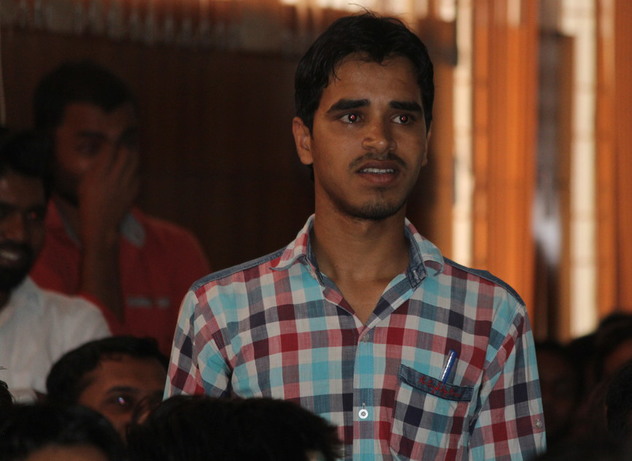
It was not a minute over and the same question was put up to the audience of AMU by Dr Arvind Subramanian. There were deans, professors, teachers and the students from several streams in the audience. A two minute of silence prevailed in the auditorium, people were looking to the faces, hoping someone to come forward as soon as possible. It was a lucky day for AMU, and an undergraduate student stood up with confidence uttering Shri Jawaharlal Nehru. It was after a long time, something shocked and impressed Dr Subramanian from the student’s crowd. He further added, “I need to be careful, the students here are pretty updated”.
On the occasion, the student of B.A (Hons) Economics, Arshad Shadab who came forward with the answer was applauded by the audience. Chief Economic Adviser even left a copy of Economic Survey for him as a gift post the event. Shadab, a shy boy from the Economics department was glad to earn this valuable gift.
When asked about the incidence he just said, “Maybe it was the changing moment of my life that motivated me to do something different”.
It was nothing but an idea, the same idea forms the basis of education, as soon as the moment came in knowledge displayed its value. This part of story enlightens us to the positive powers of knowledge. The knowledge we all are using for our selfish purposes.