

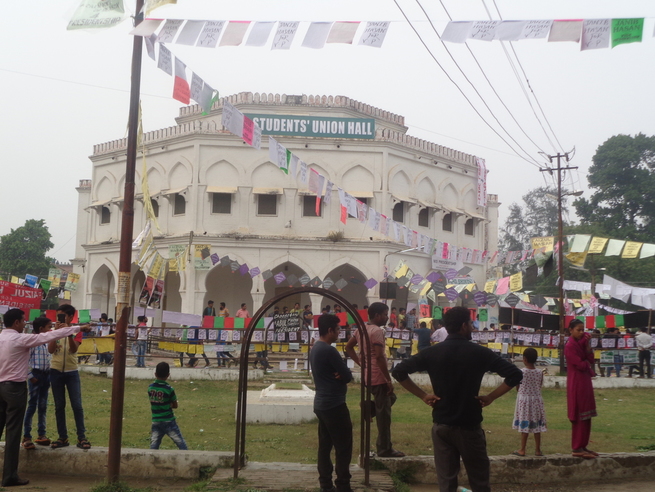
Student politics and campus democracy have always been matters of national interest. And it becomes more concerning when campuses are facing different crisis from academia to space for dissent. Nationwide there are different students political bodies in campuses and have specified political occupation in national politics. Beside this, there are also community wise representations of students beyond ideological discourse.
We are in season of campus elections and witnessing great young voices across the campuses. We have seen the students’ union elections of Jawaharlal Nehru University, Delhi University and Hyderabad Central University and finally the Aligarh Muslim University.
Lets talk specifically about Muslim University election. The result is declared. Faizul Hasan, a research scholar from the faculty of sociology has ensured its victory, whereas Nadeem Ansari and Nabeel Usmani got sweeps for chairs of Vice President and Secretary respectively. And for the women’s college union Naghma Shareff has won the chair of president and following her Farheen Sherwani and Yutba Israr Sheikh have respectively registered their victory for the post of Vice President and the Secretary.
Distinguished from other campuses, AMUSU inherits several unique features. Here candidates are not backed or affiliated to any political parties rather they get nominated independently. However, regionalism and lobbyism often defines the nature of campaign. Elections here are conducted on Lyngdoh recommendations. Hence each year tussle between candidates and administration is natural and obvious.
Recently on the day of final speech I have been to the campus and shared some chilled moments. The first thing I encountered was the ‘Dharna’, a peace protest in front of administrative block. Some young away from the heat of election were agitating for their rights to get enrolled in PhD. The second thing that crossed my eyes was the noisy bike rallies of the electoral candidates which were roaming around the campus.These two things are different but narrate one common story, and that is the insensitive attitude of the administration as well as the apathy of student representatives towards common students.
While asking some students randomly that ‘why they need union’, the most common reply was ‘Union aa jaegi to attendance ka masla khatm ho jaega’ (once we have union the issue of making 75 percent attendance to have hall ticket will be solved). Another response recorded was on dining and hostel issues. Some students also said that they must be represented and hence union is needed. Security and campus harmony were too among the issues that triggered the demand for the students’ Union.
An MBA student Hiba Kakul, said this year’s election is more important because University is going to have new Vice Chancellor in the same year.
Arsalan Mohammad a student from Mass communication, said it’s essential to air the voice that why we need union. He further said there are already posts like Senior Hall and Senior food at each hostel to address these local issues. So why we need students’ union? Recently a Kashmiri student was expelled and we saw the involvement of the local MP but no candidates talked about this issue. Further 22 students got suspended without any proper trial and none of the candidates took the stand. He said the condition of university is delicate and fragile and if union doesn’t address the required issue it will become an incumbent organization. 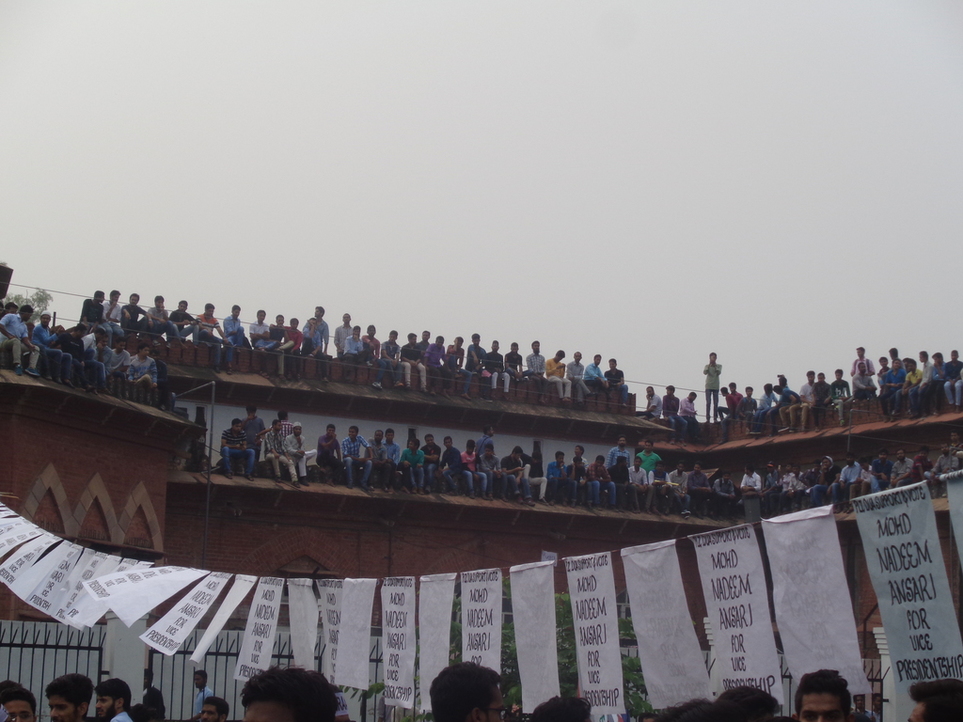
It was really unfortunate when candidates keep shying from issues of campus security and various academic facilities in entire campaign. There were questions on the Vice Chancellor in final speech but above issues raised by Arsalan were never addressed.
The platform AMUSU was created only to give space to Muslim leadership to provide leadership to the community. Minority community is striving for leadership role but unfortunately we have utterly failed to produce the leaders who could actually work for the benefit of the community, and who could raise the issues of the community and to represent the community at their best, said Mannan Wani a research scholar.
There are no party politics here in the campus. So obviously the nature of students’ union is different. The student movements here are indigenous and are potential movements though we do independently and receive no party funding nor any support from political parties, so the voice doesn’t get amplified. This is what Zulfiqar Sheth, research scholar, said to me.
One serious issue with AMUSU elections is lack of constancy in conducting union elections, for elections are held here in alternate years. This makes the union unstable and students are as a consequence, unable to work on their grievances and demands. This is because of administrative inefficiency and lack of support from it.
The party politics in the campus may have its own merits and demerits but it often isolates the AMUSU from the mainstream politics. When the India is heading towards independent community wise representation (though due to inefficient representation by existing institutions) AMUSU must come out from local issues and occupy the void space to represent the marginalized and address the anti-minorities institutionally sponsored elements. The common issue of minorities like triple talaq, women empowerment illegal arresting should also be addressed from this platform. Along with the minority character of AMU, military occupation in Northeast, Kashmir and Bastar also need urgent attention from the newly elected union. It should rise above petty lobbyism and combat bravely the growing rightist national politics.