

Islamophobia has become a buzz word in the Indian political scenario. Despite being virtually unheard despite its alarming rise in the last 6 years, today, its detractors and its die hard proponents, both, are talking about it. Islamophobia represents a variety of negative attitudes and acts of individuals, groups, or states, against Muslims, rooted in, although not necessarily restricted to, a prejudiced understanding of Islam. It’s hard to deny that Islamophobia thrives in India. Stereotypes and caricatures of Muslims were imported in India by British colonialists. There’s an astonishing continuity of Islamophobic stereotypes, from the times of the Christian Crusades, to the renaissance and enlightenment. Oriental scholars repackaged these old Christian stereotypes of Muslims and brought them to the Indian subcontinent. These Islamophobic characterizations were further repackaged and ‘nationalized’ by Hindutva nationalists. Muslim politicians, and activists have long argued its prevalence and severity, although not invoking the word explicitly. This begets the question, whether the Muslim leadership in India, political or otherwise, has a strategy to address the alarming rise of Islamophobia in India?
Professor Mohammed Nawab Osman, from Nanyang Technological University, gave a talk last month in which he shares his interviews of 5 different Indian Muslim leaders, who can be considered as 5 different schools of thought within Indian Muslim on their strategy to counter Islamophobia in India. The questions mainly pertained on what are the sources of Islamophobia in India and what should Indian Muslims do about it. Some of his slides are reproduced in this article.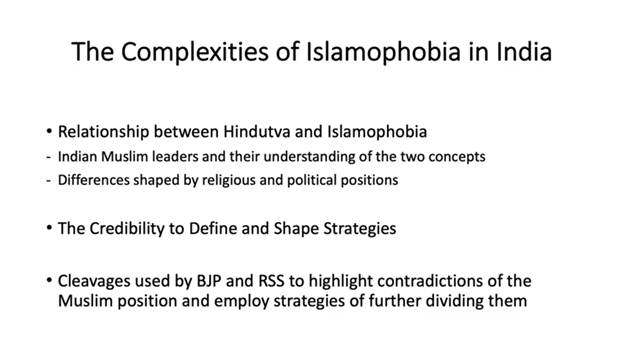
The first school of thought, can be represented by Dr. Majid Ahmed, of the Muslim Rashtriya Manch (an RSS affiliate for its Muslim outreach). Although, it could be argued that he doesn’t qualify as a Muslim leader with any ground level following, but its a surprise that such a school of thought even exists. This strand of Muslims is characterized by an uncritical total acceptance of Hindutva’s Islamophobia. According to Dr. Majid, as reported by Dr. Nawab, the solution lies in embracing Hindutva, and letting it be the elder brother which guides Muslims to what’s best for them. The success of this solution is argued through Hindutva’s acceptance of Muslims like Dr. Majid Ahmed, and the materialist success of Muslims like him is argued to substantiate Hindutva’s ability to deliver development. If the far right elements in India establish even further, this school of thought could prevail as an alternative for Muslims to escape persecution. Nonetheless, this strand of thought has failed to establish within Indian Muslims, who are justifiably apprehensive of the ulterior motives behind RSS’s Muslim outreach.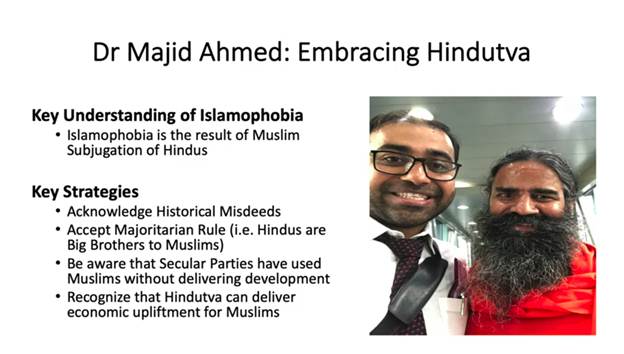
Of all the leaders Prof. Nawab interviewed, Owaisi’s understanding of Islamophobia is the most assertive. Rather than finding out Muslim groups within as a cause for Islamophobia, he points all his fingers outside. He is spot on when he points out at the so called secular parties, in keeping Indian Muslims hijacked by extorting votes out of them through either Hindutva fear mongering and/or mullah appeasement, for the lack of a better word. Owaisi’s solution to Indian Islamophobia is political which, according to him, will come through some sort of an alliance between Muslims and backward groups like Dalits, and his short-lived success in Maharashtra with VBA has indeed added to his credibility.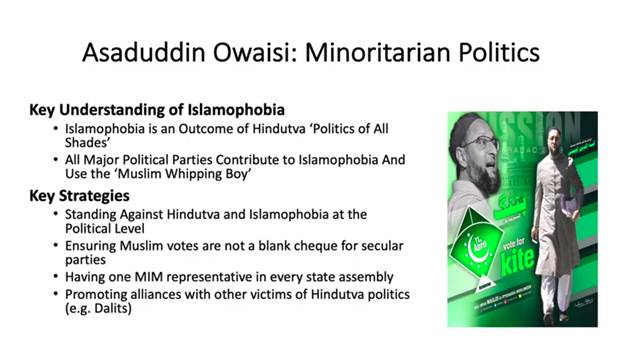
While it’s true that the potential alliances between Muslims and SCs, STs, OBCs, etc haven’t fully been exploited, the proposed solution deserves a much more critical look. Firstly, Muslims have traditionally been aligning with other marginalized groups in India. The popularity of SP, BSP, RJD etc. among Muslims is a testament that this alliance already exists, and has also delivered more respite to the Muslims of those regions than INC. So what exactly is different in Owaisi’s proposed solution? Mr. Owaisi’s critics are quick to point out that the biggest problem Muslims face is a split of votes, which will continue to be so as long as Indian polity doesn’t envisage something better than a first-past-the-post system. Thus, Mr. Owaisi’s political endeavours could end up exacerbating an existing problem rather than rectifying it. Secondly, It could be argued that it might be too late for Indian Muslims to be able to pull off such an alliance considering the speech at which Hindutva is trickling down among OBCs and Dalits. Research is showing that BJP’s first time voters in 2019 Lok Sabha elections were younger, lower-caste, and much less religious. Thirdly, a superficial observation of Mr. Owaisi’s solution demonstrates that it is a simple repackaging of the traditional caste-arithmetic formula of his nemesis INC. Will an alliance between Muslims and marginalized communities deliver while it perpetuates a status-quo of caste and nepotism? Finally, will a socio-cultural-nationalistic project like Hindutva and Islamophobia, be adequately countered by a political solution? Nonetheless, theoretically speaking, there’s still a lot of potential in such an alliance provided the political imaginations aren’t constrained by the status quo.
This leads us to our third strand of Indian Muslim political thought, the pro-congress secular nationalist Muslims like Dr. Salman Khurshid. This group believes that the causes of Islamophobia lie in Hindutva only. It denies the role played by secular nationalists and liberal Muslims in fostering Islamophobia by perpetuating the binary of “good Muslim” and “bad Muslim”. The solution lies in strengthening secularism through secular nationalist parties like Indian National Congress (INC).
INC today, is the sick man of India. It’s there, but not dead yet. As more and more lawmakers leave the sinking INC ship, it remains to be seen how long will the Muslim leadership wait before they start their exodus from INC. Additionally, INC’s vote-bank politics using the bogey of Hindutva, its blatant misappropriation of Maulana Azad for its ideological purposes, and its appropriation of soft-hindutva rather than countering it, has laid bare the elements of its insincerity in front of all Muslims. Nonetheless, Muslims who argue supporting INC for their upliftment, do still have a point. INC is still the only national alternative to BJP. On top of that, its Gandhi-Nehruvian secular nationalism remains an ideology to counter Hindutva not just at the political level, but also at a social and ideological level. Nonetheless, it can be argued that terms of Muslim engagement with the Congress, or any other secular party, have changed because of the experiences for the past 6 years.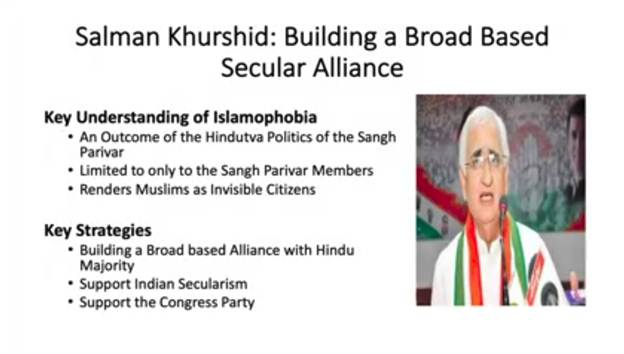
Another school of thought close to INC can be represented by the Madni family and its Jamiat Ulama e Hind. Like their secular nationalist associates, they too believe that Islamophobia in India is the exclusive project of Hindutva and its solution lies articulating their version of composite territorial nationalism. They may have lost their relevance today, especially among the educated Muslims, if they ever had one, but they’re still the inheritors of the Maulana Hussain Ahmad Madni’s basis of Indian Nationalism for Indian Muslims. Maulana Azad’s Qur’anic outlook on his Indian Muslim Nationalism got diluted because of his close proximity with INC. However, Maulana Madni’s composite Indian Nationalism for Indian Muslims has trickled down to the Indian Ulama, and consequently to Indian Muslims.
It’s important to note that the struggle against Hindutva isn’t just confined to politics but it has an ideological and a social dimension too. Although Islamophobia isn’t exclusive to Hindutva, it’s invocation by Hindutva plays a critical role in its project to denationalize Muslims. Islamophobia portrays Muslims as violent, dangerous, and alien. It would be impossible to preach Hindutva without portraying Muslims as a dangerous other. Therefore, the solution to Islamophobia in India can only lie in exposing Islamophobia while simultaneously articulating the different expressions of Muslim sense of belonging to India aka Indian Muslim Nationalism.
Therefore, it’s a travesty that this strand of thought within Muslims has drowned in the cacophony of Hindutva aggression, when the reality is that it needs to be revived. It remains the basis to counter Hindutva at an ideological level and thus, compliment the efforts to counter Islamophobia. These Muslim leaders inherit that thought, and also the machinery to mobilize Muslims at the grassroots level, although they’re marred by an inefficient organization and infighting. Nonetheless, these conversations need to happen, and their benefit will be of tremendous benefit for Muslims living as minorities in other parts of the world.
The final school of Indian Muslim political thought is the secular liberal Muslims which includes Irfan Ali Engineer of Centre for Study of Society and Secularism, the brother of famous Indian Islamic modernist Dr. Asghar Ali Engineer. Islamophobia in India, according to this group, has roots not just in of Hindutva’s ideology but also in Muslim conservatism which gives it credence. Therefore, the solution, according to them, lies in embracing modernity and secularism, while making alliances with secular groups and parties to counter Hindutva and Islamophobia.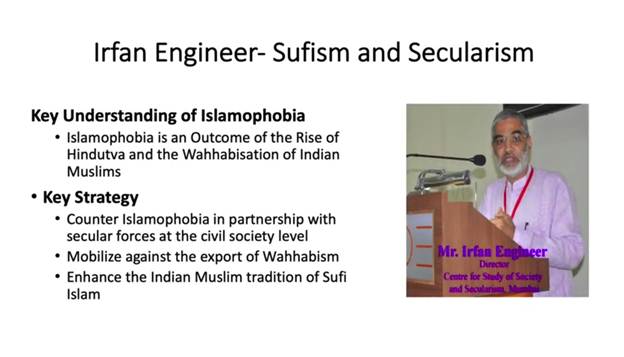
The unfortunate reality is that this group is oblivious to the fact that it itself perpetuates Islamophobia by propounding the binary of “good Muslim” and “bad Muslim”. The good Muslim is the sufi-kind, who isn’t fanatic about the 5 obligatory prayers, and derives his morality primarily from the principles of freedom of choice and prevention of harm only. Additionally, their (mis) appropriation of Sufism to perpetuate Islamophobia through the binary of moderate Muslim and extremist muslims, also needs to be called out.
Nonetheless, the liberal Muslims play a critical part in the community — they’re one of the most skillful and organized section of the Indian civil society. They’ve been critical in showing the way for Muslims to leverage democratic institutions for their rights. Additionally, the Indian Muslim orthodoxy continues as an abettor to the social issues that plague Indian Muslims, especially women’s issues. They also form the most democratic and most efficient organizations, something which is completely absent among Indian Muslims. Most importantly, their criticism of a lack of Muslim outreach towards non-Muslims and looking towards the Arab-world for fatwas on Indian issues, does have some merit to it. They’re also probably the only section which provoke a critical re-engagement with the tradition from the orthodox Ulama.
Overall, in the whole debate of countering Islamophobia in India, there hasn’t yet emerged any consensus within the Indian Muslim community. This consensus can only emerge from a deeper collaboration within all the different groups of Indian Muslim, and a realization that the problems that plague Indian Muslims are too diverse for any single person, organization, or ideology to comprehensively address them. It is only through the collective efforts of various Muslims that the trajectories of Hindutva and Islamophobia, their overlap and divergence, can be delineated, and some effective solutions could be implemented.