

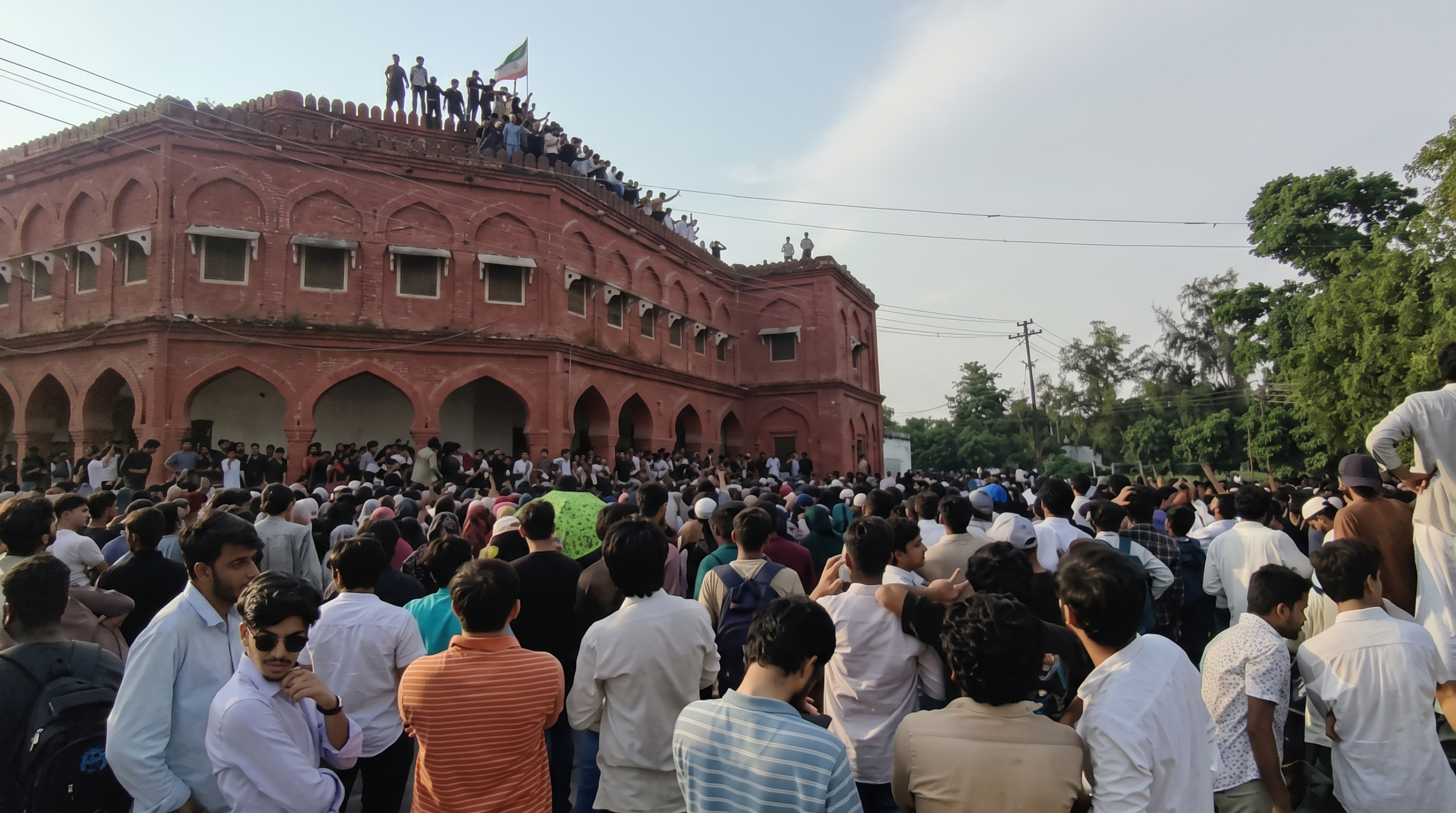
(This was originally written three days before the restoration of AMUSU and the sacking of the Chief Proctor. What followed during the celebrations made the case for this essay much stronger. Please find a note on the latter at the end.)
The political history of AMU reaches far beyond any student organization still standing today. AMU played a pivotal role in the independence of India; the Ali Brothers of the Khilafat Movement were students here, and it was the values and teachings instilled by Aligarh itself that led the Ali Brothers to eventually lead a group of rebel students and teachers to establish another great university, i.e., Jamia Millia Islamia, which in turn similarly played a crucial role in the freedom struggle. Furthermore, nearly every major political event concerning Muslims in the last 150 years has been impacted in some way by the university or its alumni.
There is no doubt that the current regime at the Center and especially the one in Lucknow do not want the students to strengthen their voice; it serves the regime’s interests as long as the students are kept away from politics. “Authoritarians and would-be authoritarians are only too aware that universities are primary sites of critique and dissent. Attacks on universities are the canary in the coalmine of fascism,” Jason Stanley, Professor of Philosophy at Yale University, wrote in The Guardian in his article “Why fascists hate universities.”
It is disheartening to see that the politics on campus has been reduced to a fight of muscle, money, and regional lobbies. It is time we try to reclaim our position in national politics and return to genuine activism within the university—a space where the student body becomes the collective voice of all students, where it becomes a pressure group for the administration, and where students start engaging in productive activities. It is surprising to see that very few or almost no people talk about the employability of a majority of the varsity’s graduates. While one can argue that getting employed is not the ultimate goal of university education, the need for employment simply cannot be ignored. I hope the next generation of student leaders on campus take this up seriously; this is only one among many things, such as the availability of hostels, illegal possession of hostel rooms, living conditions inside them, the quality of food in dining halls, etc., that can be taken up as common causes for general students.
An active student union is the need of the hour; in fact, it has been for years. However, it is crucial that election agendas and the overall politics on campus focus on real issues, rather than which caste or region a candidate belongs to. I believe it is high time the students and faculty of the varsity start looking beyond regional-lobby politics.
There has also been a growing rhetoric that ‘others’ politically active students. A narrative has emerged suggesting that political activities belong only to a specific subset of students and that those who are here “only to study” should stay away from protests and campus agitations. This is what gives space to the ‘collaborator’ kind of ‘student leaders’ who are now being seen more than ever. It is high time the general student body experiences a renaissance of sorts and understands its responsibility toward the broader student cause. Although classes are still running and the gates are still open, there is a glimpse of hope in how the current movement for the student union has been managed so far, or even in the fee hike protest last year, which achieved most of its demands and almost got the union if not for the backstabbing from the administration.
Although protests have now become normalized across the country in recent months, it was historically the AMUSU, alongside a few other student organizations, that issued the first call for protests, led agitations, and demanded accountability. There are protests going on right now in almost all the major cities of India—so much so that it has become a trend to stand in front of a bus and get a photo clicked, pretending to not let it take away the detainees. This is one among many examples of how everybody suddenly understands dissent and resistance. Historically, it was AMU, JMI, JNU, and only a handful of others who asked tough questions and held people in power accountable.
I remember being picked up from the railway track back in 2016 when, upon the Rail Roko Andolan call of the then-AMUSU President Faizul Hasan, we students marched from the AMU campus to Aligarh Junction to demand a fair inquiry into the abduction of JNU student Najeeb Ahmed. Subsequently, a Jail Bharo Andolan was announced, and we all went to jail, staying there for the entire day.
AMU initiated the agitations and protests against the CAA-NRC bills proposed by the regime. These protests caught fire, spreading first to Jamia Millia Islamia, then to Shaheen Bagh, and eventually across the entire country. It was AMU students, amongst others, who traveled nationwide, delivering speeches and raising awareness about these exclusivist bills and policies.
If the general students at AMU do not realize the golden legacy they hold, it will all go downhill from here. Stop “othering” political activism. Study hard, enjoy your time there, but speak up when it is necessary. Speak out against injustice, ask questions, and hold those in power accountable for their actions. Have discussions, organize study circles, and learn the golden history of your elders and forefathers.
The Need for a Repository
Through this, I also wish to urge whoever can take this up: there is presently no online repository listing all the past office bearers of the AMUSU. This data must be available somewhere; find it and make it accessible online.
Finally, I extend my solidarity to Yasir Fahad, who has been on a hunger strike for 16 days now. We are certain that the hegemony will break, and AMU will regain its lost glory and reclaim its voice in national politics.
P.S. Congratulations to the Alig fraternity! The hard work and persistence of the last 8 years—and specifically the last 20 days—has finally paid off. What a spectacle it was! Students stood shoulder to shoulder for a common cause without distinction of region, hall, or gender. This victory will give these young people hope and reignite their faith in organizing, agitating, and demanding what is rightfully theirs. At the same time, it was disheartening to see some individuals celebrating with regionalist slogans. As discussed throughout this piece, it is time to move past regional-lobby politics and stand united as one community, one Ummah.