

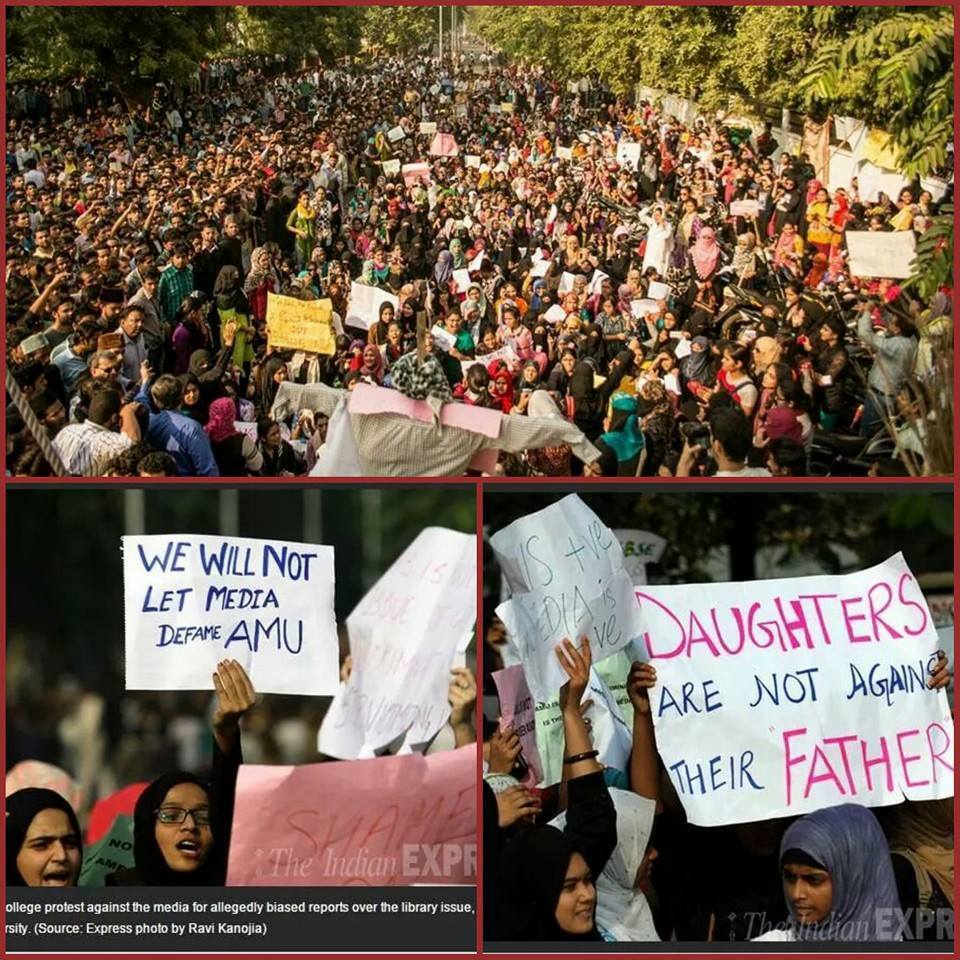
The recent statement by Aligarh Muslim Unversity Vice-Chancellor Retd. Lt. General Zameer-ud-din Shah on the use of main campus library by the students of adjacent Women’s College has set off a storm of debate, leading to projections of AMU as a “gender-biased” university. The statement, made during the official inauguration of the newly elected college union, was a response to a request made by some students that they be allowed to use the main campus library. The VC replied that the library was already over-crowded with boys, and it could not absorb any more students. It was said playfully enough, but in a few hours, his words had spread like fire, whose flames still haven’t settled down. Much of the responsibility for this catching debate lies with a single English newspaper- The Times of India.
To get the context of his speech, it is important to have some understanding of the University itself. The Aligarh Muslim Uninversity is one of the oldest universities of India, established as a madrasa called as Madrasathul Uloom in 1875. In 1877, the madrasa became the Mohammadan Anglo-Oriental College. The Central Library (Lytton Library) was also set up along with the college, and was renamed Maulana Azad library in 1960 when the then Prime Minister Pt. Jawaharlal Nehru inaugurated its present building. It is the largest academic library in India, and the second largest in Asia. It holds some 1.4 million books and has an annual budget of around Rs 23.37 million. It caters to the needs of under- graduate and post-graduates students, students of professional courses and research scholars. These includes girls as well, except the students of the Women’s College, which has a seperate library, managed by the Central Library. More than 5,000 students and teachers and other members of the university visit the library and avail its services everyday. More than 3,000 girls have library membership, and everyone has access to its facilities without any discrimination.
The intention of the media, which seeks to defame the name of a Muslim university which holds its own cultural ethos and decorum and destroy its culture by maligning it to a much dirtier environment, is clear.
In addition, every department has a Seminar Library which is sufficiently stocked to meet the needs of the respective departments without gender discrimination. Many Seminar Libraries are managed by female students. The University also has book banks which provide low-cost books for the entire semester, without discrimination on any ground. There are a variety of soceities connected with different departments which attempt to inculcate knowledge among students, and these societies have representation from both male and female communities.
The Women’s College, situated 3 km away from the main campus, basically provides education to intermediate and UG girls, since its establishment in 1937. It is dedicated to the cause of female education. At present, 2523 girl students, including overseas students from countries like Malaysia, Thailand, Iran and Afghanistan are studying in the College. The college library is equipped with the Wymax internet facility to help the users, while it is also connected to the AMU Libnet. An inter-library loan desk facility loans books from the college library to the Women’s College library. The “SARA” Talking Typing Teacher facility helps visually impaired students. All these facilities are for the exclusive use of girls, and boys do not have access to it. However, some students still felt need for more access, and asked permission to directly use the the Central Library.
Basically, it is an administrative, rather than any gender-bias, issue. But the media coverage projected a very distorted picture before the nation, making it appear as though girls were not permitted inside the library. The intention of the media, which seeks to defame the name of a Muslim university which holds its own cultural ethos and decorum and destroy its culture by maligning it to a much dirtier environment, is clear. Articles, lectures, discussions and programs on the issue have come out in plenty since the issue raised its head, and everyone has been passing judgement against AMU with little knowledge about the reality on ground. Those who passed their judgements include HRD minister Smriti Irani, Mukhtar Abbas Naqvi and Women’s Commission Chairman Najma Heptullah.
The media, which has taken this up as major instance of violation of women’s rights, has in fact failed to raise any significant debate on much more critical issues that have come up in the recent times, like the death if 12 women due to forced sterilization in government camps. More than 80 women’s lives were endangered in these camps, where they were treated like animals, but the media remained largely silent. Raising the issue would have created awareness on a critical issue, and thrown light on acute marginalization faced by many women. Similarly , a student was raped inside the English Foreign Language University(EFLU) in Hyderabad, an incident that received little media coverage, since it would not help their TRP ratings the way playing with Muslims and their institutions would do. The double standards maintained by the media is nothing new, at least in the Indian case.
The media has always largely remained discriminatory when it comes to reporting Muslim issues. It would benefit the development of the nation if the media remained accountable, and refrained from presenting any issue without proper objective analysis.
The media hype over the library issue grew so intense that Al Jazeera decided to give it coverage under the caption “gender bias or biased reporting.” Around 5,000 students from Women’s College and the University carried out a combined Peace March to show that the University was not gender-biased, but rather the media which is biased towards the University. During the march, the Students’ Union president condemned the national media for playing up a non-serious issue, while also remarking to the VC that he should be careful when he makes remarks on AMU. The students ticked off the HRD minister as well, declaring that if she was so concerned about the empowerment of AMU girl students, she should issue separate funding for the Women’s College library.
The AMU campus sees equal participation from girls and boys in every sphere. Women’s College has its separate students’ union from the main campus, but in the latter campus, girls actively participate in the elections. The current AMUSU has a woman cabinet member.
AMU students have been circulating short films on the social media to highlight the reality on ground. The Alig. Fraternity (people who are part of AMU in any form) came out in full force against this biased reporting, feeling the need to protect the legacy of their alma matter. During the installation ceremony of AMUSU inside the Kennedy auditorium, an oral memorandum was passed banning The Times of India(ToI) from the campus. ToI adminstrators were shocked, and a meeting was scheduled within two days between the VC and senior members of the publication in New Delhi in an attempt to sort things out.
The media has always largely remained discriminatory when it comes to reporting Muslim issues. It would benefit the development of the nation if the media remained accountable, and refrained from presenting any issue without proper objective analysis. As a prime provider of information in this age, they have the responsibility to not fabricate things, which only serves to malign the image of the nation.