

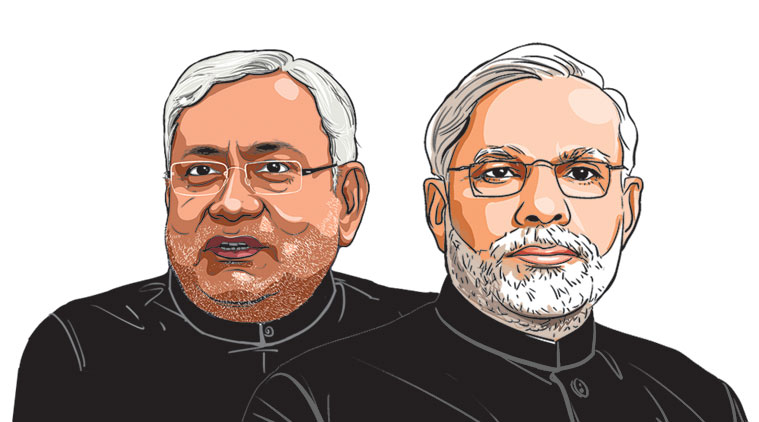
The grand victory of Grand Alliance, consisting of JD(U), RJD and Congress against the National Democratic Alliance, consisting of Bharatiya Janata Party (BJP), the Ramvilas Paswan-led Lok Janshakti Party (LJP), the Upendra Kushwaha-led Rashtriya Lok Samata Party and the Jitanram Manjhi-led Hindustani Awam Morcha, has written a unique chapter in the political history of India. The victory is indeed a victory of democracy and its values as against kakistocracy, totalitarianism and its contemptuous repercussions.
Bihar election result, with certitude, carries a bold message that the communal-fascist agenda of RSS-led BJP to polarise the people in the name of its self-stylised political cow has met an ignominious debacle and is doomed. The people of Bihar are not easily docile to be swayed away by Amit Shah’s hate-galvanising speeches. Nor do they lack acute understanding of development and its prudent macro implications. Modi’s one year plus regime has unravelled all the enigma behind his Sabka vikas sabke sath trumpets. Biharis have also underscored the elitist intentions of eating up ‘reservation’ when Mohan Bhagwat spoke of reconsidering it. To all these political baboos, Biharis have shown their might against Baharis (outsiders).
The striking defeat of BJP in the election has caused discomfort among the senior party leaders like L.K Advani, Raj Nath Singh and Ram Madhav about the manner in which the campaign was done. They have started questioning the Modi-Amit duo. To add to dismay after their crumbling loss in Delhi election against Arvind Kejriwal, the mahaghatbandhan has crippled the Modi factor and given a bold blow to his conceited hubris once again.
The pseudo ultra-nationalists have also hurled criticism on the grand Alliance for playing the caste politics and strengthening the same. But those people should not be blind-folded to the Modi’s arithmetic game by knotting ties with LJP and Manjhi. Moreover Modi himself breaking long silence on all such communal incidents, made divisive statements during his rallies in Bihar. More such statements were made by Amit Shah too. This all indicate that first, BJP is all immoral, communal, elite-focussed and anti-constitutional party, and secondly the fringe elements within the party like Sadhvi Prachi and Yogi Adityanath and central leaders are more or less on the same footing.
The previous two consecutive electoral regimes of Nitish Kumar have improved Bihar’s socio-economic state and empowerment of backward castes and Dalits. This can be largely gauged from the excessive rise in growth rate of Bihar, sharp increase in literacy rate and political participation of marginalised sections especially women in Panchayat raj. Between 2001 and 2011, the literacy rate increased by 16.8 percentage points and female literacy by 20 percentage points. There has been a dramatic decline in the infant mortality rate, which now equals the national average. According to Central Statistical Organisation (CSO), Bihar has been the fastest growing state in terms of gross state domestic product (GSDP) and per capita income over the period 2012-13. These factors have contributed to building up of a healthier political atmosphere for Nitish Kumar. The recent election has also highlighted people’s perceptions about ‘models’ of development. By voting Nitish to power for third time, the people of Bihar have not only rejected the BJP politics of hatred and divisiveness, they have also openly shown their allegiance to Nitish’s model of development as opposed to Gujrat model of development spearheaded by Modi. The former is a democratic model of development with social justice, while the latter is a neoliberal one favouring the elite and the corporate with rolling back of public expenditure in social sectors.
It is hoped that in the next five years Bihar will flourish more with continuous leaps in all sectors. Nitish and laloo have to play a much daunting role for its growth. Bihar still has a long way to go. They both have to prove their political commitment to a striding state and see for an optimal use of public funds with due emphasis on equity considerations.