

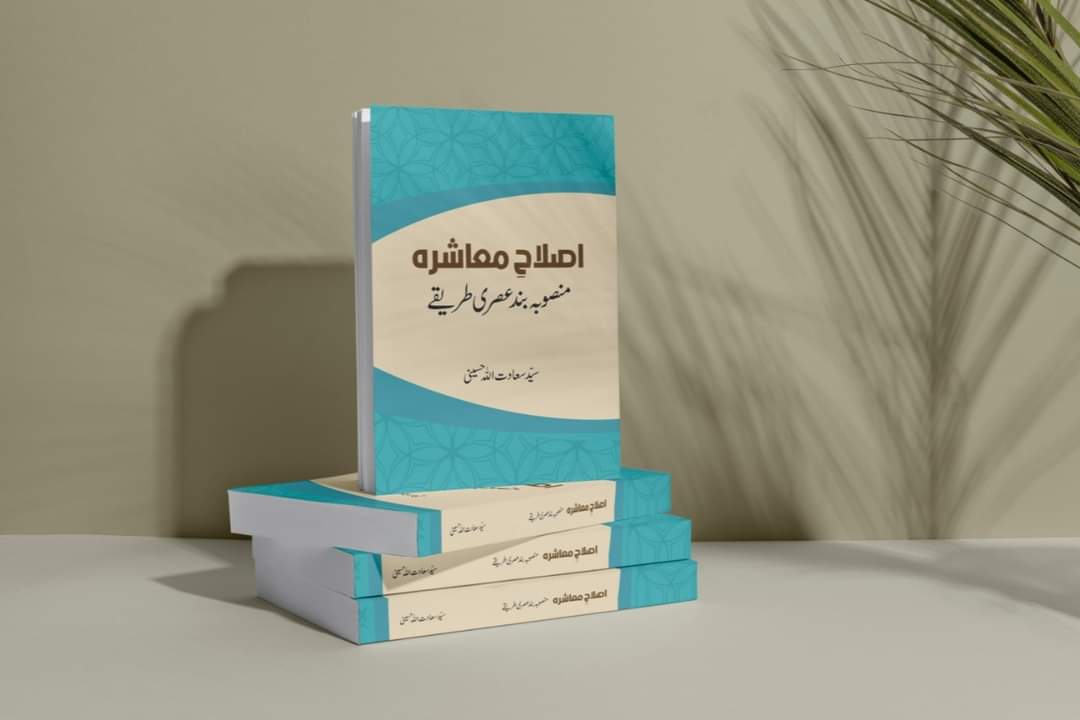
The book ‘Islahe Muashra: Mansubaband Asri Tariqe’ is authored by Syed Sadatuallah Hussaini, a renowned Islamic scholar and thinker. The book aims to provide a contemporary understanding of the various social reforms that have given rise to modernity and other such ideologies. The book primarily addresses Islamic Movements and the Muslim community at large, delivering practical methods through which societies can be reformed with respect to Islamic values and morals.
The foreword of the book basically introduces the book and talks of its new approach to social reform, which is mainly, termed as ‘social engineering. Social engineering is the branch of sociology that principally discusses the techniques for a well-planned societal change.
The first section of the book is mainly based on the purpose of the book and is titled “social approach to the societal reform” in which the author acknowledges that different organizations, unions, NGOs, religious Islamic scholars and other well-known personalities that are working for the reform of societies, specifically Muslim societies on an international and national level through their speeches in mass gatherings, small video clips and other activities.
However, the author goes on to make a point that reforms should occur on a more local level. Planning and strategies should be intended to reform society at its grass root level. Every locality, every town and every city should have its own strategies of transformation and these strategies must be applied to its locality based on the trends, observation, social psychology and the evil persisting in that particular locality with consistency and patience. On a central level, a “think tank” needs to be established to guide and support them in the implementation of the program.
In the second section, the author emphasizes the importance of recognizing the roots of different evils. Every evil has its reasons and every evil can be eradicated by applying its particular method of eradication. According to the author, there are mainly five sources of evil. These include wrong belief systems, social norms, Habits, profit of certain sections of society and practical hurdles.
These five criteria provide stability and persistence to the evils in society. The author explains how these criteria play their specific roles in stabilizing the evils. He goes on to explain methods and ways through which these strategies can be used to curb evils in society. Later on, with the connotation to the Prophets’ life, he highlights how prophet Muhammad (PBUH) challenged the evil societal trends of his time by applying the appropriate methodology.
The third section deals with the concept of morality and moral sensitivity. Here, the author brings to light the various moral trends, witnessed in different societies. First of all, he beautifully explains the Islamic concept of morality and the way in which societal trends have affected certain aspects of the moral sensitivity of the people belonging to the Muslim community.
There are many moral issues regarding which the Muslim societies appear to be highly sensitive and abiding but it is to be acknowledged that there are certain other moral issues to which Muslim societies show utter ignorance. Astonishingly in the case of some moral issues, western societies tend to be completely opposite of what Muslim societies are. The author also discusses the factors behind these moral trends.
The fourth section talks about various social norms. The social norm is one of the most commonly used terms in different fields of social sciences. We can say that social norm is the hive of society. It is basically an expectation of the society from its individuals of how they behave in certain conditions. It does not have any legal reputation but in its effect, it is much more powerful than the legal laws of the society. In this section, the author primarily discusses social norms and how these social norms can be altered. For this, the author provides the readers with six practical methods for the evolution and transformation of social norms.
The fifth section of the book voices on “reformation of society and social engineering”. Social engineering is a well-planned strategy that can be used to alter the norms, behaviour, and habits of society. In the recent past, the system of social engineering has availed wide acceptance by the dictators and democrats to alter the society for acquiring their objectives.
Piecemeal engineering is a method proposed by Karl Popper. The idea of Popper was against the idea of an ideal society shaped through the rapid process, where a wide-ranging societal change can be acquired abruptly and this he called “Utopian social engineering”. Unlike utopian social engineering, Piecemeal engineering primarily shapes the opinion of the people rationally and sensibly. It is a stepwise process of social change. According to the author, Popper’s idea in a major way matches the Islamic ideals of social change and this can be widely found in the teachings and reformation process of Prophet Mohammed (PBUH) if one glances at history.
The sixth section largely deals with the “evil supporting power and social engineering”. This section provides us with the idea of how the evil supporting lobbyists plan and work in a strategical way to dominate and push forth their agendas by neutralizing the Islamic ideals.
The focus of lobbyists is to push issues like moderate Islam, gender equality, sexual freedom etc. To acquire their objective, they are working in a well-planned multi-dimensional way with every sector of the society from media, government, multinational companies, different organizations, NGOs working in one or the other way to promote their ideas and contribute in shaping the opinions of the people. A lot of this is stirring in a well-organized, systematic and obscure way. By reading this chapter, readers can gain very interesting information about how the lobbyists are making strategies in pursuit of their evil goals.
In the last section, the author provides the readers with four practical examples and explains in detail how we can work to reform the society through various means and methodologies.